

Most advice about Christian apparel brands starts with a list of winners. That's the wrong starting point. A brand can have a polished logo, a verse-heavy catalog, and a charitable mission statement, yet still sell flimsy shirts with unclear sourcing and inconsistent theology. Meanwhile, a quieter label may communicate faith through its design language, business practices, and long-term usefulness rather than a giant Bible reference.
The category deserves a sharper buying standard. Christian apparel has become a measurable retail segment, not merely church merchandise. Tracked Christian apparel and accessories retailers generated an estimated $77 million in aggregate online sales in 2025, according to industry category intelligence from Grips. Broader religious apparel reached an estimated $3.7 billion in 2024, with a projection of $6.1 billion by 2033, according to Research Intelo's religious apparel market overview.
That scale makes discernment more important, not less. Use a theology, quality, and transparency lens, and you can evaluate any Christian clothing brand even when trends, founders, and product drops change.
Table of Contents
- More Than Just Verse Tees
- The Faith-Informed Spectrum
- Four Things to Weigh Before You Buy
- Reading Quality Signals Without the Marketing
- How to Judge a Brand Beyond the Product
- Matching the Framework to Real Shoppers
- A Practical Buyer's Checklist
- Merch, Ministry, or Something in Between
More Than Just Verse Tees
The lazy definition of Christian apparel is a Bible verse printed across a basic T-shirt. That product still exists, and sometimes it's exactly right for a youth group, church event, or gift. But treating the entire category as slogan merchandise misses what many Christian apparel brands are doing.
Faith-informed clothing now spans minimalist basics, streetwear silhouettes, heritage-inspired garments, workwear influences, and subtle symbolic design. The Christian connection may appear in a stated mission, a founder's convictions, a charitable structure, or the visual language of the collection. The garment itself doesn't need to announce a verse to belong in the conversation.
That distinction matters because visible faith and meaningful faith aren't identical.
An overt message can open a conversation quickly. It can also feel forced, overly familiar, or disconnected from the wearer's actual personality. A restrained piece may avoid the eye-roll, but it asks the wearer to explain the meaning when someone notices it. Neither approach is automatically more faithful or more legitimate.
Practical rule: Judge visibility as a design choice, not as proof of spiritual seriousness.
A brand's purpose should be evaluated separately from the volume of its graphics. Read the mission page. Check whether the theology is clear and consistent. Look at the fabric details, size chart, care instructions, return terms, and impact disclosures. Those details tell you whether the company treats customers as people to serve or as an audience for messaging.
For a useful overview of how faith-based T-shirts fit into modern wardrobes, compare the discussion in 99 Collection's guide to faith-based T-shirts. The useful reframe is simple: Christian apparel is a spectrum of faith expression, not a single graphic style.
Once you stop equating a large cross with legitimacy, you can ask better questions. Does the garment work in real life? Does the brand explain what it believes? Does the quality justify the price? Can the company support its ethical or charitable language with specific information?
The Faith-Informed Spectrum
Think of Christian clothing in three messaging tiers, moving from loud to quiet. The right tier depends on the wearer, the setting, and whether the garment needs to communicate directly or carry a private point of reference.
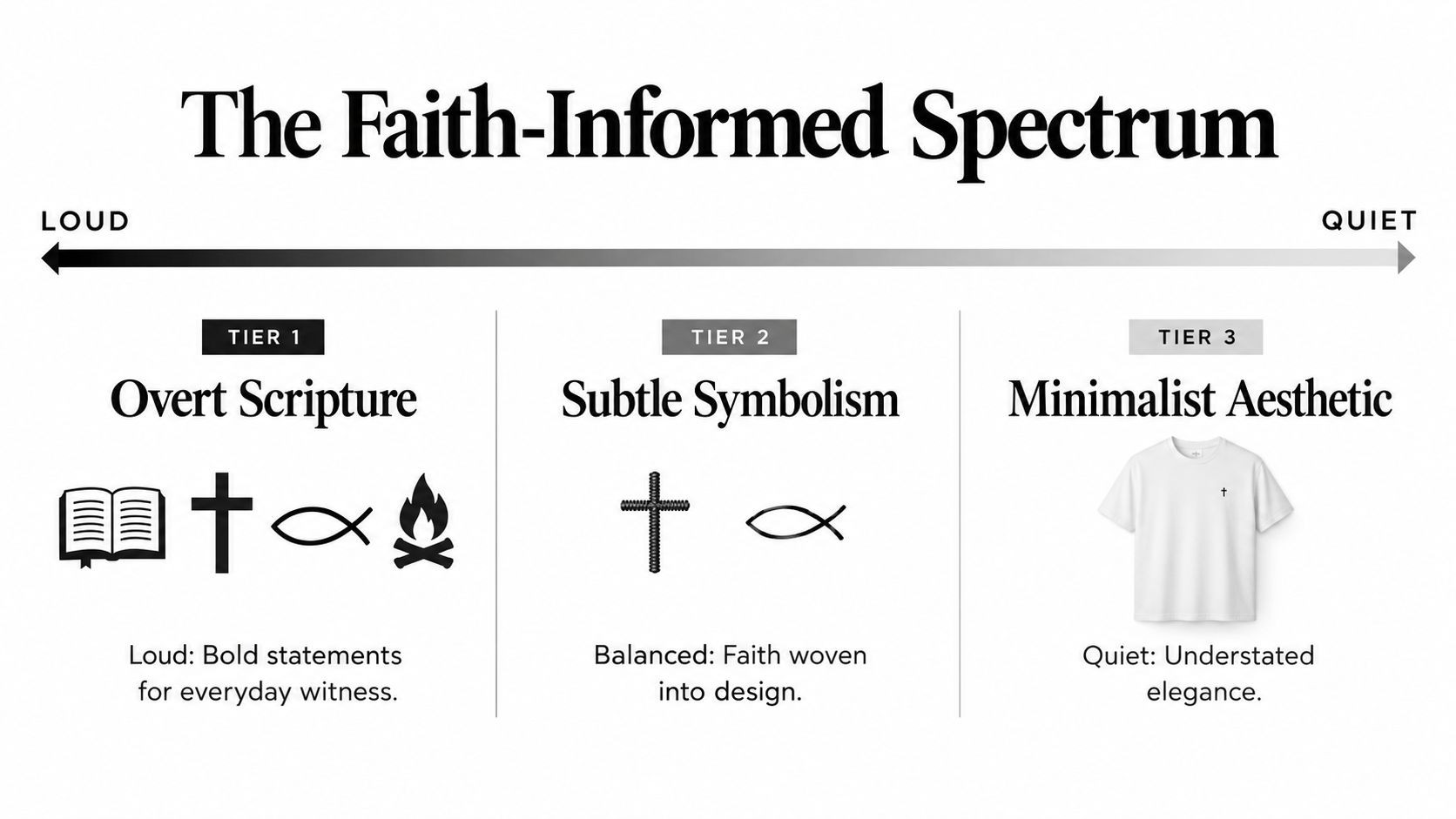
Tier one uses overt scripture
This is the unmistakable lane: printed Bible verses, crosses, fish symbols, church-camp references, and direct statements about Jesus. The wearer is choosing clothing that functions as a public declaration. Gift shoppers and group leaders often prefer this tier because the message is immediately legible.
The trade-off is subtlety. Large graphics can start conversations, but they can also dominate the outfit and narrow where the piece feels comfortable. Buy overt apparel when you want the message to lead.
Tier two relies on symbolism
Symbolic designs use lions, doves, olive branches, stained-glass references, small stitched crosses, or minimalist fish motifs. Insiders may understand the reference immediately, while everyone else sees a considered graphic.
This tier works well for people who want faith to remain present without turning every outfit into an announcement. It also gives designers more room to create garments that feel like clothing first and religious merchandise second.
Tier three makes faith part of the aesthetic
The quietest tier uses minimalist cuts, neutral palettes, heritage textures, small placement details, and restrained branding. A faith-informed brand may express its identity through its mission and design philosophy while keeping the surface of the garment understated.
A product such as the Unisex Pure Cotton T-Shirt illustrates why specifications matter more than assumptions. Its listing identifies 100% cotton, a fabric weight of 6.8 oz/yd², or 230 g/m², a non-stretch construction, a loose fit, and a drop shoulder. The size chart gives measurements from S through XXL, which is more useful than calling the fit “unisex.” You can compare the listed chest and length measurements with a shirt you already own.
The strongest christian apparel brands usually mix all three tiers. They may offer direct Scripture for customers who want witness-oriented clothing, symbolic pieces for everyday wear, and quiet basics for design-led buyers. For more context on minimalist faith-informed clothing, see 99 Collection's perspective on ninety-nine clothes.
Four Things to Weigh Before You Buy
Don't begin with price. Start by deciding whether you can support the brand's beliefs and conduct. Then inspect the garment, verify the fit information, and investigate the company's ethics.
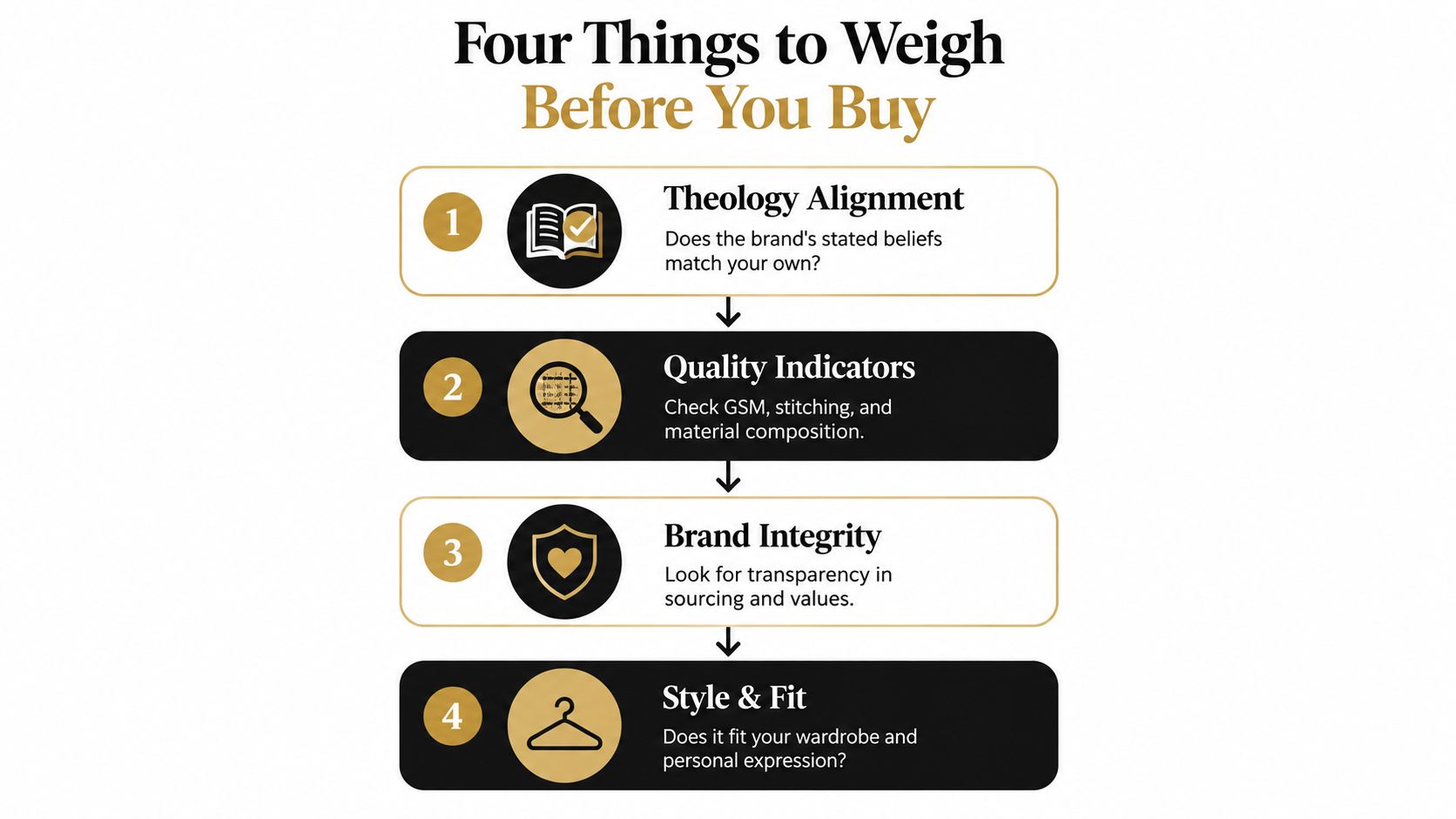
Theology alignment comes first
Read the stated beliefs before browsing the collection. Look for denominational language, doctrinal statements, ministry partnerships, founder commentary, and public social posts. You don't need a brand to mirror every personal conviction, but you should know where it stands.
A brand that uses Christian language without explaining its meaning deserves more scrutiny. So does a company whose messaging shifts dramatically between product drops. Consistency matters because the faith claim is part of the product context.
Quality decides whether the price makes sense
Inspect the material composition, fabric weight, stitching details, print method, and care instructions. A beautiful message doesn't rescue a shirt that twists after washing or develops a stretched collar quickly.
The Unisex Cotton T-Shirt guide is a useful example of why product pages should provide measurable information. You want details you can compare, not adjectives such as “premium” or “luxurious” without supporting specifications.
Sizing transparency prevents avoidable returns
Look for measurements for each style, not one generic chart copied across the whole store. Check chest width, body length, shoulder measurements, sleeve length, and whether the garment is described as standard, relaxed, boxy, oversized, or loose.
A fair return policy matters just as much. If a brand makes customers absorb the cost of guessing, its size guidance isn't doing enough work.
Ethics needs evidence
Sourcing claims should identify factories, production regions, certifications, materials, or audit practices where applicable. Charitable claims should name partners and explain the financial relationship instead of relying on “a portion of proceeds” alone.
Store-selection research on U.S. Christian apparel consumers found that religiosity helps predict store preferences, while price, size, convenience, and fashion image also matter. The California State University research on Christian apparel consumers supports a practical conclusion: online brands can compete by making product pages, size guidance, and checkout straightforward.
Reading Quality Signals Without the Marketing
Marketing copy is cheap. Construction details are harder to fake.
Start with fabric weight. Product listings may use GSM or ounces per square yard, and those figures let you compare garments across brands. The provided product snapshot for 99 Collection's cotton tee lists 230 g/m², but it also describes the fabric as thin and non-stretch. That combination is a reminder not to infer the entire wearing experience from one number.
Inspect the fabric and seams
A heavier fabric can feel more substantial, but it may also feel warmer or more structured. A lighter fabric can work better in hot climates or layered outfits, but it may show more wear and offer less structure.
Look for straight seams, tight stitching, taped shoulders, double-needle hems, and a collar that sits flat. Loose threads, puckering, uneven hems, and a neckline that looks stretched in product photos are warning signs. A side-seamed body generally gives the garment more structure than a tube-knit body, though the details still depend on execution.
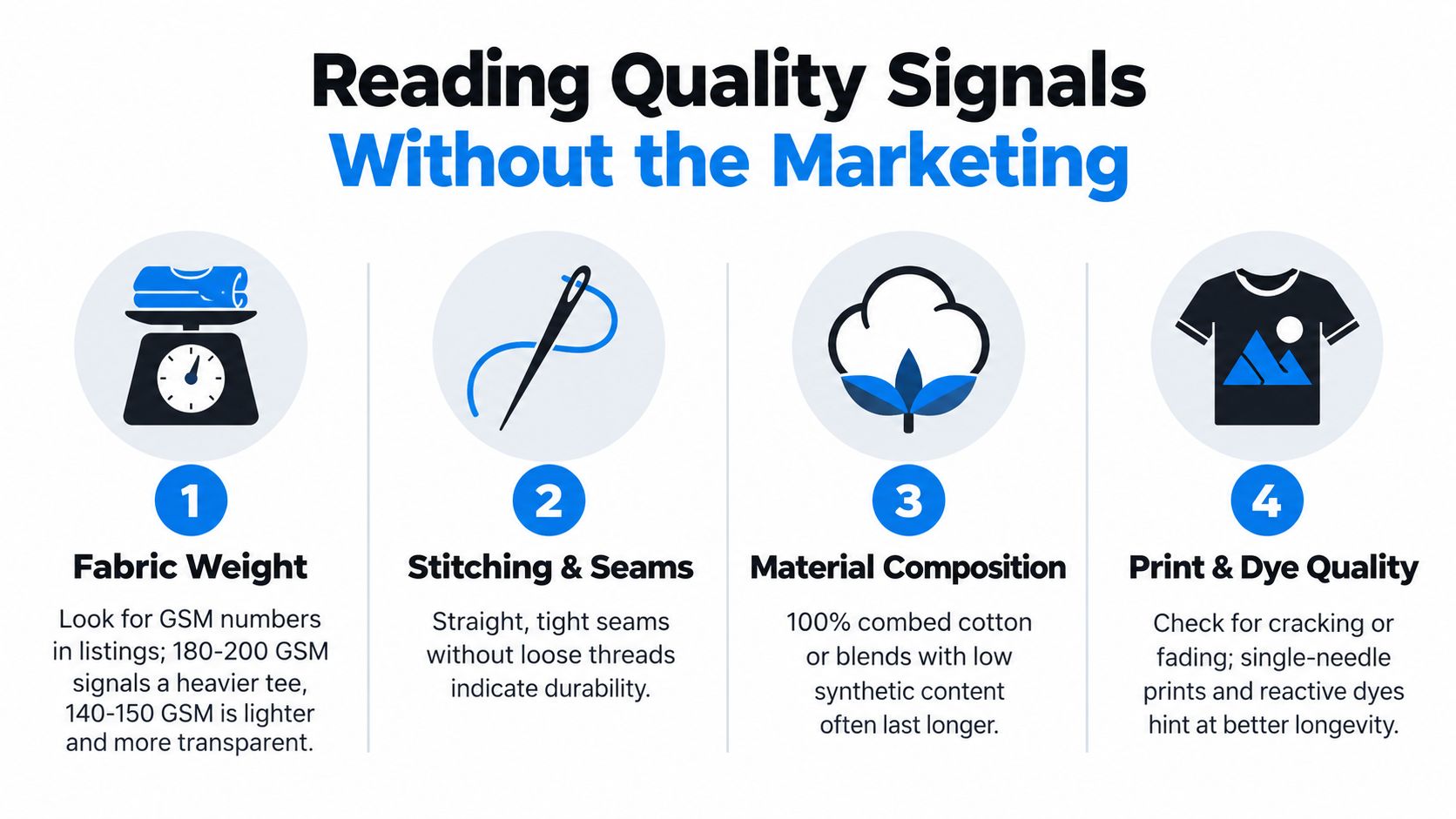
Treat the print as a separate component
A religious graphic often stays visually important after the underlying shirt has started to fail. Check whether the design is screen printed, direct-to-garment, embroidered, or applied through another transfer method. The method alone doesn't guarantee durability, but vague print descriptions leave you with less information.
After washing, inspect the print for cracking, lifting, tackiness, or fading. Wash printed garments inside out on a gentle cycle, avoid bleach, use low heat, and don't iron directly over the design. Those care instructions also appear in the product information for the 99 Collection cotton tee, though that source should be treated as a product-specific guide rather than a universal rule.
For a visual look at garment construction and print considerations, watch this clothing quality demonstration.
Compare construction, not just price
A low-priced shirt with thin fabric, weak seams, and a brittle graphic may cost more over time if you replace it quickly. A higher-priced shirt isn't automatically better either. Ask what the price buys: better fabric, improved finishing, more reliable sizing, ethical production, or a larger logo and stronger branding.
A study of Christian consumers found that religiosity has a positive direct relationship with quality consciousness, fashion consciousness, and price consciousness, while more committed Christians showed lower brand orientation. The Cal State ScholarWorks consumer study points to the buying behavior many brands overlook: committed shoppers can want better garments, current styling, and a fair deal at the same time.
How to Judge a Brand Beyond the Product
A polished shirt can hide an unclear company. Evaluate the organization behind the garment before you treat its faith language as a trust signal.
Look first at charitable giving. “We give back” tells you almost nothing. A stronger disclosure names the recipient, describes the relationship, states what is donated, and explains whether the contribution is tied to sales, profits, or a separate campaign.
Sourcing transparency deserves the same treatment. Look for factory information, country of manufacture, fiber origin, and credible certifications where the brand relies on them. If a company makes environmental claims but offers no supporting detail, treat the claim as marketing rather than evidence.
Brand-Level Credibility Signals
| Signal Type | Green Flag | Red Flag |
|---|---|---|
| Charitable giving | Named partners, clear calculation method, published updates | Vague “a portion” language with no definition |
| Sourcing | Factory or production details, relevant certifications, material information | No manufacturing information despite strong ethical claims |
| Founder story | Origin story matches the current mission and product range | Inspirational founding story disconnected from present conduct |
| Public accountability | Respectful responses to reviews, corrections, and sizing complaints | Deleted criticism, defensive replies, or silence on recurring issues |
Founder stories should explain the business, not replace disclosure. A compelling testimony doesn't prove that the supply chain is responsible or that donations reach the stated cause.
Pay attention to how the company handles criticism. Customers who report poor sizing, print failure, or misleading descriptions are providing useful evidence. A brand doesn't need to agree with every complaint, but it should respond clearly and correct factual errors.
Red flags include inconsistent theology across collections, unexplained leadership changes, and marketing that blurs patriotism with Christianity as if the two are interchangeable. Faith-informed buyers don't need cynical suspicion. They need enough information to distinguish conviction from decoration.
Matching the Framework to Real Shoppers
The same brand can be a smart choice for one shopper and a poor choice for another. Start with the use case, then apply the framework without pretending every customer wants the same message.
The gift buyer
You're buying for a relative who may appreciate the Christian context but doesn't usually wear overt religious graphics. Choose a symbolic or faith-informed piece in a neutral palette. The recipient will judge it as clothing first, so inspect the construction, fabric, and care requirements carefully.
Avoid buying a loud verse tee because the message feels meaningful to you. A gift should respect the wearer's actual wardrobe. If the recipient dresses minimally, a small symbol or understated placement will probably earn more use than a large front graphic.
The streetwear shopper
You like bold graphics, oversized proportions, and designs that make the outfit unmistakable. Overt Scripture can work here, but don't let the artwork distract you from the blank garment underneath.
Check shoulder construction, body measurements, print coverage, and fabric behavior. Large prints can make a shirt feel heavier and may show cracking more visibly, while an oversized cut can fit very differently across brands. Buy the statement piece because you want to wear it repeatedly, not because the message makes the product impossible to criticize.
The value-conscious parent
You need basics that can survive school, ordinary play, and repeated laundering. Minimalist faith-informed apparel often makes more sense than novelty designs because it can rotate through more outfits and remain wearable as tastes change.
Prioritize transparent measurements, easy care, and a clear return policy. A parent should also check whether the garment is non-stretch, loose, or drop-shoulder rather than relying on the word “unisex.” The Christian consumer study cited earlier found that committed buyers can be highly price-conscious while still caring about quality and fashion, which describes this shopping situation perfectly.
These scenarios produce different answers because the best Christian clothing brand isn't universal. It's the brand whose theology, garment, and operating standards fit the person who will wear it.
A Practical Buyer's Checklist
Save this as a decision filter before your next purchase. It turns vague goodwill into questions you can answer from a product page, mission page, and independent customer feedback.
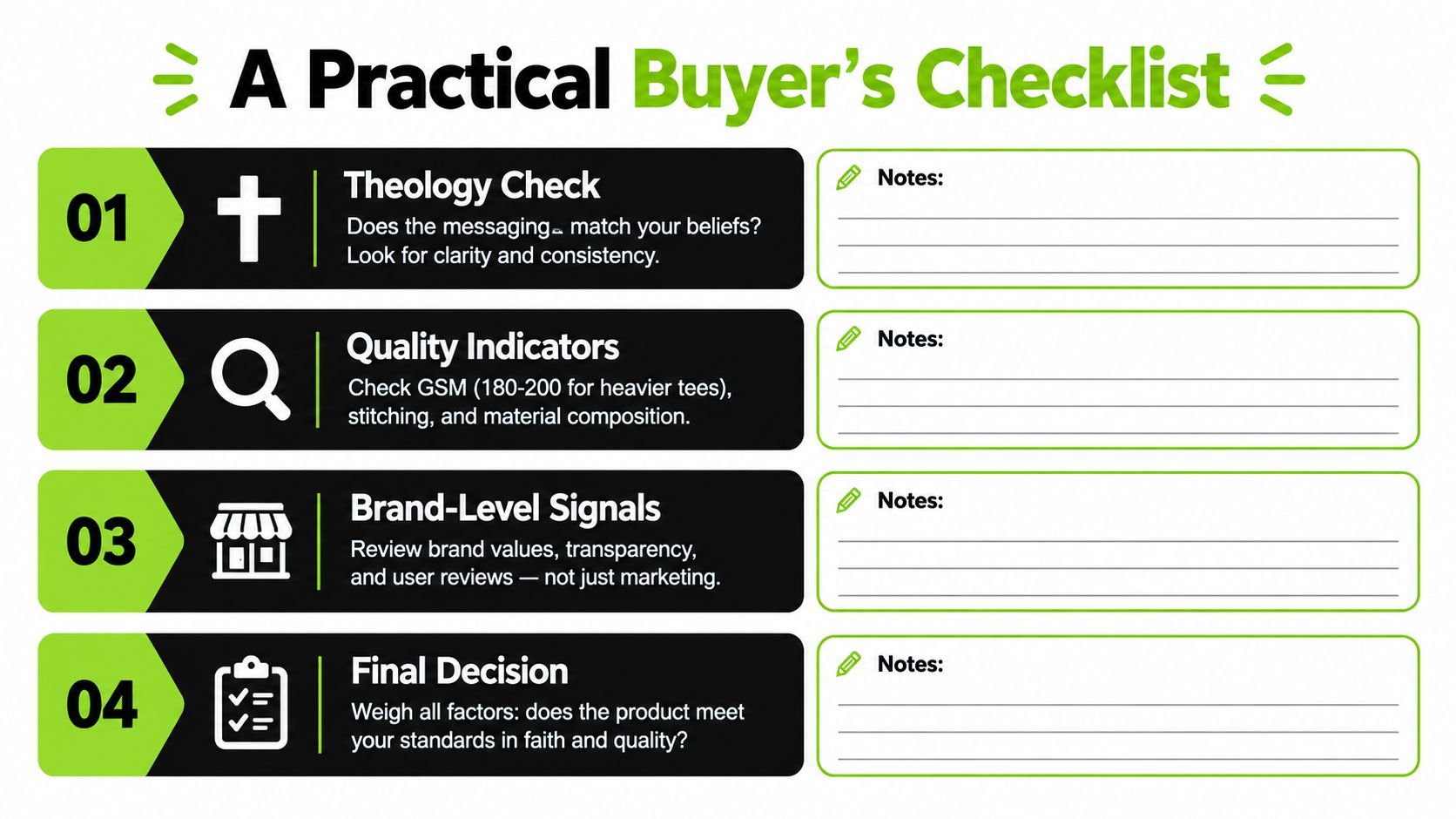
Theology check
- Message: Does the design fit your tradition and convictions?
- Consistency: Do the mission page, product language, and public posts agree?
- Context: Is the brand clear about whether it's selling faith-informed clothing, supporting ministry, or doing both?
Construction check
- Material: Is the fiber composition published?
- Weight: Does the listing provide GSM or ounces per square yard?
- Build: Can you see useful details about seams, hems, collars, and print or embroidery?
- Care: Are washing and drying instructions specific enough to follow?
Transparency check
- Origin: Does the brand explain where the garment is made?
- Impact: Are charitable partners and contribution methods named?
- Fit: Are measurements provided for the specific style?
- Returns: Can you try the garment without absorbing unreasonable risk?
Intent check
- Mission: Does the stated purpose match the visible business?
- Structure: Is there a nonprofit arm, a disclosed giving model, or a commercial apparel company with faith-based branding?
- Accountability: Does the brand answer criticism without deleting inconvenient questions?
Use a binary rule: if a brand fails any two blocks, skip the purchase. A beautiful design isn't enough to compensate for unclear theology, weak construction, missing measurements, or unsupported impact claims.
Merch, Ministry, or Something in Between
Most Christian apparel brands occupy the middle ground. They're commercial businesses with faith-informed missions, not automatically churches or nonprofit ministries. That isn't a problem, but pretending the distinction doesn't exist makes buyers less informed.
Read the company's structure alongside its language. Does it have a registered nonprofit arm? Does it publish how profits or revenue support a cause? Does it name vetted organizations? Does it distinguish charitable donations from general business expenses? If the brand uses the word “ministry,” ask what that means operationally.
Three questions cut through most ambiguity:
- What percentage of revenue or profits supports the stated cause?
- Who verifies or documents that claim?
- Would the business still exist without the Christian framing?
The first question tests financial clarity. The second tests accountability. The third isn't an accusation. It helps you understand whether you're buying a fashion label with a faith-informed aesthetic, a mission-driven company, or apparel that funds a broader ministry.
Independent guides on Christian clothing brands repeatedly identify sourcing and charitable disclosure as areas where shoppers want more detail, while She Wears Faith's discussion of Christian clothing brands highlights the gap between values-led messaging and verifiable impact information. Faith branding can signal shared values, but it can also create a higher expectation of honesty.
Buy consciously: Apparel can support ministry, fund charity, express belief, or simply reflect a Christian aesthetic. All four choices can be legitimate when the brand tells you which one you're making.
Don't demand that every apparel company become a nonprofit. Do demand that each company describe its business accurately. If you want to buy clothing that supports a specific ministry, choose a brand with documented giving. If you want a well-designed basic from a faith-informed label, evaluate it as apparel first and judge the values separately.
That is the mature standard for Christian apparel. Message matters, but so do fabric, fit, sourcing, and financial honesty.
If you're looking for contemporary unisex basics with a faith-informed aesthetic, visit 99 Collection and review each product's material details, measurements, fit notes, and care instructions before you buy. Use the theology, quality, and transparency checklist here to decide whether a piece belongs in your wardrobe.