

You're standing in front of your closet on a quiet morning, trying to decide whether a faith based tee should feel like part of your actual wardrobe or like something saved for church youth night. That's the right question. The best shirts in this space don't shout first, they fit well, wear easily, and let the message land without taking over the outfit.
Table of Contents
- What This Guide Is Really About
- What Counts as a Faith Based T Shirt Today
- The Messaging Behind the Print
- Design and Ethical Choices That Matter
- How Faith Tees Actually Perform in Real Life
- Styling Faith Based T Shirts Beyond Sunday
- Why Quiet Faith Often Outlasts Loud Faith
- Your Shortlist Before You Buy
What This Guide Is Really About
A good faith based T-shirt starts with a simple job, it should look like a shirt you reach for often. If the fabric feels awkward, the cut is off, or the print is too loud for your life, the message gets pushed to the side. That's why the clearest way to judge this category is to think about fit, fabric, print style, and where you'll wear it.
The shift away from one-note slogan wear
Faith apparel has split into two different moods. One side is loud, oversized, and built to be seen from far away. The other side is quieter, with smaller references, softer color choices, and a shape that works with jeans, trousers, or layered looks.
The second lane is where understated devotional tees live, including minimal Luke 15 references and other quiet scripture pieces. That approach matters because a shirt that works on a Sunday morning should also work on a coffee run or travel day. It's easier to build a wardrobe around one thoughtful tee than around a shirt that only makes sense in a narrow setting.
Practical rule: If you can only describe the shirt by its slogan, it's probably more statement than staple.
For a concrete reference point, the Unisex Pure Cotton T-Shirt uses a unisex cut, 100% cotton, and a 6.8 oz/yd² (230 g/m²) fabric weight with a drop shoulder and loose fit. Those details matter because they tell you more about how the shirt will sit on the body than the artwork does.
What Counts as a Faith Based T Shirt Today
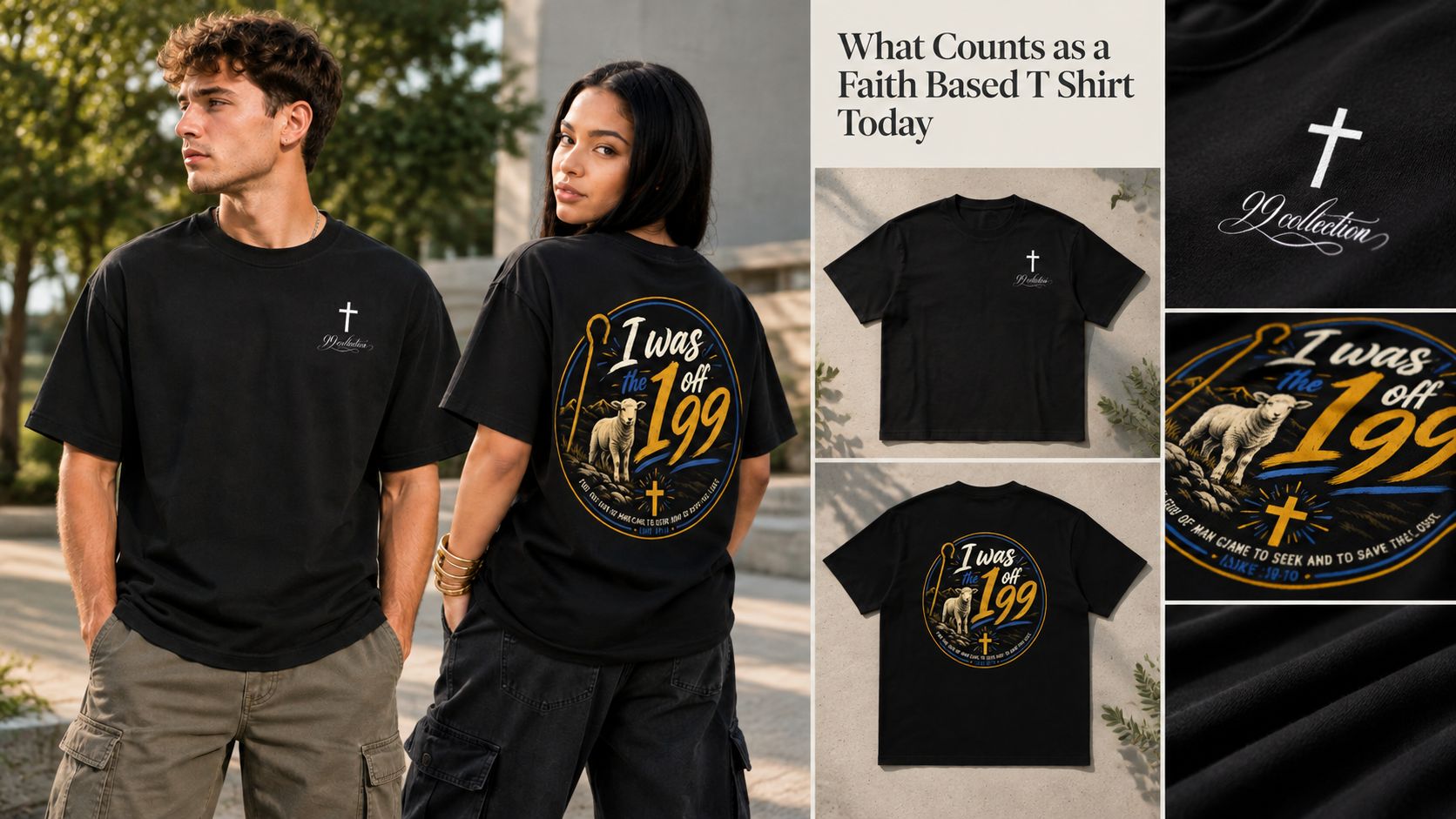
A faith based T-shirt is any tee whose main design language comes from Christian belief, usually through scripture, symbol, or short devotional phrasing. The key word is wearable. If the piece feels like clothing first and a handout second, it fits the category.
Two lanes, two different signals
The bold lane uses large graphics, stacked text, and high contrast. It reads as public, direct, and often youthful. The understated lane uses neutral colors, smaller marks, tonal printing, and short references that feel more personal than performative.
| Feature | Bold Streetwear Faith | Understated Devotional Wear |
|---|---|---|
| Visual impact | Loud, immediate | Quiet, close-up |
| Message length | Often long or stacked | Usually short or fragment-based |
| Styling range | Narrower, more event-driven | Broader, easier to repeat |
| Audience feel | Public-facing | Personal and discreet |
That difference is why a shirt can be a faith tee without being a billboard. The test is whether the design can move from home, to church, to lunch, to a casual work setting without feeling out of place. A shirt with a smaller scripture note or a subtle symbol tends to do that more naturally.
Reading the shirt before you buy it
Look at three things first, the size of the graphic, the contrast against the fabric, and the overall cut. A shirt that leans quiet will usually use spacing more carefully, with the message placed where the eye finds it naturally instead of where it has to hunt for it. That's why minimal tees often feel more premium, even when they're simple.
A shirt like the unisex pure cotton tee above also shows how construction supports the message. The length runs from 27.56 to 30.71 inches, the chest runs from 21.85 to 25.59 inches, and the sleeve length runs from 8.23 to 9.13 inches across sizes, so the silhouette is clearly built to be relaxed rather than fitted. Those proportions matter when the goal is a clean, everyday look.
The Messaging Behind the Print
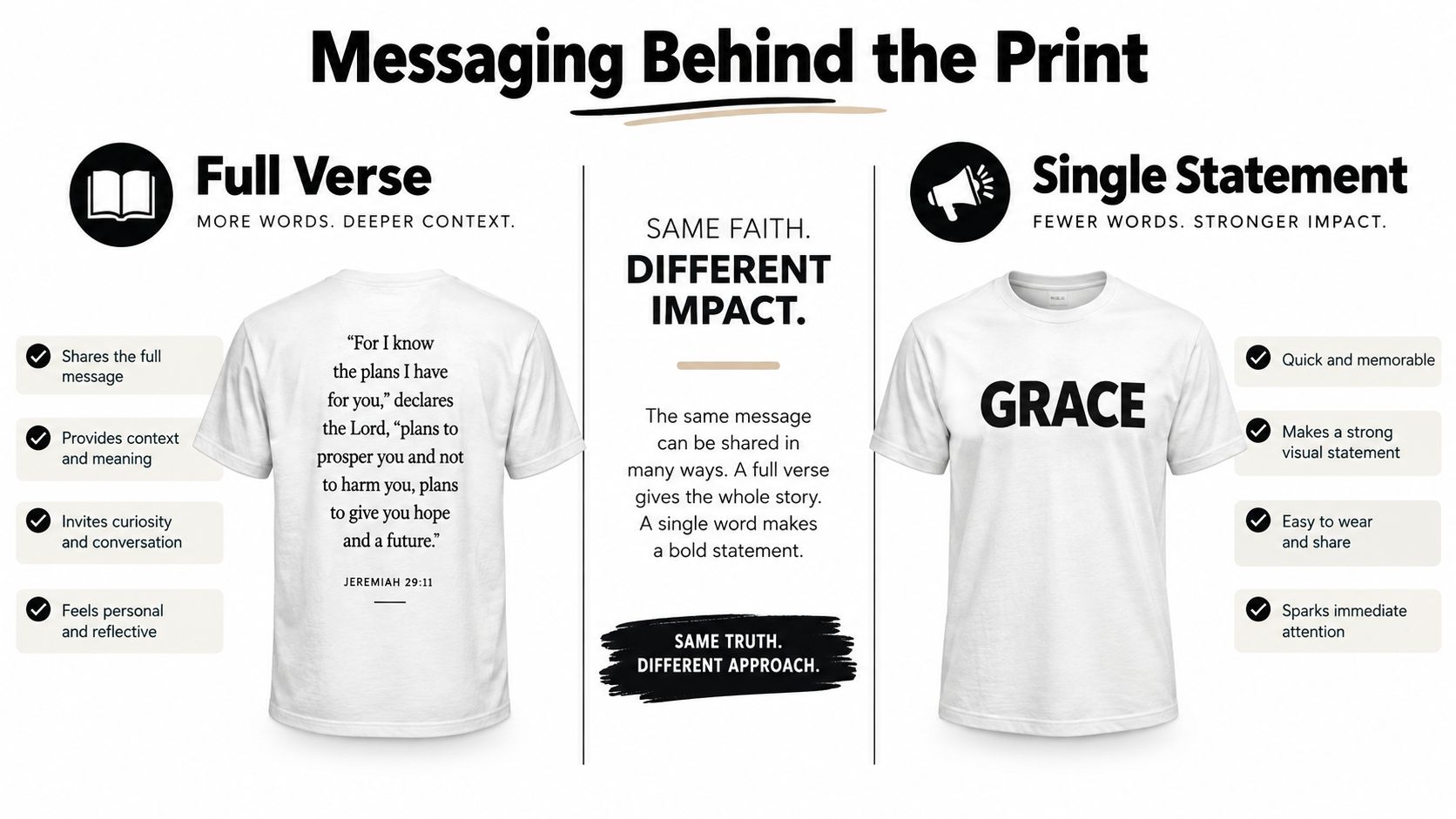
The print tells you how the shirt wants to be read. Some tees speak in one glance, while others ask for a closer look. If you understand the message style, you can predict how the shirt will behave in church, at work, or in a room full of strangers.
Full scripture, single line, symbol, tonal print
Full scripture prints are the most direct. They can feel powerful, especially when the verse matters greatly to the wearer, but they usually read as more public and more event-specific.
Single-line phrases keep the message simple. Short wording is easier to read on fabric, and design guidance for Christian merch often favors concise text for exactly that reason, because garments don't give you much space to ramble.
Symbolic designs use crosses, doves, fish, or small typographic marks. They don't force a reading experience, so they work across mixed audiences and more settings.
Tonal prints sit close to the color of the fabric. They rely on texture, placement, and subtle contrast, which makes them ideal for a quiet faith wardrobe.
A quiet shirt doesn't hide belief. It just lets the wearer decide how much to say at once.
That's where brands like 99 Collection often land, with shorter scripture cues and more restrained treatment. The effect is less “look at this” and more “notice this if you're close enough.”
Why shorter wording works better on fabric
Long paragraphs don't usually belong on tees. They crowd the chest, pull attention away from fit, and make the garment feel more like a poster than clothing. Short phrases and scripture fragments also leave room for the rest of the outfit to breathe, which is why they age better in a wardrobe.
When a verse matters to you, the design should still let the shirt function as a shirt. That balance is what separates a devotional staple from a one-time statement piece.
Design and Ethical Choices That Matter
A faith tee feels premium when the parts work together. Fabric, fit, print method, and production ethics all shape whether a shirt keeps its form, keeps its message, and stays in regular wear. If one piece is off, the whole garment reads as weaker.
Fabric and fit are the first quality checks
Mid-weight cotton usually gives a shirt more structure than a very thin jersey, while still staying easy to wear. A tee that is too light can cling, twist, or look tired quickly. A shirt with enough body holds the print better and feels steadier on its own, which matters when the design is intentionally minimal.
Fit matters just as much. A relaxed cut can still look sharp if the shoulders sit correctly and the sleeves do not flare out. A shirt meant to be unisex needs careful grading, because the same shape has to sit naturally on different bodies. For a fuller guide to that approach, see gender-neutral clothing for adults.
Print method changes how long the message lasts
For faith tees with scripture or symbolic graphics, the print method affects how long the message stays clear. Screen printing on cotton is usually associated with longer wear, while transfer methods can crack or wear at the edges sooner. If the design carries devotional meaning, the words or symbols should still read cleanly after repeated washing.
Ethics should be visible in the basics
Small-batch production, transparent sourcing, and recycled packaging are the kinds of details that make a faith tee feel aligned with its message. If a shirt speaks about conviction but hides how it is made, the gap is hard to ignore. Ethical presentation does not need to be loud, but it should be clear.
The broader category also shows why this matters. Online faith-based apparel remains a small, measurable niche, and one tracker estimated $16 million in 2025 for tracked faith-based apparel and accessories online, with a 10–20% decline from the prior year. Grips Intelligence forecasts a further 20–50% revenue decline for 2026. That kind of uneven demand makes quality and positioning more important, not less.
| Factor | Lower-Quality Choice | Better-Made Choice |
|---|---|---|
| Fabric | Thin jersey that loses shape | Cotton with enough body to hold the cut |
| Fit | One-size feel with weak grading | A cut designed to sit cleanly on different bodies |
| Thick or fragile decoration | Print that stays readable and comfortable | |
| Ethics | No sourcing clarity | Transparent, small-batch, or responsible production |
How Faith Tees Actually Perform in Real Life
A woman in a 99 Collection shirt described wearing her first shirt to church, where people complimented the quality and asked where she got it. That kind of response tells you something useful. A quiet shirt doesn't need to dominate the room to start a conversation.
A shirt that works in movement, not just mirrors
The most revealing test is not the product photo, it's the full day. A tee with a small Luke 15 reference can start in a church service, then move into a café with denim, then stay comfortable on a travel day because the cotton feels familiar and the cut isn't fussy. When the message is restrained, the shirt is easier to repeat without the outfit feeling staged.
That matters because Christian apparel can function as a conversation starter. A visible faith message can invite a question, and that gives the wearer a natural opening to explain what the design means. The point isn't to perform belief, it's to make room for it.
Low light, crowds, and close-up reading
Tonal printing behaves differently than high contrast graphics. In a busy room, it reads as texture first and message second. In a pew or at a dinner table, it becomes visible as people come closer.
That's a useful tradeoff. A shirt with a slightly dropped shoulder and a relaxed fit can look easy in a crowded setting, while a message that stays subtle keeps the tone warm instead of preachy. A louder graphic often works against that balance.
Christian retail data also shows why this kind of wearability matters. One analytics source estimated $77 million in 2025 online sales across tracked Christian apparel and accessories retailers, with 2.03 million sessions recorded in July 2026 and a 2.0–2.5% conversion rate (Gracefiber). That footprint suggests shoppers are still looking for faith apparel that behaves like real clothing, not just memorabilia.
Styling Faith Based T Shirts Beyond Sunday
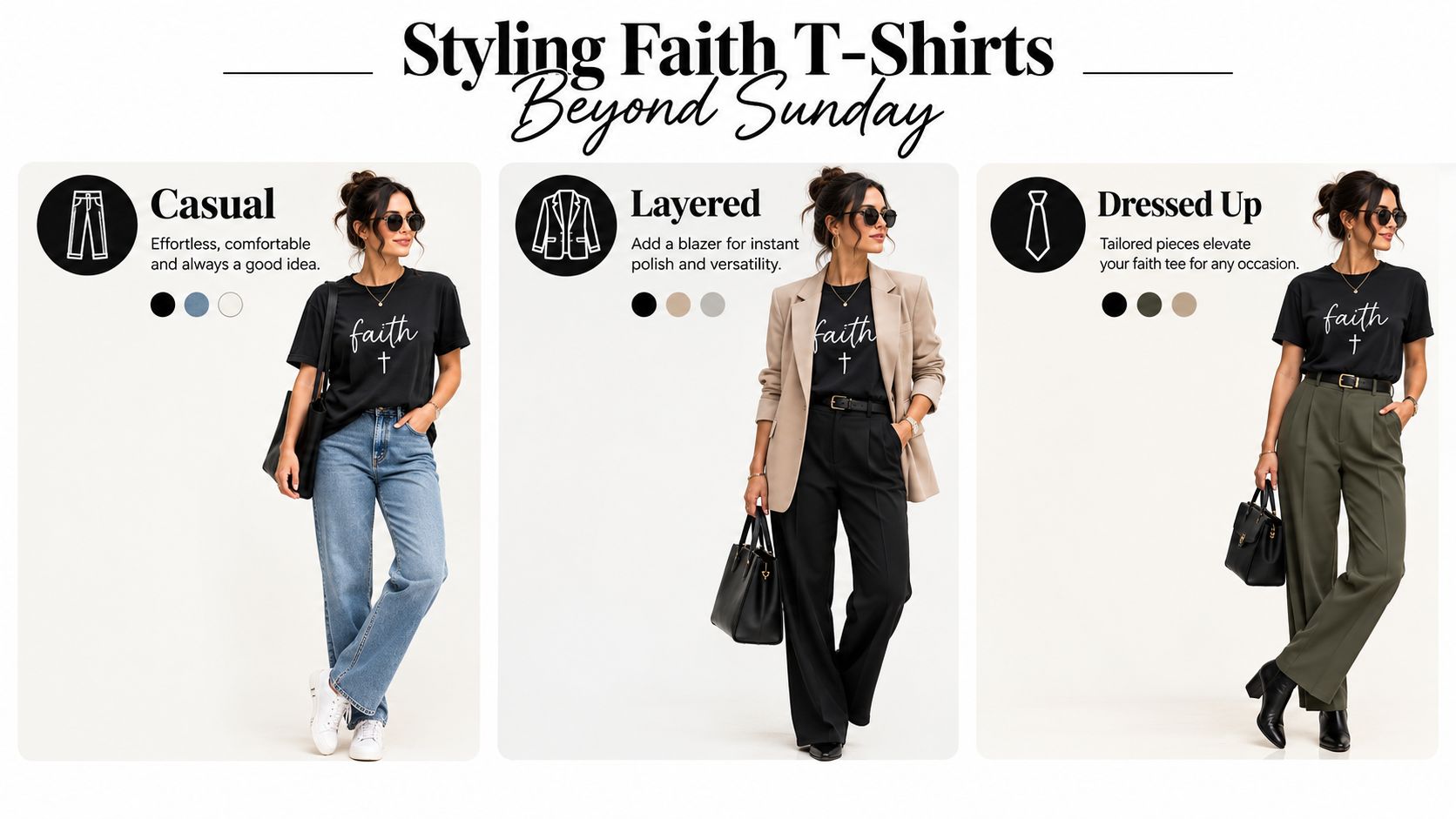
A faith tee earns its place when it can move across outfits. If you only know how to wear it with joggers, it's not really a staple yet. The easiest way to test versatility is to build three looks around the same shirt.
Casual, smart-casual, and weekend formulas
Casual: pair a relaxed-fit faith tee with straight-leg denim and canvas sneakers. This keeps the shirt grounded and lets the message stay easy.
Smart-casual: tuck a tonal scripture print into slim-fit trousers, add an unstructured blazer, and finish with loafers. The key here is restraint, because the shirt should support the outfit, not fight it.
Weekend: layer an oversized tee under a chore jacket with pleated cotton pants. This works for travel, errands, and relaxed gatherings because the layers make the look feel intentional.
The mistakes that make faith tees look costume-like
Don't tuck a loud graphic into dress trousers unless you want the shirt to become the whole outfit. Don't pair oversized tops with equally oversized bottoms unless you're deliberately going for volume. And don't wear a tee that's wrinkled under formal layers, because the texture reads as carelessness, not ease.
Style rule: If the tee is the loudest thing in the outfit, the rest of the clothes need to be very deliberately simple.
The category has also been shifting toward a quieter visual language. Commentary on Christian apparel increasingly points to a whisper aesthetic, with subtle typography, muted tones, and scripture that invites conversation instead of broadcasting it (Blank Scout). That direction makes styling easier, because understated shirts move cleanly from casual to polished settings.
For more shape ideas, the guide on how to wear an oversized T-shirt is useful if you're trying to balance volume without losing proportion. The right oversized faith tee should still feel deliberate, not sloppy.
Why Quiet Faith Often Outlasts Loud Faith
Loud faith tees had a clear moment. They worked as instant identity pieces, especially in youth culture and event merch, but they also locked the wearer into a specific visual mood. Once the graphic style changes, the shirt usually ages fast.
Why restraint makes a shirt easier to keep wearing
Quiet faith pieces tend to last longer because they stay useful across more settings. Small typography, scripture fragments, and tonal embroidery all pair well with denim, blazers, and layered outfits. They don't depend on one season's graphic language.
That's a big reason minimalist faith basics feel more current. They treat belief as part of the wardrobe, not as a billboard. Brands that lean into fit-first basics, including 99 Collection's quieter approach, tap into that shift without making the shirt feel overdesigned.
Christian apparel also reflects a broader preference for belief expressed through everyday wear rather than constant announcement. The message is still there, but it doesn't have to dominate every interaction. For many people, that's the point.
The shirt should respect the wearer's real life
A loud print can work at the right event, but it narrows the situations where the shirt feels natural. A quiet shirt can go farther because the outfit still feels like yours, not like a message board. That flexibility matters if you want repeat wear and a cleaner wardrobe.
The strongest faith tees age with the closet around them. They don't compete with your other basics, they sit beside them and stay relevant. That's the difference between a shirt you own and a shirt you wear.
Your Shortlist Before You Buy
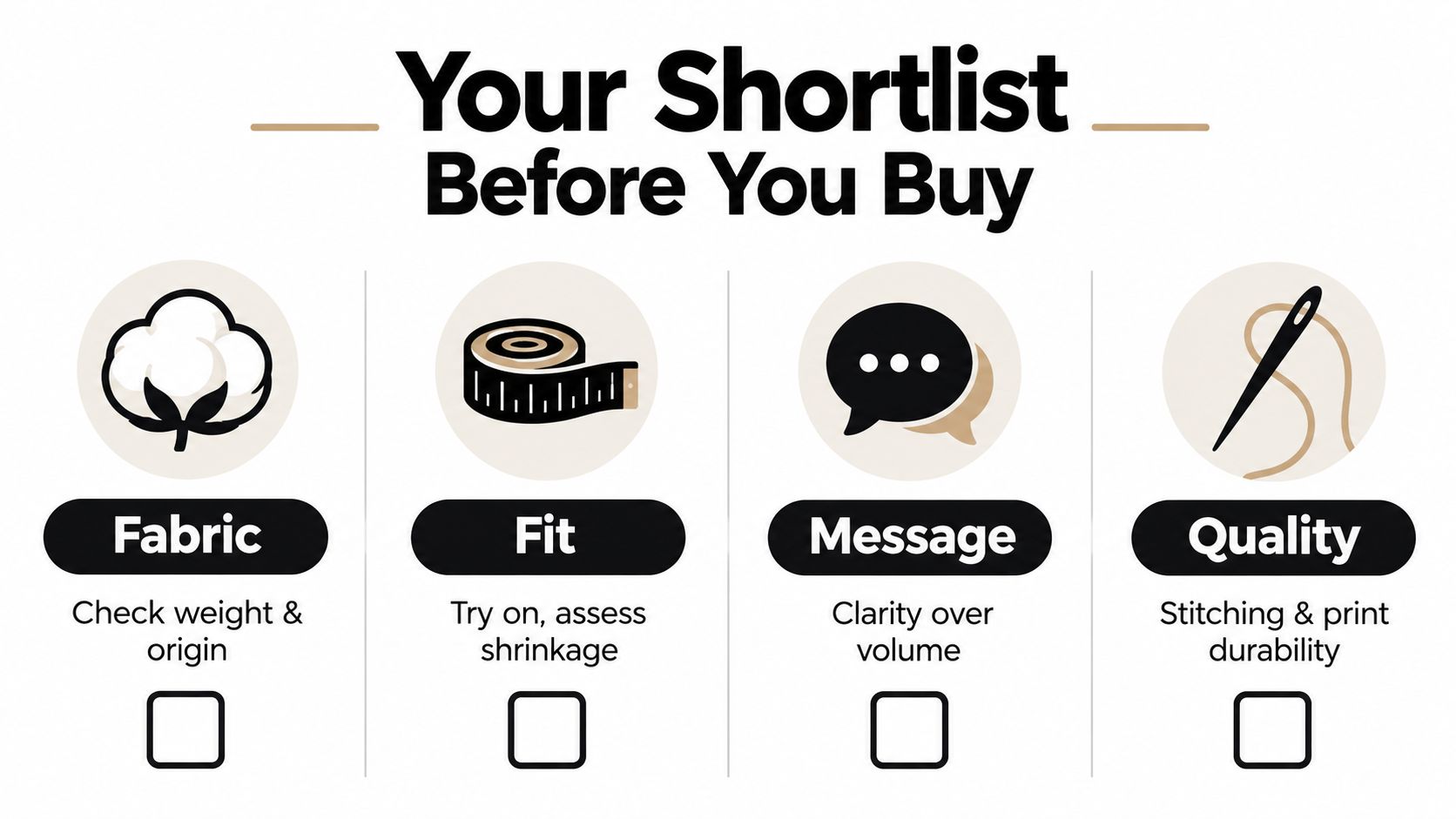
Before you buy, check the shirt the way you'd check any staple. The fabric should feel substantial enough to hold the cut. The message should match how openly you want to wear your faith. And the fit should work with your real clothes, not just with a studio photo.
Five things to verify first
- Fabric weight and feel: Look for cotton that doesn't collapse the moment you lift it.
- Fit on your body: Check the shoulder line, sleeve length, and how much room you need through the chest.
- Message clarity: Make sure the verse, phrase, or symbol reads the way you want it to read.
- Construction and print: Judge stitching, print placement, and how well the design is anchored to the garment.
- Wearability beyond Sunday: Ask whether you'd still reach for it with denim, trousers, or a jacket.
A neutral first purchase is usually the safest move. A stone, oat, or soft neutral tee with a short Luke 15 reference gives you room to style it in multiple ways without locking you into a loud look. If you want to compare sizing logic for a broader range of bodies, the guidance on oversized T-shirts for plus size can help you think through proportion before you order.
Wash the shirt inside out, treat the first few cycles gently, and judge it after a few wears instead of after the first try-on. That's when you find out whether the fit holds and whether the message still feels like something you'll want to reach for.
If you want faith based t shirts that feel calm, modern, and easy to wear, take a look at 99 Collection. The brand focuses on unisex basics with a faith-informed aesthetic, so the shirts are built to live in a real wardrobe, not just a niche moment. Start with one understated piece, wear it often, and let the fit and message prove themselves over time.