

You're standing in front of the same unisex T-shirt as another shopper. Their concern is sleeve length and shoulder room. Yours is whether the body will hang straight without feeling too wide, and neither of you knows whether the size chart is based on actual garment measurements or a generic men's template. The label says “unisex,” but that word doesn't tell either shopper enough.
That's the practical challenge with gender-neutral clothing for adults. The category offers more choice than it once did, yet shoppers still need clear help with measurements, proportions, silhouettes, fabric weight, and everyday styling. A useful wardrobe shouldn't require you to decode identity language or guess at a cut.
The sections below focus on the decisions that matter at the point of purchase: what gender-neutral design means, how unisex sizing maps to a real body, which silhouettes suit different occasions, and how to build a small collection of dependable tees, tanks, sweatpants, and layers.
Table of Contents
- Why Gender Neutral Clothing for Adults Is Having a Moment
- What Gender Neutral Clothing Actually Means
- From the 1968 Unisex Wave to Today's Mainstream Wardrobe
- How Unisex Sizing Works Across Different Bodies
- Choosing the Right Silhouette for Your Body and Occasion
- Building a Neutral Basics Wardrobe From Scratch
- The Takeaway on Fit, Function, and Confidence
Why Gender Neutral Clothing for Adults Is Having a Moment
You find a straight cotton tee that looks promising, then check the size chart and hesitate. Will it hang close to the chest, or give you the extra room of a relaxed fit? That question explains much of the appeal of gender-neutral adult clothing. A simple tee, tank, or pair of sweatpants can suit different bodies when its measurements and proportions are clear.
The category has also moved beyond a niche idea. One independent gender-neutral clothing market estimate places the global market at about USD 8.5 billion in 2024, including roughly USD 3.4 billion in North America, USD 3.0 billion in Europe, and USD 1.5 billion in Asia Pacific. The forecast reaches approximately USD 18.2 billion by 2033, with an 8.8% CAGR. Those figures reflect a market supported by mainstream retail, online shopping, and demand for clothing that can accommodate varied preferences and proportions.
The problem is usually fit clarity
A shopper may like a boxy tank but still need to know whether “boxy” means wider through the chest, shorter through the body, or both. Someone seeking an oversized tee may want extra room without a dropped shoulder extending far beyond the natural arm line. These are construction questions. The label alone cannot answer them.
A useful neutral wardrobe must also handle ordinary adult routines. A soft tee can serve for errands, a modest tank for warm weather, sweatpants for travel, and a light layer for time at home or casual social plans. Fabric weight, stretch, rise, hem shape, and finishing details determine whether each piece works beyond a trend-led outfit.
The practical test is simple: can you predict how the garment will sit before buying it? Focus on chest width, shoulder shape, body length, rise, fabric behavior, and styling flexibility. Read those details like a map. Once the measurements make sense, choosing a unisex garment feels less like guessing and more like selecting the right tool for your wardrobe.
What Gender Neutral Clothing Actually Means
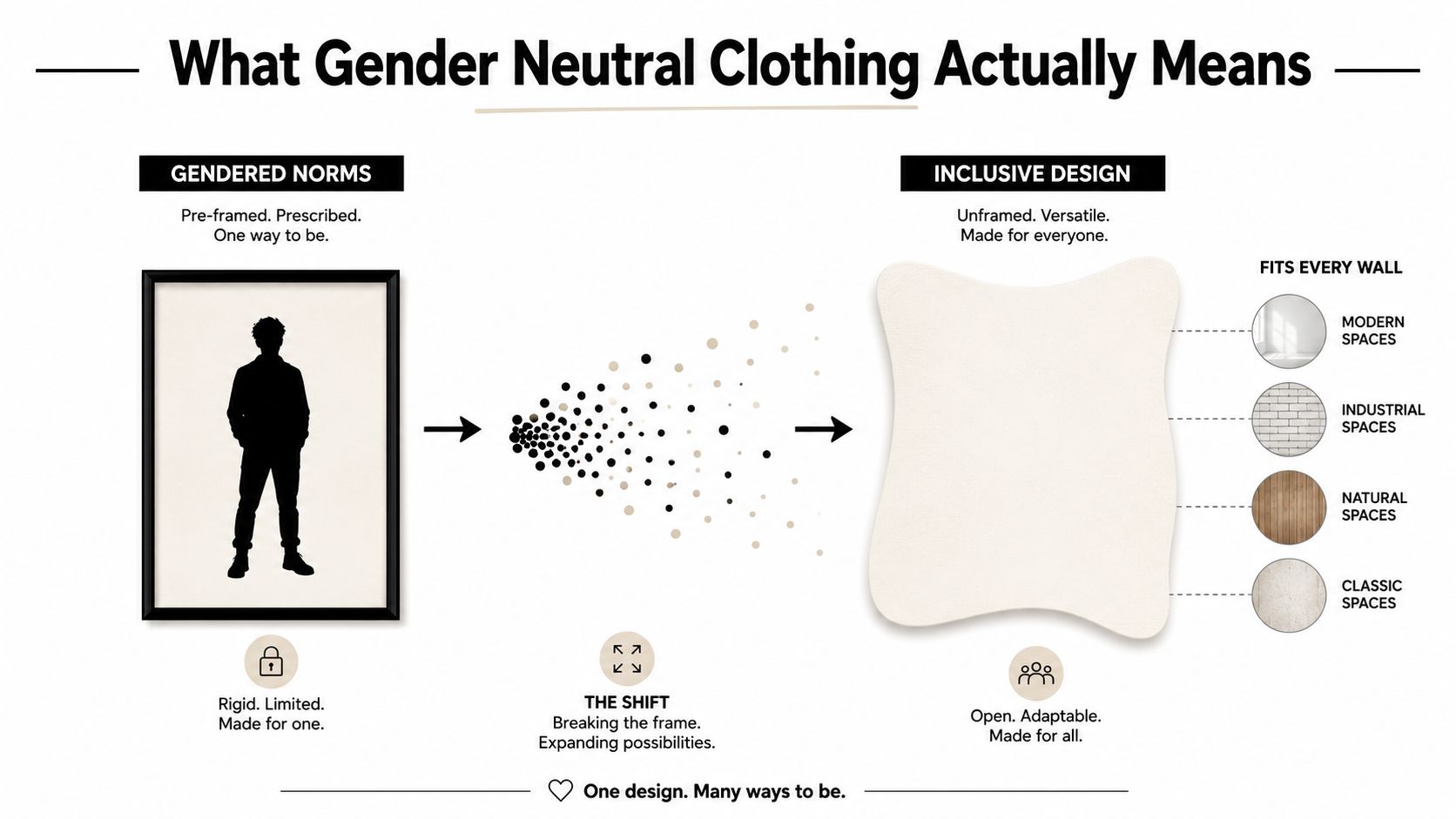
Think of gendered clothing as a picture inside a preselected frame. The frame tells you how the image should be read before you've decided whether it suits your wall. Gender-neutral clothing is closer to a blank canvas. It still has dimensions, texture, and structure, but it's designed to work in more than one setting and on more than one kind of body.
Unisex often describes a fit approach. It may signal that one pattern block or size range is offered across shoppers rather than separated into women's and men's categories. Gender-neutral is broader. It describes design choices that avoid relying on conventional gender signals, including silhouette, neckline, color, wash, branding, and styling.
Look at the garment, not only the label
A straight-cut cotton tee is a useful example. Its shape can be relaxed without becoming shapeless, and its neckline can stay simple enough to layer under a shirt, hoodie, or jacket. A boxy French terry tank uses width and fabric texture to create presence, rather than relying on a strongly gendered neckline or decoration.
Jogged sweatpants show another approach. An elastic cuff, comfortable rise, and adjustable waist can make the garment adaptable across bodies. The design communicates ease through construction, not through a slogan.
Neutral clothing isn't automatically one-size-fits-all. It also isn't limited to oversized streetwear. A regular-fit tee, a clean tank, a zip-up layer, or a structured overshirt can all belong in a gender-neutral wardrobe if the design allows the wearer to style the piece without a narrow set of assumptions.
Neutrality lives in the cut, not the tag.
The most helpful product description therefore tells you more than “unisex.” It should explain whether the shoulder drops, how long the body runs, whether the fabric stretches, and whether the garment is intended to sit close, straight, or loose.
From the 1968 Unisex Wave to Today's Mainstream Wardrobe
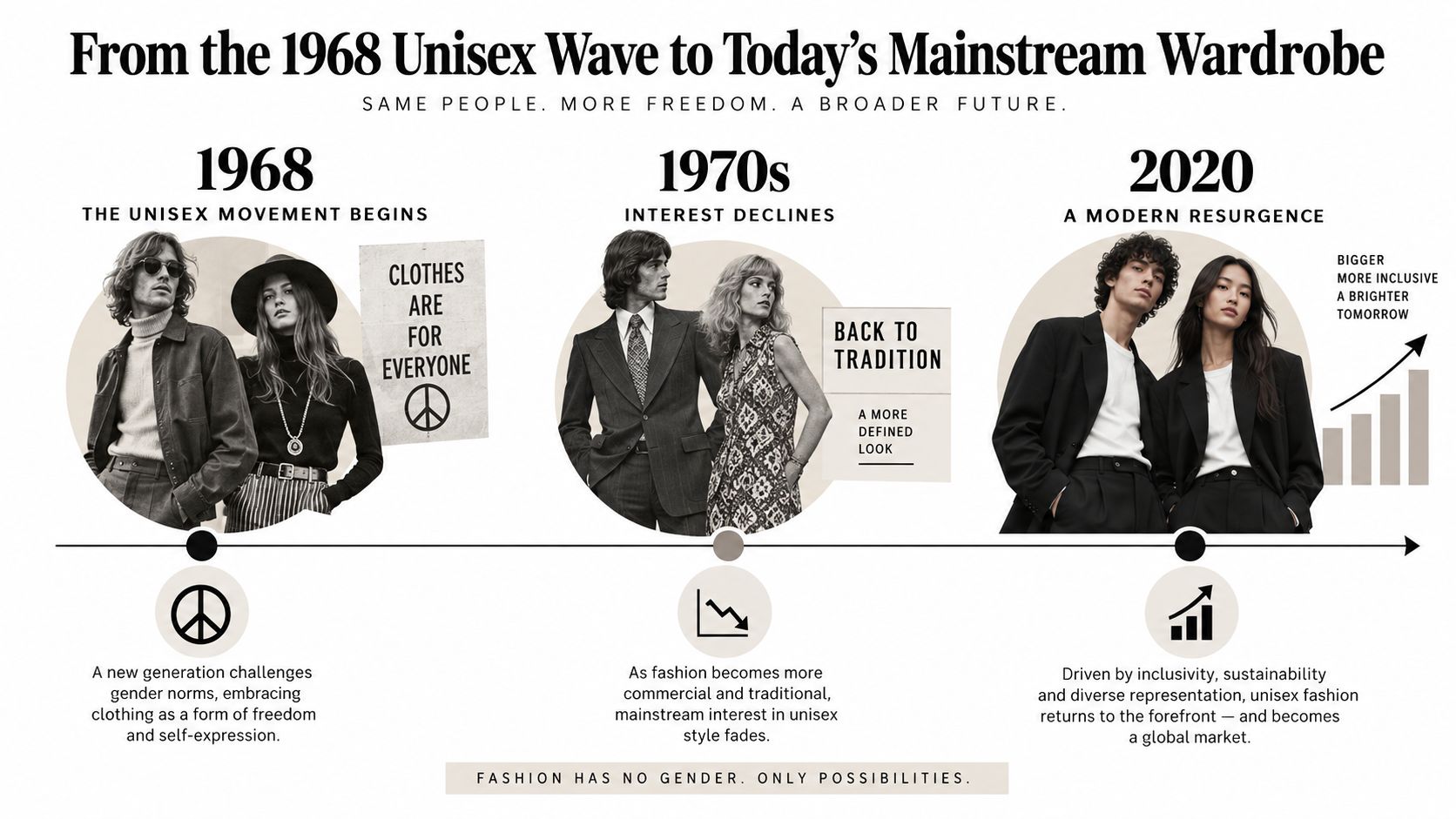
The modern unisex movement has a recognizable historical starting point in 1968. A historical review of American fashion observed that the movement “came and largely went in one year: 1968,” as described in The Atlantic's review of the unisex moment. At the time, clothing often reinforced strict expectations about how men and women should present themselves.
What changed is how neutral clothing fits into adult wardrobes. A 2022 survey found that 36% of U.S. consumers, 33% in Sweden, and 31% in the United Kingdom had purchased fashion outside their gender identity. The same source reported lower-end country results in the 19% to 21% range, while another retail survey found that about two in five U.S. consumers had bought clothing or footwear outside their gender. These figures appear in the consumer survey overview from Statista.
From statement to repeat purchase
For an adult shopper, the useful test is simple: can the garment work on an ordinary week? Tees, tanks, and sweatpants need to handle washing, layering, repeated wear, and replacement. Their value comes from practical use, so the shopper can judge them by chest room, body length, rise, stretch, and comfort rather than by a seasonal image.
Market estimates also point to continued growth. A separate industry forecast values the broader gender-neutral fashion market at USD 24.70 billion in 2025 and projects USD 54.12 billion by 2034, according to the market forecast from DataHorizzon Research. Because market definitions differ, these figures should not be compared as identical measurements. They still suggest that neutral clothing has moved beyond a short-lived runway moment.
The modern adult shopper may want a tee that layers cleanly, a tank with predictable room through the chest, or sweatpants whose waist and rise feel comfortable. Neutral clothing earns a lasting place in the wardrobe when its shape, fabric, and measurements support those everyday choices.
How Unisex Sizing Works Across Different Bodies
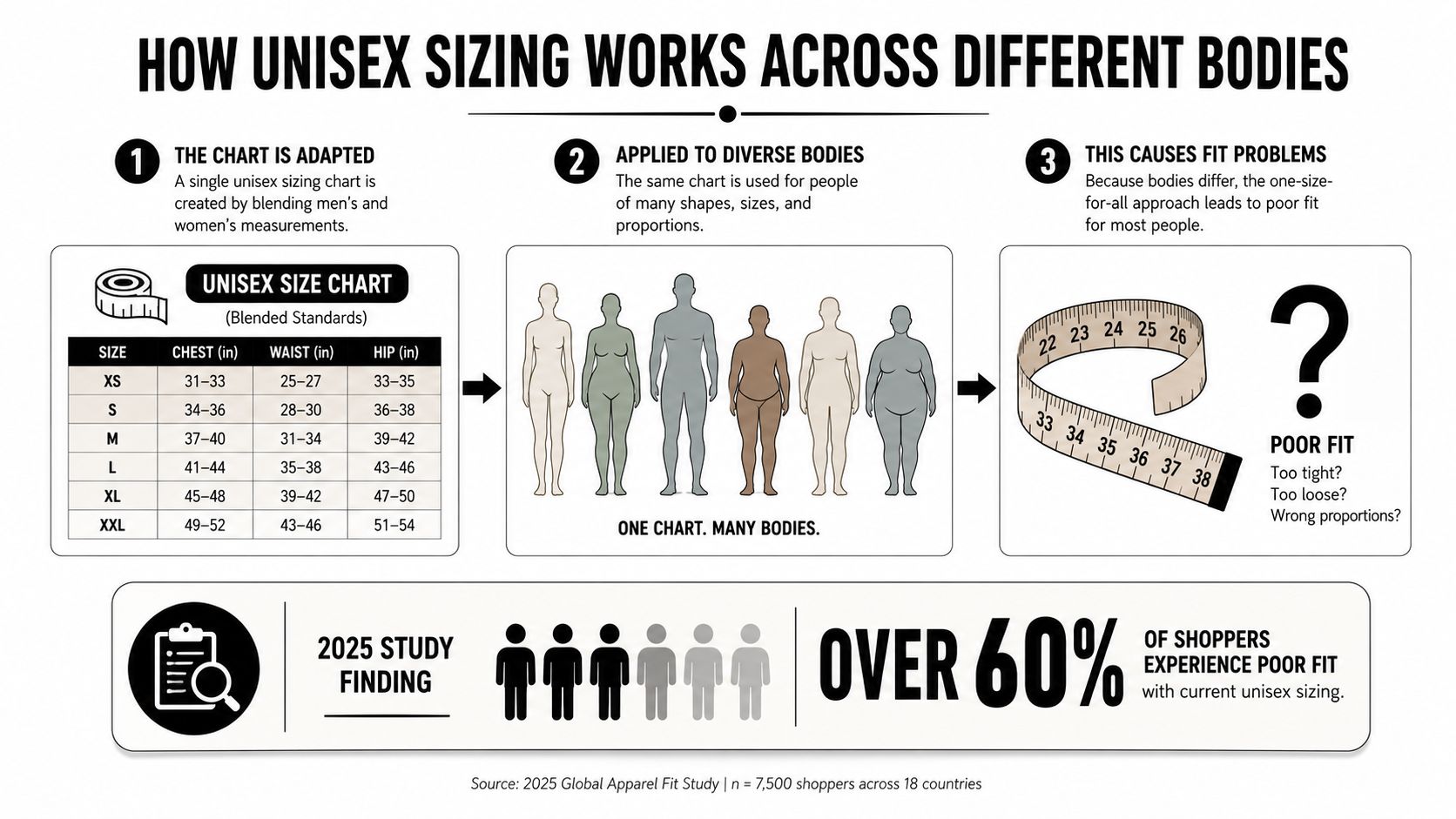
Unisex sizing often begins with a generalized chart, but generalized charts don't represent every body equally. A 2025 study on unisex clothing sizing found that the current system didn't appropriately reflect body measurements and identified size as the most important reason people wore unisex clothing, while satisfaction with fit was very low. The findings are available in the study on unisex sizing and body measurements.
That doesn't mean unisex garments can't fit well. It means the shopper has to treat the size label as a starting point, not a verdict. A medium in one brand may have a very different chest, shoulder, or body length from a medium elsewhere.
Use garment measurements as a prediction tool
Technical grading guidance for unisex tops commonly uses about 2.5 cm, or 1 inch, of chest increase per size, with roughly 1.3 to 2.5 cm, or 0.5 to 1 inch, of body-length increase, and 0.6 to 1.3 cm, or 0.25 to 0.5 inch, of sleeve-length increase. The technical size-grading guide explains these controlled increments.
You can use that logic before ordering:
- Measure your chest. Wrap the tape around the fullest part of the chest or upper torso. Keep it level and avoid pulling tightly.
- Check your shoulders. Measure from one shoulder point to the other, or compare a well-fitting tee laid flat with the product's shoulder measurement if one is provided.
- Measure your waist. This matters most for tanks, fitted tees, and sweatpants. Record the natural measurement, then consider how much ease you prefer.
- Choose a body length. Measure from the highest shoulder point down to where you want the hem to finish. A relaxed tee and a regular tee won't necessarily end in the same place.
- Compare the chart directly. Don't select a size because you usually wear it. Compare your measurements with the product's measurements and read the fit notes.
For a first purchase, a pure cotton tee is a useful test garment because the shape is easy to evaluate. You can review a unisex pure cotton T-shirt by checking its listed size information, fabric details, and intended fit before deciding.
A good size choice may still involve a trade-off. If your chest fits one size but your preferred length fits another, choose based on the area that affects comfort most, then decide whether a tailor, a tuck, or a deliberately relaxed styling approach solves the remaining difference.
Practical rule: If the chart doesn't show enough measurements to predict shoulder, chest, waist, and length, treat the purchase as uncertain rather than assuming “unisex” guarantees flexibility.
Choosing the Right Silhouette for Your Body and Occasion
Once measurements narrow the options, silhouette determines how the garment feels in use. Three cuts appear often in gender-neutral adult clothing: oversized, boxy, and regular. None is universally better. Each creates a different relationship between your body, the fabric, and the rest of the outfit.
| Silhouette | Fit Feel | Best For | Pairs Well With |
|---|---|---|---|
| Oversized | Loose through the chest and body, often with dropped shoulders | Relaxed errands, casual streetwear, comfortable layering | Tapered joggers, straight trousers, fitted or narrow layers |
| Boxy | Wider and shorter, with a square visual shape | Warm-weather outfits, cropped layering, structured casual looks | High-rise trousers, sweatpants, longer undershirts |
| Regular | Straight and balanced, with less excess fabric | Daily basics, work-appropriate casual wear, easy layering | Jeans, chinos, joggers, overshirts, jackets |
Match volume to the rest of the outfit
An oversized tee creates the most visual volume, especially when it uses a heavy cotton fabric. Balance it with tapered joggers or a narrower bottom. A boxy tank can look intentional with a longer layer underneath, while a regular tee usually offers the easiest starting point for a mixed wardrobe.
Fabric changes the apparent cut. Heavyweight cotton holds a broad shoulder and gives a tee more structure. Lightweight fabric falls closer to the body and may make an oversized shape look less dramatic. French terry adds texture and substance to a tank without requiring bold graphics.
A washed finish can also provide interest. Snow-washed cotton creates variation across the surface, while vintage-washed or frayed detailing adds a lived-in appearance. These effects can make a simple silhouette feel considered without introducing loud branding. For textured construction, compare the details of a waffle raw-edge T-shirt with the cleaner shape of a basic tee.
Your decision rule can stay simple: choose regular for maximum versatility, boxy for width with a shorter line, and oversized when you want relaxed volume that you'll balance elsewhere.
Building a Neutral Basics Wardrobe From Scratch
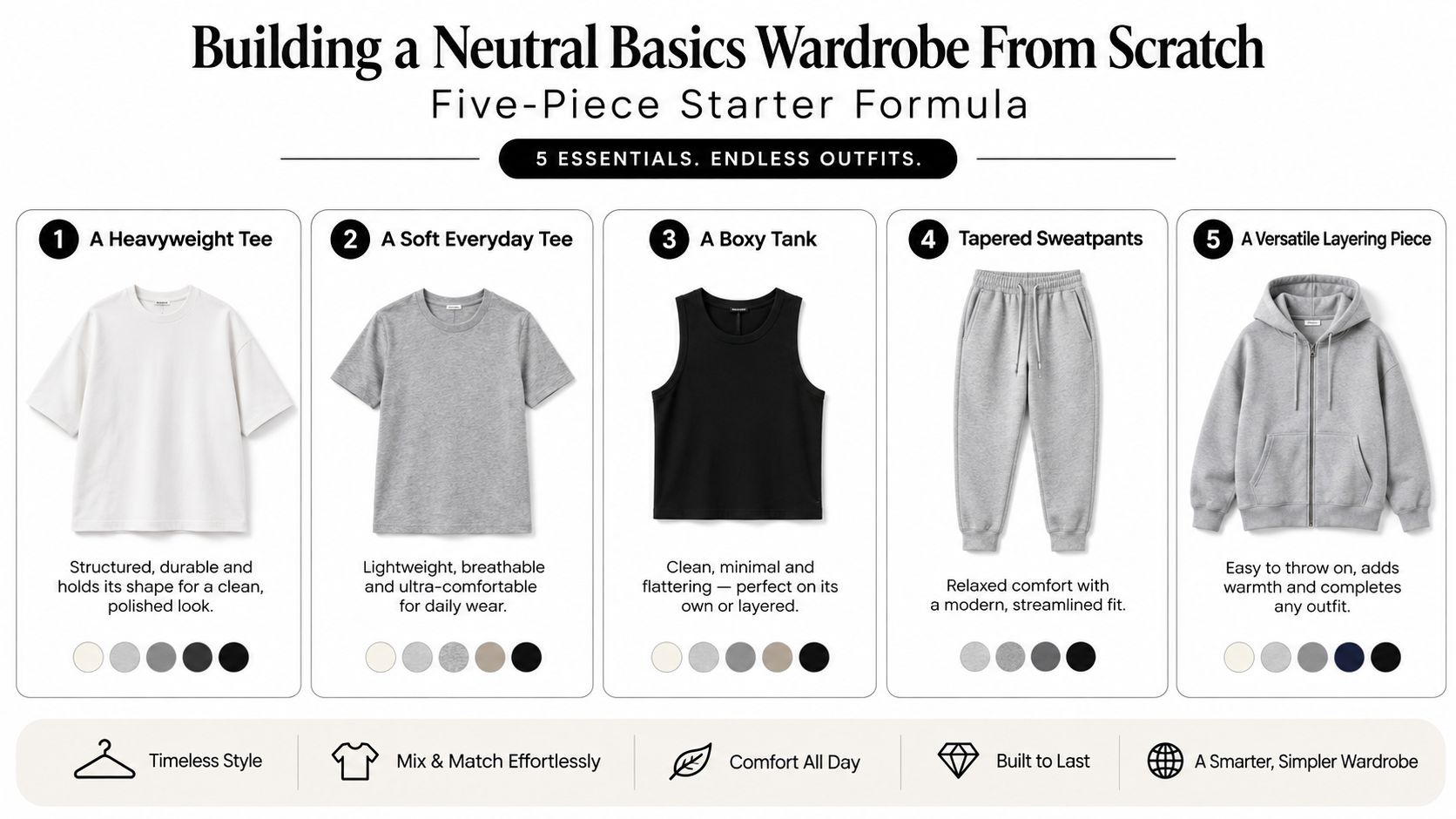
A useful starter wardrobe doesn't need a large rotation. Begin with five pieces that cover different temperatures, textures, and levels of relaxation:
- A heavyweight tee: It gives structure under a jacket and can stand alone with sweatpants or trousers.
- A soft everyday tee: Choose a lighter, easier layer for repeated casual wear.
- A boxy tank: It adds a warm-weather option and introduces a different proportion.
- Tapered sweatpants: An elastic waist and narrowed cuff create comfort without making every outfit look oversized.
- One layering piece: A zip-up hoodie, overshirt, or similar layer extends the use of the tees and tank.
Build outfits from contrast
An oversized snow-washed cotton tee can anchor an errands outfit with tapered joggers and simple footwear. The washed surface supplies visual variation, while the jogger cuff keeps the lower half controlled.
For warmer days, pair a French terry boxy tank with sweatpants or relaxed trousers. The tank's shorter, wider shape works well when the lower garment has a clean line and the fabric isn't competing for attention.
A layered look can use a soft everyday tee under a heavyweight vintage-washed frayed tee, provided the necklines and lengths don't create unwanted bulk. Alternatively, wear the heavyweight tee beneath an open zip-up layer for transitional weather. The point is to let fabric weight create the difference rather than relying on multiple colors or strong logos.
Essentials-focused labels such as 99 Collection organize their catalog around staples including cotton T-shirts, tanks, and sweatpants. You can browse the general clothing collection to compare those categories and inspect the details of individual pieces.
Protect the fit you chose
Cotton can change with washing, especially when heat is involved. Follow the care instructions, avoid assuming every garment should be dried on high heat, and check whether the product description warns about shrinkage. Wash finishes and frayed details may also change subtly over time, so laundering gently helps preserve the intended surface.
Before buying multiples, wear and wash one piece if possible. Check whether the shoulder stays comfortable, whether the hem lands where you expected, and whether the waistband remains supportive. A wardrobe becomes predictable through this kind of testing, not through collecting many labels.
The Takeaway on Fit, Function, and Confidence
Gender-neutral clothing for adults works best when it solves an ordinary wardrobe problem. You want a tee that sits comfortably across the shoulders, a tank that doesn't require constant adjustment, or sweatpants that move easily while retaining a clean shape. Those needs exist before the product is assigned a category.
The most useful shift is to treat neutrality as a design quality rather than a promise of universal fit. A garment can be neutral in its styling and still need careful sizing. It can suit different shoppers and still have a specific shoulder width, body length, rise, or leg shape.
Keep this checklist nearby
- Read the cut: Identify whether the piece is oversized, boxy, or regular before choosing a size.
- Measure your body: Chest, shoulders, waist, and preferred length give you more information than a familiar size label.
- Check the fabric: Weight, stretch, texture, and wash finish affect how the silhouette behaves.
- Balance proportions: Pair broad volume with a tapered or cleaner line elsewhere.
- Test before expanding: One successful tee tells you more about a brand's measurements than a large untested order.
The contrarian lesson is that this category may succeed less as a statement category and more as a fit-and-function category. Shoppers need measurement guidance, item-specific fit notes, and consistency across repeat purchases. They don't need every garment to make the same visual argument.
You also don't have to rebuild your entire wardrobe at once. Start with one piece whose measurements are clear, choose the silhouette deliberately, and judge it by how comfortably it works across your real routines. Confidence often follows from removing uncertainty, not from wearing something more dramatic.
99 Collection offers contemporary unisex staples including cotton T-shirts, sweatpants, and tanks with minimalist styling, vintage washes, and snow-washed finishes. Visit 99 Collection to explore a small set of gender-neutral basics and choose one piece whose measurements and silhouette fit the way you dress.