

Have you ever bought a T-shirt because the label says “heavyweight,” only to discover that it's merely stiff, oversized, and uncomfortable? Fabric weight matters, but it doesn't tell the whole story. The knit, cotton quality, cut, finishing, and care routine decide whether a heavyweight cotton T shirt becomes a dependable wardrobe staple or a disappointing boxy mistake.
A good heavy tee feels substantial when you fold it, holds a clean shoulder line when you wear it, and stays opaque without feeling like cardboard. This guide follows the garment through its full lifecycle, from reading GSM and ounces on a product page to choosing a flattering silhouette and washing it without letting shrinkage change the fit.
Table of Contents
- Why a Heavyweight Cotton T-Shirt Feels Different the Moment You Pick It Up
- What Heavyweight Means in GSM and Oz per Square Yard
- Trade-Offs of Heavier Cotton
- How to Judge Quality Before You Buy
- Finding the Right Fit and Silhouette
- How to Style a Heavyweight Cotton T-Shirt
- Washing, Drying, and Keeping the Weight for Years
- Choosing the Heavyweight Tee That Is Right for You
Why a Heavyweight Cotton T-Shirt Feels Different the Moment You Pick It Up
You notice the difference before you put it on. A freshly laundered lightweight tee slips through your hands and collapses into a soft heap. A heavyweight cotton T-shirt lands with more presence. The hem drops cleanly, the body resists folding in on itself, and the shoulders keep a visible line instead of draping limp.
That sensation comes from a denser cotton jersey construction. Fabric with more mass per area has more body, so it can support a silhouette rather than following the shape underneath it. The practical result is a shirt that often looks more like a complete top layer than an undershirt.
The useful test: Don't ask only whether a T-shirt feels heavy. Ask whether its weight helps the garment hold the shape you want.
The same quality can also create problems. A thick tee may feel warm, take longer to dry, and look awkward if the pattern is too wide for your frame. Heavy fabric doesn't rescue poor proportions. In fact, it can make oversized sleeves, a low armhole, or a stretched collar more obvious because the material stands away from the body instead of hiding inside a soft drape.
This guide will help you identify the difference. You'll learn how GSM and oz/yd² describe fabric weight, why a dense knit improves opacity and structure, and which construction details reveal whether the shirt was designed thoughtfully. You'll also compare straight, boxy, and drop-shoulder fits before putting together practical outfits.
The final part matters just as much as the buying decision. Pure cotton jersey still shrinks and relaxes with washing, even when the shirt feels exceptionally substantial. The right routine, including temperature, drying method, and storage, protects the collar, shoulders, hems, and overall length long after the first wear.
What Heavyweight Means in GSM and Oz per Square Yard
How can a number on a product label tell you whether a T-shirt will feel substantial? Start with the unit, then connect it to the fabric in your hand.
GSM means grams per square meter. It measures the weight of the fabric itself, not the finished T-shirt. Oz/yd² means ounces per square yard, a unit used on many American apparel listings. Both describe fabric mass per area, but they use different measurement systems.
The comparison is similar to paper. A thin sheet bends easily, while cardstock has more body and resists collapsing. GSM and oz/yd² place a T-shirt along that same spectrum before product photography or words such as “premium” influence your judgment.
Apparel references commonly place heavyweight cotton T-shirts around 5.3 to 7.5 oz/yd², or approximately 180 to 254 g/m². A 6.0 oz/yd² fabric is about 203 g/m², while 7.1 oz/yd² and above is often treated as super-heavyweight, according to this fabric-weight reference for heavyweight T-shirts.
Another industry convention starts heavyweight at 200 GSM, with common heavyweight ranges around 220 to 280 GSM, or about 6.5 to 8.2 oz/yd². Summer-weight tees generally sit closer to 120 to 180 GSM, as described in this heavyweight T-shirt construction guide.
Compare the number with the sensation
| Category | GSM Range | Oz/yd² Range | Typical Feel | Best Season |
|---|---|---|---|---|
| Lightweight | 120–150 GSM | About 3.5–4.4 oz/yd² | Soft, flexible, airy | Hot weather |
| Midweight | 160–190 GSM | About 4.7–5.6 oz/yd² | Balanced and easy to layer | Most conditions |
| Heavyweight | 200–254 GSM | About 5.9–7.5 oz/yd² | Dense, opaque, structured | Mild weather, layering |
| Super-heavyweight | 254 GSM and above | About 7.1 oz/yd² and above | Very substantial and firm | Cooler weather, structure-focused outfits |
Use the table as a comparison language, not a complete quality score. Two shirts with the same GSM can feel different because yarn, knit density, finish, and pattern change the result. A 240 GSM tee will generally feel more substantial than a 140 GSM tee, but its cut decides whether that mass looks clean or cumbersome.
Read the product description carefully. Check the number and unit, then confirm whether the listing means fabric weight or finished garment weight. If a measurement chart is available, compare chest, body length, shoulder, and sleeve dimensions alongside GSM. Weight helps explain the fabric, while measurements tell you how it will sit on your body. This guide to thick cotton T-shirts for men can also help you build the vocabulary for comparing product pages.
Trade-Offs of Heavier Cotton
Wondering whether a heavier tee is automatically better? Heavyweight cotton gives a T-shirt more structure, but that structure changes warmth, breathability, movement, and drying time. You are choosing a balance of opacity, shape retention, durability, and comfort rather than buying more fabric.
What you gain
The clearest benefit is opacity. Dense heavyweight jersey is less likely to reveal an undershirt, skin tone, or body outline, particularly in light colors. That makes the tee easier to wear as a visible top instead of relying on it only as a base layer.
You also get a more structured drape. A thin tee tends to follow movement and fold around the torso. A heavier tee hangs with more definition, helping the hem and shoulder line look cleaner. Straight, relaxed, and slightly boxy patterns usually make good use of that stability.
A substantial knit can provide a steadier printing surface, so graphics may look clearer when the body does not collapse around them. Print quality still depends on the ink, application method, and finishing process. Heavy fabric may handle repeated everyday wear well, but fiber quality and construction matter more than weight alone.
What you give up
Breathability is the most noticeable compromise. Air passes through a lightweight tee more easily, while dense cotton is closer to trying to sip air through a thick towel than a thin cloth. During activity, the shirt can feel warmer and may dry more slowly after sweat or rain.
Direct sun adds another problem. Dark, substantial cotton can absorb heat and feel heavier during a hot afternoon. A heavyweight tee often works better under an overshirt or jacket in transitional weather than as a solo shirt during peak heat. It can still suit a cool summer evening, but it is not the automatic choice for every warm climate.
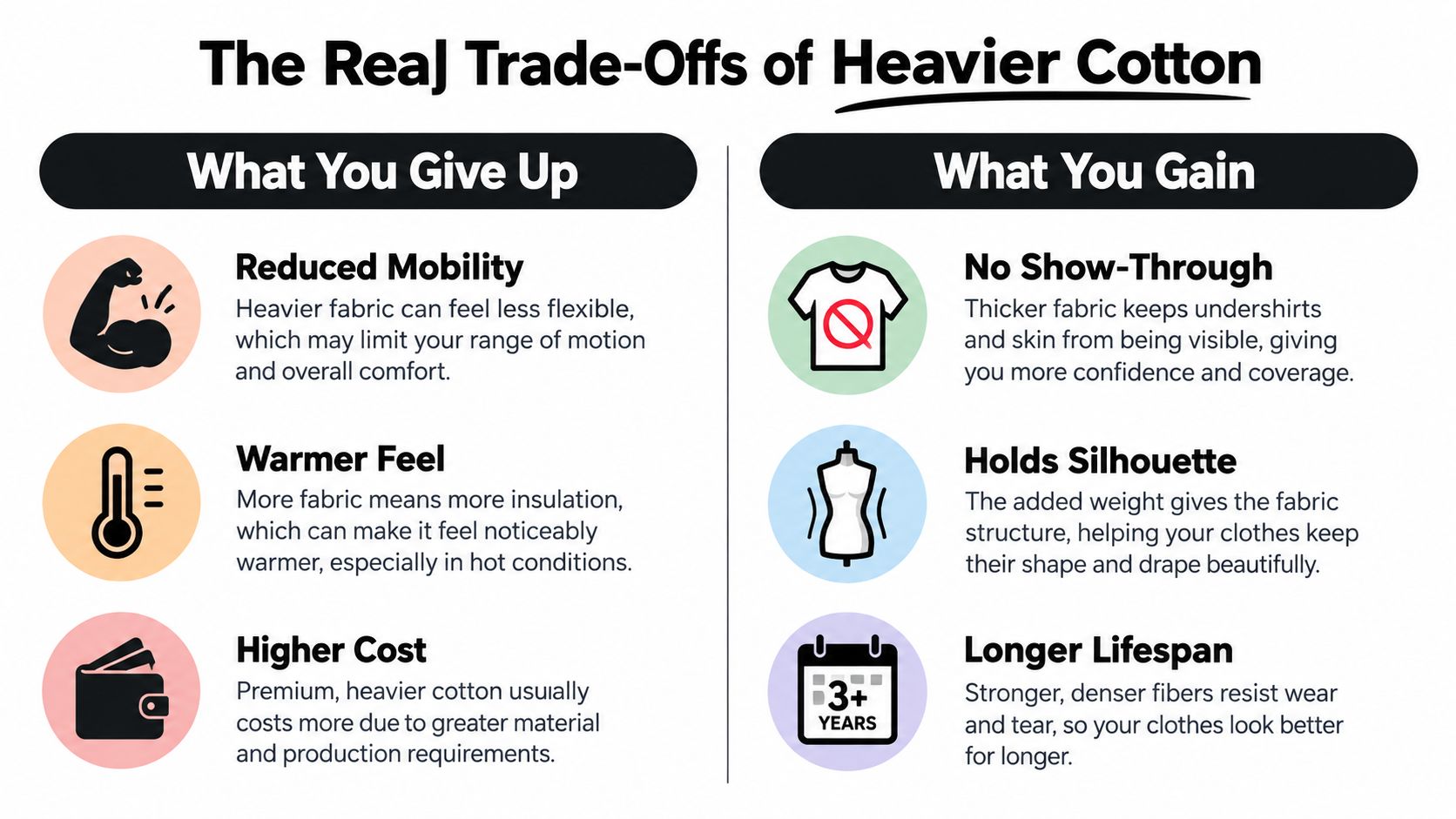
A new shirt may also feel firm during its first wears. Washing and regular use can soften that stiffness, especially if the garment was washed or brushed during production. If you want a fluid, immediately soft tee, midweight cotton may be a better match.
Best use case: Choose heavyweight cotton when you want the T-shirt to act as a visible top, not merely as a thin layer beneath something else.
Weight can affect movement too. Wide sleeves and a low armhole may combine with a firm knit to limit how freely the garment swings. A well-balanced pattern can remain comfortable despite its density, so judge the complete garment, not just the fabric specification.
For a visual explanation of how weight changes a tee's advantages and limitations, watch the following overview.
How to Judge Quality Before You Buy
A high GSM number can still describe a mediocre T-shirt. Quality comes from the relationship between yarn, knit, finishing, and sewing. Start with the fabric, then inspect the places that take stress.
Start with the knit
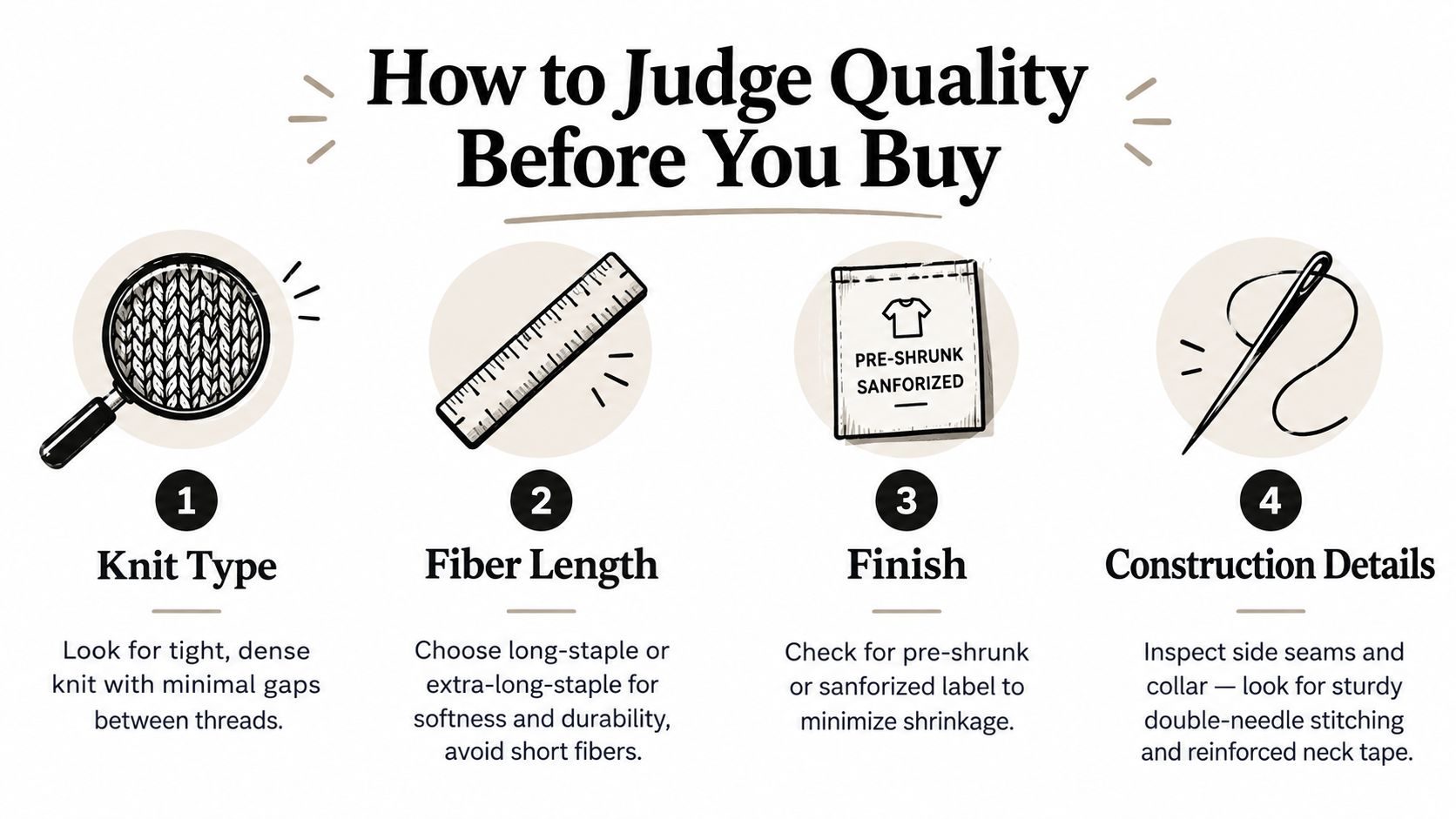
Most heavyweight tees use single jersey, a familiar T-shirt knit with a smooth face and a slightly textured reverse. The gauge, yarn size, and knitting tension influence whether that jersey feels soft, compact, springy, or rigid. Look for a tight, even surface with minimal gaps between threads, especially when you hold a light color up to indoor light.
Fiber length matters next. Long-staple and extra-long-staple cotton can produce smoother yarns with less loose fiber at the surface, while shorter fibers can feel fuzzier and become more prone to pilling. Terms such as combed cotton and ring-spun cotton describe processing or yarn formation, so read them as useful clues rather than automatic proof of quality.
Check the finish and measurements
A product page should tell you more than “heavy cotton.” Look for a stated figure such as 203 GSM, 240 GSM, or a corresponding oz/yd² specification, then check whether the fabric is pre-shrunk, sanforized, garment-dyed, or garment-washed. Pre-shrinking can improve sizing consistency, while garment dyeing and washing can give the shirt a softer, lived-in hand.
In person, pinch the fabric between your fingers. It should feel dense and even, not merely rigid. Release it and check whether the surface returns without looking distorted. Hold the shirt against a light background to judge opacity, then inspect the collar, shoulder seams, sleeve hems, and bottom hem.
Look at the sewing
Useful construction tells include:
- Neck tape: A reinforced strip inside the shoulder and neck seam can help stabilize the collar area.
- Double-needle hems: Parallel stitching at sleeve and bottom hems gives those edges a more secure finish.
- Side seams: Side-seamed bodies can offer controlled shaping, while tubular bodies create a straighter, uninterrupted torso. Neither is automatically superior.
- Collar stitching: The rib should sit flat and match the body's visual weight rather than looking thin and underbuilt.
Finding the Right Fit and Silhouette
Fabric weight can't tell you whether a T-shirt will flatter your body. The pattern decides where that weight sits, and the shoulder seam is usually the most revealing measurement.
A classic straight fit keeps the side seams relatively direct and works as an everyday foundation with denim, chinos, or shorts. A relaxed boxy fit uses more width and often a shorter body, creating a modern shape that works well for layering. A modern fit follows the torso more closely and can sit neatly beneath a jacket. An oversized drop-shoulder fit moves the shoulder seam down the arm for a deliberate streetwear proportion.
| Fit Type | Best For | Shoulder Seam | Body Shape |
|---|---|---|---|
| Classic straight | Everyday wear and simple layering | At the natural shoulder | Balanced and direct |
| Relaxed boxy | Casual outfits and wider trousers | At or slightly beyond the shoulder | Wider body, shorter visual length |
| Tailored modern | Jackets, smart-casual outfits | Close to the natural shoulder | Closer to the torso |
| Oversized drop-shoulder | Streetwear and relaxed styling | Deliberately dropped | Broad, loose, substantial |
Measure the shoulder before the chest
Align the seam with the bony point of your shoulder for a clean, conventional look. Drop it by roughly one to two inches for a more pronounced streetwear read. That measurement is especially important in heavyweight cotton because the firm fabric makes the seam's position visible instead of allowing it to collapse softly.
Neckline choice changes the balance near your face. A crew neck offers the most familiar proportion, a scoop neck opens more space around the collarbone, and a mock neck adds vertical emphasis. Wider collarbones may carry a broad crew neck comfortably, while a narrower frame can benefit from a closer neckline that prevents the shirt from looking too expansive.
Sleeve length and cuff width matter too. A short sleeve ending high on the upper arm can make a boxy body look sharper, while a longer sleeve reinforces a relaxed silhouette. If the cuff stands away from the arm, the shirt will look wider than its chest measurement suggests.
Sizing also depends on finishing. Pre-shrunk fabric and raw cotton won't behave identically after laundering, so read the care information and compare the garment measurements with a T-shirt you already like. For broader unisex proportions, this unisex cotton T-shirt guide offers another useful comparison point.
How to Style a Heavyweight Cotton T-Shirt
Can one T-shirt carry an entire outfit? A heavyweight tee often can, because its dense jersey supplies structure and visual weight before you add accessories. Start with a simple formula: heavyweight cotton T-shirt, rigid or raw denim, leather or canvas boots, and one piece of metal. The clothing works like a balanced frame, so the remaining pieces can stay restrained.
Three outfits that use the fabric well
For workwear, choose a straight or relaxed tee and tuck it into carpenter pants. Add chore boots and keep the belt practical. The shirt works like a simpler henley, giving sturdy trousers a substantial upper half without another buttoned layer.
For smart casual, wear a clean white heavyweight tee under an unstructured blazer. Pleated trousers and loafers set the firm cotton jersey against softer jacket fabric. Keep the neckline flat and the body close enough to prevent bunching beneath the lapels. A fitted modern proportion keeps this combination neat without making the tee feel delicate.
For layered streetwear, place a black heavyweight tee beneath a flannel overshirt. Cropped trousers and simple sneakers stop the lower half from becoming too heavy. A drop-shoulder tee suits the outfit, provided the overshirt has enough room across the arms.
Style principle: Let one garment carry the volume. If the T-shirt is oversized, keep at least one neighboring piece cleaner and closer to the body.
Color changes how fabric weight appears. Bone, oxblood, forest, and charcoal give thick cotton a rich surface because dense fabric holds saturated color with visual depth. These shades can look more considered than the same colors on flimsy jersey, especially when the outfit uses simple shapes.
Seasonal use follows conditions rather than the calendar. Heavyweight cotton makes a useful base layer under knitwear or outerwear in winter, and it can stand alone on a cool summer evening. In humid climates above 85°F, choose a lighter fabric for daytime comfort. Dense cotton retains more warmth and dries more slowly, so the outfit should leave room for airflow when the weather is hot.
Washing, Drying, and Keeping the Weight for Years
Heavyweight cotton needs a care routine that respects its density. Wash the shirt in cold water, 30°C or below, on a gentle cycle with mild detergent. Turning it inside out reduces abrasion on the visible surface, especially when the shirt has a smooth finish, print, or dyed effect.
Pure cotton jersey can shrink and relax even when it feels thick. One technical guide reports about 7% lengthwise shrinkage at 200 GSM after a 40°C prewash, while untreated pure cotton jersey can show 5 to 10% lengthwise shrinkage and 3 to 6% widthwise shrinkage, with weak recovery when elastane isn't present, according to this cotton jersey shrinkage and quality guide. That's why pre-shrinking, controlled tolerances, and careful drying matter more than the word “heavyweight” on the label.
Build the routine around low heat
Air drying is the safest default. Lay the shirt flat on a rack when possible, or place it over a hanger in a way that doesn't pull the damp shoulders out of shape. While it's still damp, straighten the side seams, smooth the hem, and restore the collar before leaving it to dry.
If you must use a dryer, select low heat and remove the tee while it's slightly damp. A high-heat cycle can compact cotton fibers and fix unwanted shrinkage into the garment. Fold the shirt for long-term storage rather than leaving it on a hanger, which can stretch the neck and distort the shoulders.
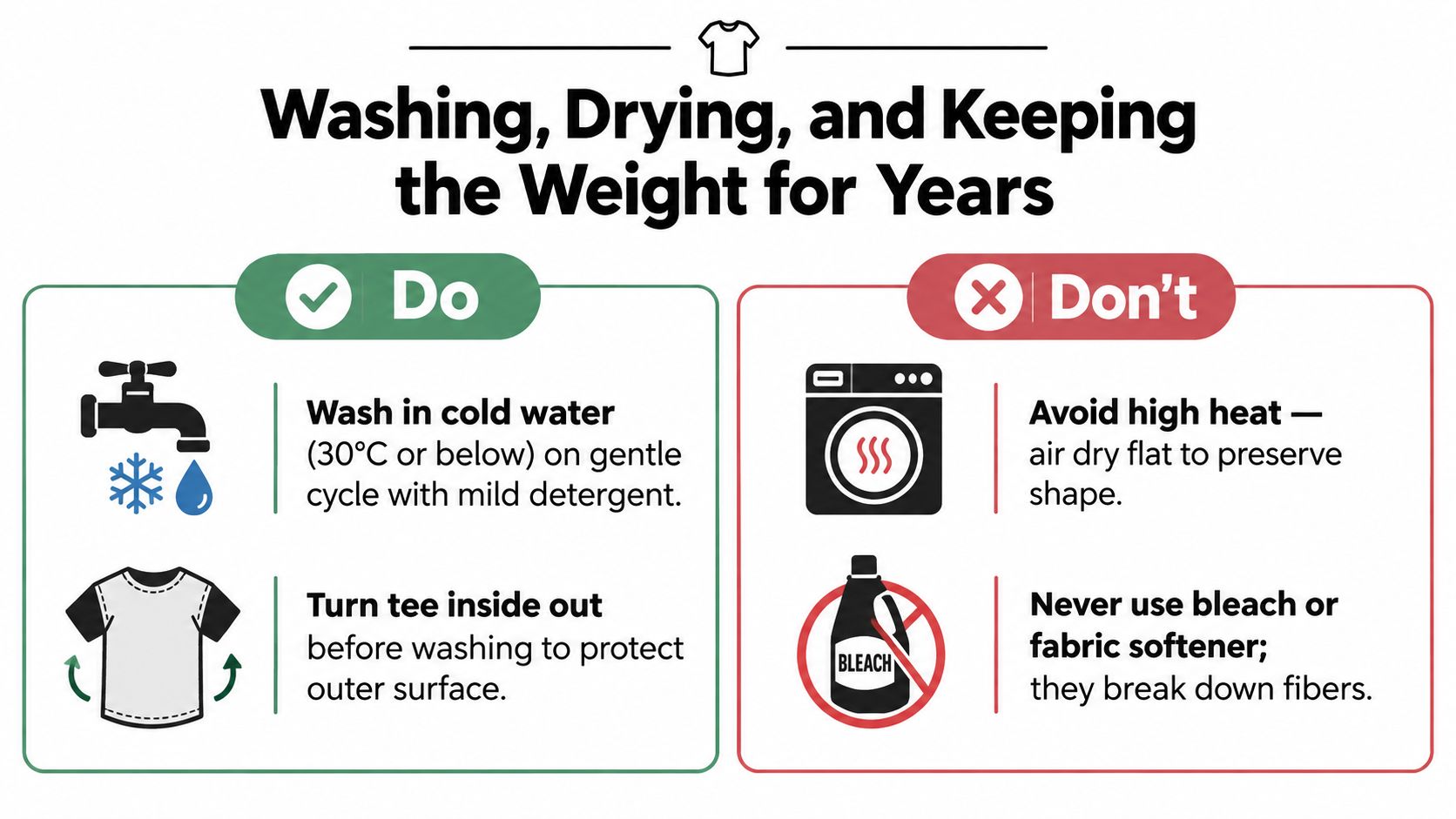
Avoid bleach and fabric softener. Bleach can weaken fibers and alter color, while fabric softener can coat the surface and change the way cotton absorbs moisture. A mild detergent and gentle handling usually preserve the fabric's original hand better.
Before buying, read the care label instead of assuming all cotton behaves alike. A garment such as a vintage wash T-shirt may have a deliberately softened surface, so washing it aggressively can change its appearance faster than careful cold washing.
Choosing the Heavyweight Tee That Is Right for You
Which heavyweight cotton T-shirt fits your life, not just your preference for a thicker fabric? Start by matching fabric weight, fit, construction, and care requirements to your routine. 200 to 240 GSM often works across seasons, while 260 GSM and above gives more structure and opacity in cooler conditions, with less airflow.
Choose long-staple cotton, Pima, Egyptian cotton, or combed ring-spun cotton if you prefer a smoother hand and less surface fuzzing. Decide on the silhouette before the size: a relaxed boxy cut leaves room for layering, a classic straight cut suits everyday wear, and a closer fit sits more neatly beneath a jacket.
Use a T-shirt you already like as your measuring reference. Compare the shoulder seam, neckline, body length, and sleeve width. Then check the care tag. High-heat tumble drying can cause more dimensional change than careful washing of a pre-shrunk shirt, and a heavier tee may also take longer to dry.
The best choice feels substantial in your hand, hangs cleanly across the chest, and stays comfortable through repeated wear. Weight starts the decision, not finishes it.
99 Collection offers contemporary unisex staples, including heavyweight, vintage-washed, snow-washed, and minimalist cotton T-shirts. Visit 99 Collection to compare silhouettes and finishes, then match one to your preferred weight, proportions, and care routine.