

Why do some cotton tees feel like they were cut from workwear, while others turn soft and limp before the season changes? The answer usually isn't just “better cotton.” It's a mix of fabric weight, knit structure, finishing, and care, and those details show up in the way a shirt sits on the shoulders, hangs from the hem, and keeps its neckline from warping.
Heavyweight cotton T-shirts sit in that sweet spot where a shirt can feel substantial without becoming costume-like. The tricky part is that different guides use different thresholds, so a shopper can read three descriptions and get three answers. A practical buyer needs a simple framework that turns GSM, ounces, climate, and fit into one decision instead of a guessing game.
Table of Contents
- Why Some Cotton Tees Feel Built to Last
- What Heavyweight Means in GSM and Ounces
- How Heavyweight Cotton T-Shirts Are Built
- Choosing the Right Weight for Your Climate and Style
- Shrinkage, Care, and Long-Term Durability
- The Tradeoff Between Comfort and Structure
- A Practical Buying and Styling Checklist
Why Some Cotton Tees Feel Built to Last
Why does one cotton tee hold its shape while another starts looking tired after a few wears? The answer usually shows up in the fabric's mass, knit, and finish. Those details affect how the shirt sits on the shoulders, hangs at the hem, and keeps the neckline from stretching out.
A tee that still looks clean after repeated wear usually gives itself away on day one. The collar sits flat, the body hangs instead of clinging, and the fabric has enough density that light does not shine through it easily. That is the appeal of heavyweight cotton T-shirts, they are made to look intentional, not flimsy.
The numbers help, but the feel matters more. A shirt in the 6 to 7 oz/yd² range, roughly 180 to 200 GSM, is already in the heavyweight zone by mainstream guidance from Printful t-shirt weight guide. In practical terms, that weight gives the tee more body, so it resists droop and reads as more structured at the neck and shoulder.
What wearers notice
The first clues are tactile. A heavier shirt feels fuller in the hand, lands with more drape across the chest, and gives the neckline a firmer edge. That does not mean it is stiff. It means the fabric has enough mass to behave like a garment, instead of a thin layer that disappears on the body.
There is also a broader market signal. Cotton T-shirts are a major global category, with the U.S. cotton T-shirt market estimated at $29.853 billion in 2023 and China at $13.297 billion in the same year, while broader reports put the global cotton T-shirt market at $15.8 billion in 2024 and project $24.93 billion by 2033 at 5.2% CAGR from 2026 to 2033 (ReportLinker dataset). That scale matters because tees are a core wardrobe item, so small differences in feel and build show up quickly in daily wear.
Practical rule: if a tee feels good for one wear but collapses after washing, the problem usually is not the logo or the color, it is the fabric mass and construction doing too little work.
The simplest way to shop is to ask what the shirt should do on your body. If you want a tee that stays polished under a jacket, holds a boxier silhouette, or feels more substantial in the hand, heavyweight cotton deserves attention. If you want something nearly weightless for heat and movement, that is a different lane entirely.
What Heavyweight Means in GSM and Ounces
Different brands draw the line in different places, which is why heavyweight can sound vague instead of helpful. One sourcing guide places heavyweight tees around 6 to 7 oz/yd², another uses 180 to 220 GSM, and another pushes the category much higher, even treating 340 GSM as a heavyweight starting point in some cases (Merchize heavyweight T-shirt guide). The label changes, but the buyer experience is the same problem, you are trying to figure out how a shirt will hang, feel, and breathe.
A buyer-friendly definition
A clearer way to shop is to sort tees by how they behave on the body, not by the marketing word on the tag.
| Weight Band | GSM Range | oz/yd² Range | Typical Feel | Best For |
|---|---|---|---|---|
| Lightweight | Under 150 | Under about 4.4 | Airy, soft, less structured | Hot weather, thin layering |
| Midweight | 150 to 200 | About 4.4 to 5.9 | Balanced, everyday wearable | Most daily basics |
| Heavyweight | 200 to 250 | About 5.9 to 7.4 | Substantial, structured, more opaque | Standalone tees, streetwear, premium basics |
| Ultra-heavy | Above 250 | Above about 7.4 | Very dense, boxy, strongly shaped | Statement fits, colder climates, very structured looks |
The conversion is straightforward. In apparel sourcing, 1 oz/yd² is about 33.9 GSM, so the two systems are just different ways of expressing fabric mass. That matters because a listing in ounces can be translated into the way a shirt will feel on your back, across the chest, and at the hem.
Confusion usually starts when the word heavyweight is used for both fabric weight and style intent. A shirt can be heavy enough to feel substantial in daily wear, yet still stay easy to move in. The same label can also point to a much denser, boxier tee that works best as the main piece in an outfit.
Buyer's shortcut: once a tee crosses 200 GSM, it usually starts to feel distinctly substantial. Above that point, the tradeoff becomes clearer, more structure usually means less breathability.
That is why the band matters more than the label. A 200 to 250 GSM shirt is often the most versatile heavyweight range for most buyers, while anything above that leans harder toward cool-weather wear or a more deliberate silhouette. The goal is not to chase the heaviest shirt on the rack, it is to choose the lightest shirt that still gives you the shape and opacity you want.
How Heavyweight Cotton T-Shirts Are Built
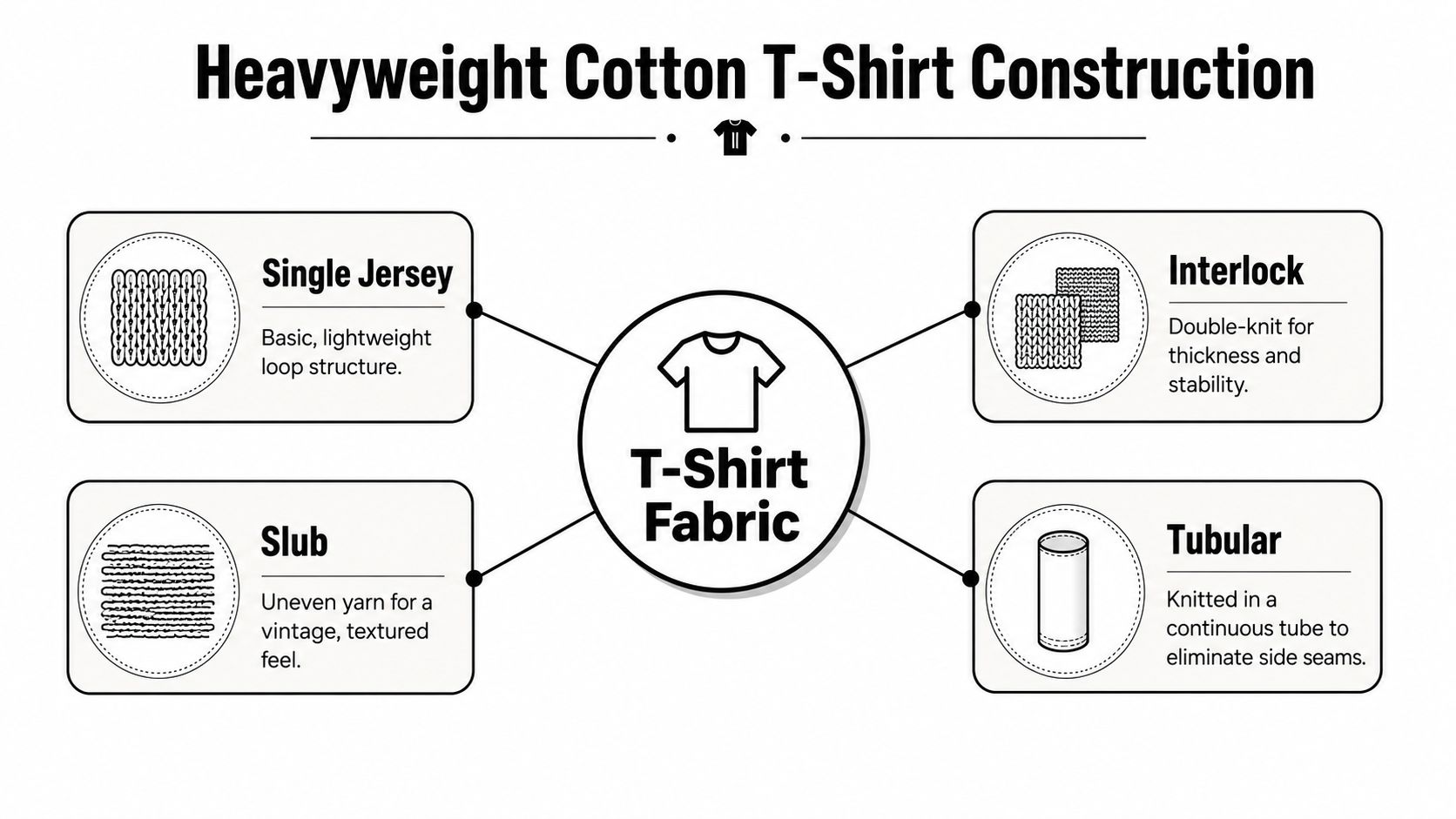
What makes one heavyweight tee feel sturdy and another feel bulky? The answer is not just fabric mass. It is how the cotton is knit, finished, and reinforced so the shirt can hold its shape through wear and washing.
Knit structure changes the whole experience
Single jersey is the baseline many people know. It feels smooth, flexible, and familiar, like a standard tee that has been given more body. In a heavier version, the knit is packed more tightly, so the shirt feels fuller without turning stiff.
Interlock goes one step further. Because it uses a double-knit construction, it adds thickness and stability, so the shirt sits more solidly and twists less. That extra structure is useful if you want a tee that keeps its line instead of collapsing after a few wears.
Other constructions change the look and feel in smaller ways. Slub cotton uses uneven yarn, which creates a slightly textured surface and a more lived-in finish. Tubular construction knits the body in one continuous tube, so there are no side seams through the torso and the shirt feels cleaner inside and out.
Finishing details are not cosmetic
Small choices around the edges can decide whether a heavy tee feels premium or just thick. A reinforced collar helps the neckline keep its shape. Taped neck seams smooth the inside finish and reduce irritation at the neck. Double-needle hems add strength where sleeves and waist openings get the most pull.
Yarn quality matters too. Long-staple cotton usually makes smoother, stronger yarns, so higher-end heavyweight tees often feel cleaner on the face of the fabric. Dye treatment changes the final character as well. Garment-dyed pieces usually look softer and more broken-in, while reactive dye tends to keep color more even and crisp.
A well-built heavyweight tee should feel dense in the hand, sit evenly on the shoulders, and spring back after you tug the hem. If it stretches out fast or feels lopsided, the label may say heavyweight, but the construction is not carrying its weight.
Choosing the Right Weight for Your Climate and Style
Which cotton tee feels right depends on more than the number on the tag. The same shirt can feel balanced in a cool office and heavy in humid weather, just as a tee that looks neat on its own may sit awkwardly under a jacket.
Match the tee to the job
For warm summers, breezy indoor spaces, and light layering under an open shirt, the sweet spot often sits around 180 to 200 GSM. That band gives a shirt enough body to look intentional, while still staying easy on the skin. It suits people who want one tee that can handle casual wear and a slightly more polished outfit.
For most year-round wear, 200 to 230 GSM is the middle ground. It adds more structure than a standard basic tee, yet it still works as an everyday piece without feeling too seasonal. If you like a shirt that keeps its shape with denim or chinos, this range usually feels the most practical.
| Weight Band | GSM Range | Best For |
|---|---|---|
| Warm-weather lean | 180 to 200 | Summer wear, light layering, soft structure |
| Year-round middle | 200 to 230 | Daily basics, most climates, balanced drape |
| Cool-weather structured | Above 230 | Jackets, streetwear silhouettes, stand-alone looks |
Think in terms of your outfit habits
Layering changes the answer quickly. If you wear tees under overshirts, hoodies, or jackets, a mid to upper-mid weight usually keeps bulk in check. If you want a tee that frames the body and hangs cleanly from the shoulder, a heavier band can help. In hot, humid weather, though, too much GSM can feel like extra work on the body.
Warm-weather shoppers often do better with shirts that breathe and dry fast, especially for active days or kids who run hot. A piece such as the Sorona quick-dry cooling kids T-shirt shows why lighter, faster-drying fabrics can make more sense than chasing weight alone.
For a simpler cotton baseline, a unisex pure cotton T-shirt shows how a tee can still feel solid without pushing into the heaviest end of the scale. The useful question is not which number sounds strongest, but which weight gives you the drape, opacity, and shoulder shape you will wear often.
Pick the lightest weight that still gives you the feel you want. That keeps the shirt useful across more outfits instead of turning it into something you only reach for in one season.
Shrinkage, Care, and Long-Term Durability
Heavyweight cotton can still shrink, and the most useful thing to know is that care matters more than the number on the tag. A heavyweight knit may resist distortion better than a thin one, but if you hit it with hot water and hot air, cotton fibers still tighten.
What to expect after washing
A practical expectation for non-pre-shrunk cotton is about 3 to 10% shrinkage depending on fabric construction and laundering, while pre-shrunk cotton is commonly closer to 3 to 5% residual shrinkage (Heavy T-Shirt shrink guide). Heat is the main trigger, and cold washing with air-drying reduces dimensional change because it limits fiber contraction. Heavier knits don't become shrink-proof, but they often keep their shape better once they've settled.
Care that protects the shirt
A gentle routine makes the difference between a tee that holds its silhouette and one that slowly warps. Cold water reduces heat stress, and air-drying keeps the fabric from being hammered by tumble heat. Hot dryers are especially rough because they combine heat with repeated motion, which can flatten the hand-feel and stress seams over time.
- Wash cold: keep the cycle gentle so cotton fibers aren't pushed into repeated heat contraction.
- Dry flat or hang: reduce seam stress and shape distortion instead of tumbling the shirt hard.
- Rotate your tees: give fibers a break between wears so one shirt isn't taking the full load every day.
- Skip fabric softener: it can coat cotton and dull the absorbency and breathability that make a dense tee comfortable.
Why heavier tees can last longer
Thicker cotton knits usually stand up better to abrasion, especially around the torso and under the arms. They also tend to recover better from normal stretching, which helps the shirt look less tired after a long day. The catch is that this durability only shows up when the wash routine respects the fabric.
A heavy tee that gets treated gently often looks better for longer than a thin one because it starts with more structure to lose. A heavy tee that gets abused can still twist, pill, or feel boardy earlier than you'd expect. The shirt doesn't need pampering, but it does need consistency.
The Tradeoff Between Comfort and Structure
Heavier cotton usually feels more substantial, but that extra density changes how the shirt behaves on your body. If you wear a tee for hours in hot weather, the added structure can start to feel like more shirt than you want.
Breathability is the first place that tradeoff shows up. A denser knit holds more warmth close to the skin, which can feel great in cooler weather and less comfortable once the day heats up. The shirt may also take longer to soften, so the first few wears can feel a little firm before the fabric settles.
When the extra weight pays off
Heavier cotton makes sense when the tee needs to hold the visual line of an outfit. It gives a cleaner outline, less cling when dry, and a more deliberate drape from shoulder to hem. Under a jacket, that same structure helps the shirt keep its shape instead of collapsing into the layers around it.
A lighter midweight tee is often the better daily pick in warmer climates or for people who run hot. You still get enough body for a clean silhouette, but you give up less comfort to trapped heat. That matters most when the shirt has to work all day, not just look good for a short stretch.
Don't buy for the label, buy for the rotation
The most useful wardrobe plan is usually a mix of weights. A denser tee for structured outfits, a midweight tee for regular wear, and a lighter option for hot days covers more situations than buying every shirt at the heaviest end.
For a different cut and finish in the same category, the unisex pure cotton T-shirt shows how comfort and structure can be balanced without chasing the highest spec on the tag. The better question is how the shirt will feel after a full day, not how dense it sounds on paper.
A Practical Buying and Styling Checklist
A heavy tee is easier to choose once you read it in layers. Start with climate, then check the shape on the body, then judge how the fabric behaves in hand and in a real outfit.
Four checks before you buy
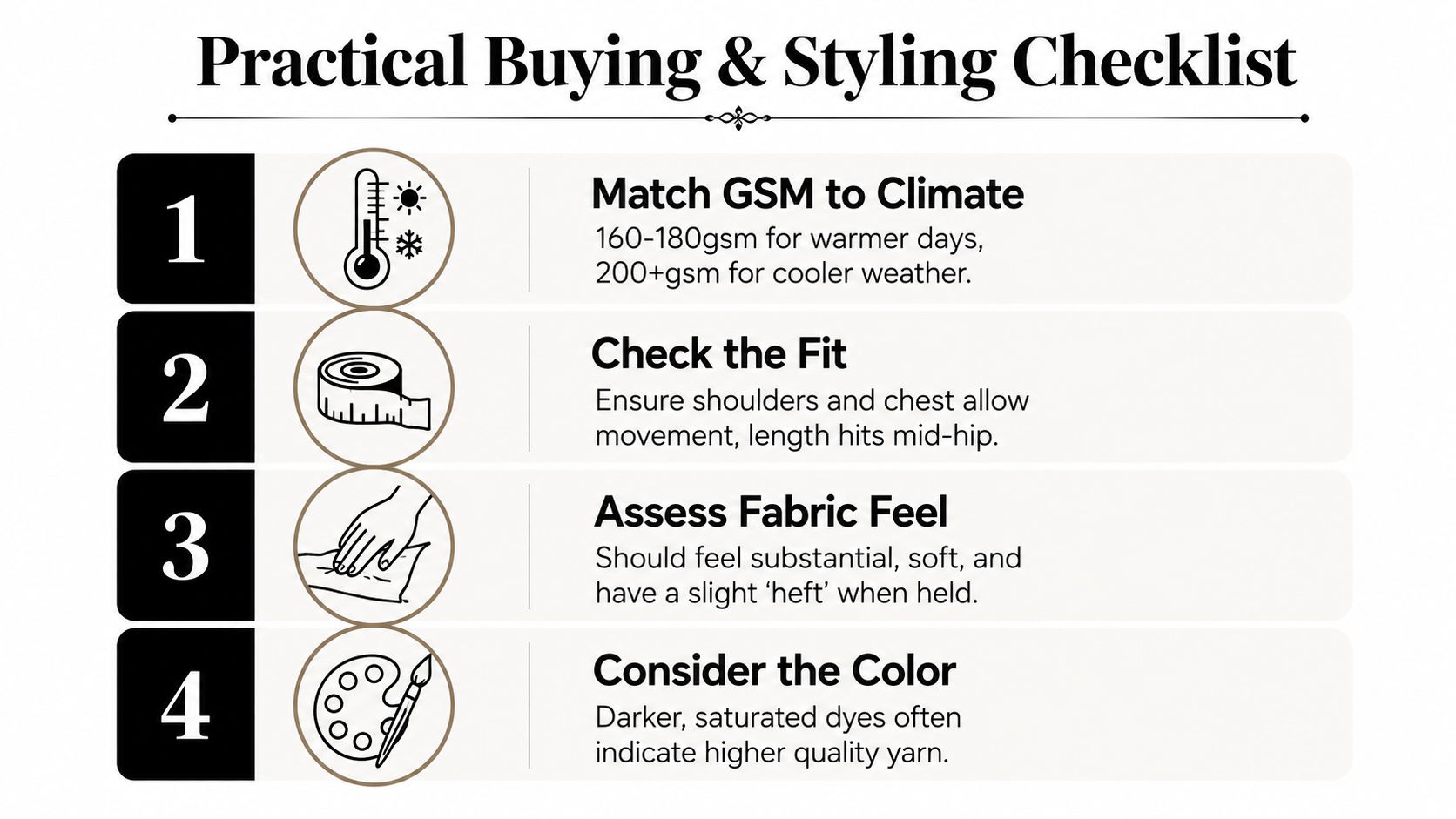
- Match GSM to climate. Lower weights usually feel easier in heat and humidity. Higher weights make more sense if you want a tee that stands away from the body and keeps its outline.
- Check the fit shape. Shoulder seams should sit at the edge of your shoulders, and the hem should fall where you wear your shirts.
- Assess the fabric feel. A solid tee feels dense in the hand, but it should still feel soft rather than cardboard-stiff. If it feels hollow, it will usually read that way on the body too.
- Plan care from day one. Wash cold, avoid the hottest dryer settings, and treat the first wash as part of the sizing process.
Styling by weight band
| Weight Band | GSM Range | Best For |
|---|---|---|
| Lightest useful tee | 160 to 180 | Warm days, overshirts, easy layering |
| Everyday heavyweight middle | 200 to 220 | Solo wear with denim or chinos |
| Strong statement weight | 230+ | Jackets, streetwear looks, visual structure |
For styling, the number matters less than the job the shirt has to do. A middle-weight tee usually works best for everyday wear because it gives enough body without feeling bulky. A heavier shirt brings a cleaner line under outerwear and a more deliberate drape when worn on its own.
Fabric finish changes the mood too. Compact combed cotton usually reads smoother and more polished, while slub adds texture if you want a shirt that looks broken-in. Side seams tend to keep the body line more fitted, while tubular construction feels simpler and more relaxed.
If you want a ready-made reference point, the Heavyweight Vintage Washed Frayed T-Shirt shows how weight and finish can work together without feeling overworked. The best tee is usually the one that fits your climate, keeps its shape, and sits naturally with the rest of your closet.
Drafted with the Outrank tool