

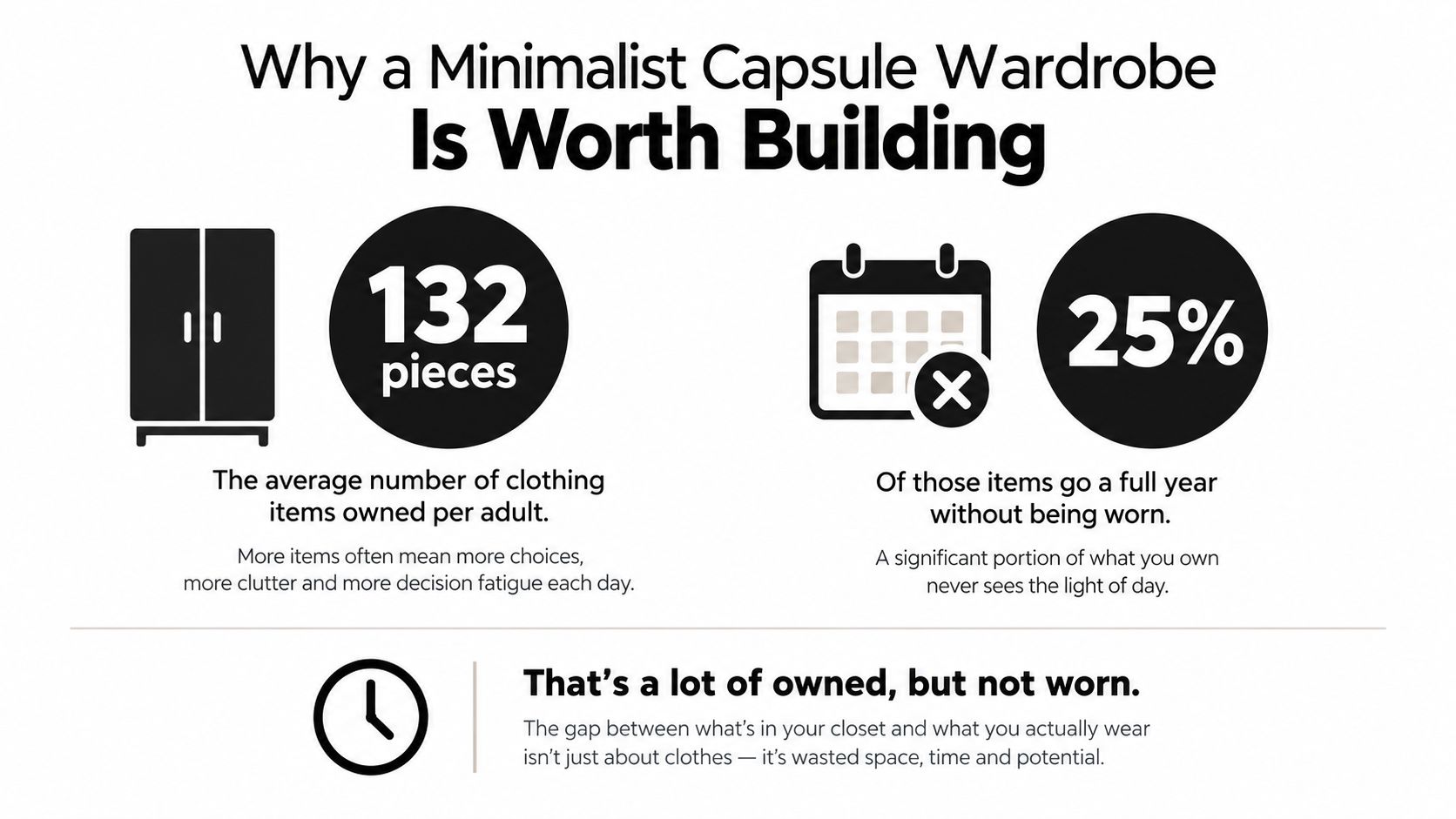
The average wardrobe contains 132.33 clothing items, yet 32.91 of them go unworn, meaning about 24.87% never make it into regular rotation, according to a 2022 global wardrobe study. That gap is the reason to learn how to build a minimalist capsule wardrobe. You probably don't need a better shopping list. You need a clearer picture of what you already wear.
A useful capsule is a working, unisex basics kit. Tees, tanks, joggers, trousers, and layering pieces earn their space by pairing easily and surviving repeated wear. The method below treats minimalism as edit and repeat, not as a race toward an arbitrary number. It also deals with the trap many capsule wardrobes create: buying several versions of the “perfect” basic until the simplified closet is full again.
Table of Contents
- Why a Minimalist Capsule Wardrobe Is Worth Building
- Audit What You Already Own Before You Buy Anything
- Pick the Right Capsule Size for Your Real Life
- Outfit Formulas That Do the Heavy Lifting
- Adding Texture and Slow-Trend Pieces Without Breaking the Capsule
- Seasonless Styling So One Capsule Works Most of the Year
- A 30-Day Launch Plan and Rules That Keep It Working
Why a Minimalist Capsule Wardrobe Is Worth Building
A minimalist capsule wardrobe solves the gap between ownership and actual wear. The global study cited above found that short-sleeve T-shirts and tops were among the larger clothing categories people owned, which makes sense. Tees and easy layers are often the pieces people reach for most, but closets commonly hold duplicates in slightly different colors, fits, and weights.
The broader fashion system makes the case for editing even stronger. The industry produces more than 100 to 150 billion individual parts each year, while annual garment consumption was estimated at 183.81 billion pieces in 2022 and projected to reach 197.32 billion by 2026, according to this fashion statistics overview. Those figures don't tell you how many pieces belong in your closet, but they do show the environment you're dressing within: high volume, frequent turnover, and constant pressure to add.
A capsule takes the opposite approach. It condenses a large clothing system into a small set of dependable garments that cover real routines. For a unisex streetwear wardrobe, that might mean heavyweight and midweight tees, tanks, joggers, one or two trousers, and layers that work across relaxed and slightly sharper outfits.
Practical rule: If an item only works with one other item, it isn't pulling enough weight for a small capsule.
The benefit isn't an Instagram-perfect rail. It's fewer morning decisions, less duplication, and faster identification of what never gets worn. The approach also exposes uncomfortable truths. Maybe the expensive shirt is too stiff for your routine. Maybe the five nearly identical white tees are all competing for the same job. Maybe your “minimalist” shopping list is just clutter with a calmer color palette.
Build around wear frequency, fabric function, and outfit compatibility. Buy only after an audit shows a specific gap. A capsule should make repetition easier, not make you feel guilty for wearing the same dependable outfit.
Audit What You Already Own Before You Buy Anything
The audit starts with an empty wardrobe, not a browser tab. Pull out every relevant garment, including pieces in laundry baskets, storage boxes, and the back of a drawer. Trying items on matters because fit, comfort, condition, and proportion often explain low wear better than color does.
Use three piles, but give each one a firm decision rule.
The regularly worn pile
Place here anything you've worn recently, wash often, pack for trips, or reach for without much thought. This pile contains your actual capsule, even if it doesn't look coordinated yet. Separate basics from special-purpose pieces, then notice the repeated characteristics: loose or fitted cuts, soft or structured fabrics, cropped or long hems, and colors that already work together.
The untouched pile
This includes garments not worn for 12 to 18 months, items that no longer fit, and clothes kept for hypothetical occasions. The time range and staged editing approach are consistent with practical capsule wardrobe guidance from Woman and Home. Donate, sell, recycle, or discard according to condition, unless you have a concrete near-term reason to keep something.
“Maybe I'll wear it someday” isn't a plan. A real plan sounds like a wedding, job requirement, or scheduled event. If that event doesn't exist, the garment is taking up space for an imagined version of your life.
The potential keeper pile
Seasonal items, sentimental pieces, occasional clothing, and garments worn only once or twice belong here. Don't force an immediate decision. Put them in a separate, visible holding area and assign a wear-by date tied to the next seasonal rotation.
After about a month, revisit the holding area. Anything you could have worn but didn't becomes a stronger candidate for removal. Expert guidance recommends staged editing and a revisit after about a month because habit can disguise low utility.
Keep a short gap list as you go. Write “midweight black layer” or “bottom that works with three tees,” not “new clothes.” The first description records a wardrobe function. The second invites browsing.
Pick the Right Capsule Size for Your Real Life
Capsule size is a practical constraint, not a personality test. Expert guidance commonly places a very tight edit at 10 to 20 pieces, while a more workable seasonal system sits around 20 to 40 pieces, as outlined in this capsule wardrobe guide. The smaller range suits short trips, controlled climates, or people happy to repeat outfits frequently. It becomes frustrating when laundry, exercise, work, and changing weather all compete for the same few garments.
Start near the lower end of the broader range and let wear reveal what is missing. Don't count underwear, sleepwear, sports equipment, or specialist protective clothing if they don't participate in daily outfits. Do count the visible garments that need to coordinate.
The central test is not the number. It is the pairing matrix:
- Every top should work with multiple bottoms.
- Every bottom should work with multiple tops.
- Each layer should serve more than one temperature or setting.
- A distinctive item should connect to the existing color and texture palette.
A guide states that 25 pieces can generate 60 or more outfits, illustrating the combinatorial value of interchangeable shapes and coordinated colors. Treat that as a design example, not a promise that every 25-piece wardrobe will produce the same result. A capsule produces variety only when the garments pair well.
| Factor | 10-20 Pieces | 20-40 Pieces |
|---|---|---|
| Best for | Travel, short seasons, highly repetitive routines | Work, exercise, social plans, and variable weather |
| Main advantage | Very fast decisions and minimal storage | More breathing room between laundry and activities |
| Main risk | Too little redundancy for real-life interruptions | Duplicates can hide inside a larger edit |
| Selection standard | Almost every item must multitask | Core items multitask, specialist pieces can have a defined role |
Lay the clothes on a bed or floor and test combinations before buying. If a proposed item doesn't close a visible gap more than once, leave it out. Start smaller, observe your routine, then add with evidence.
Outfit Formulas That Do the Heavy Lifting
A good formula removes guesswork while leaving room for fit and texture. The following combinations use tees, tanks, and joggers as anchors, with 99 Collection basics as practical reference points. The same logic works with pieces already in your wardrobe.
Formula one, heavyweight tee and joggers
Use a heavyweight tee, relaxed joggers, and clean sneakers. Tuck or half-tuck the shirt, then roll the jogger cuff slightly if the hem allows it. The tucked upper body gives structure to the relaxed bottom, while the visible ankle keeps the outfit from becoming one uninterrupted block of fabric.
Wear it for errands, travel days, or casual work settings where a relaxed silhouette fits. A thick tee also holds its shape more convincingly than a thin undershirt when worn as the main layer.
The Heavyweight Vintage Washed Frayed T-Shirt is a unisex, 100% cotton option with a listed fabric weight of 12.7 oz/yd², or 430 g/m², and a thick construction. Its drop shoulder, loose shape, and long silhouette make it a proportion-led piece, so balance it with a cleaner jogger rather than another oversized lower half.
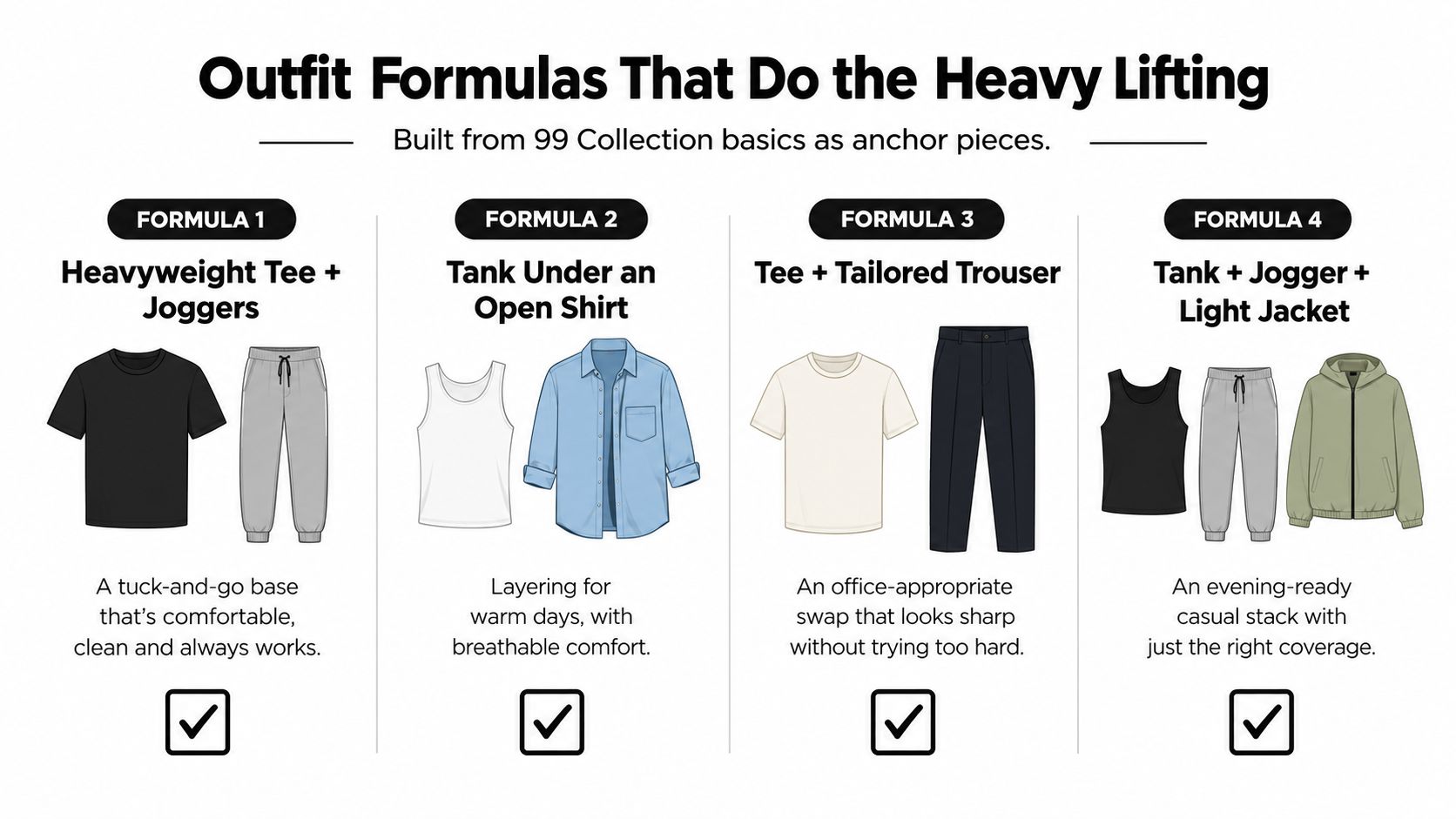
Formula two, tank under an open tee
Start with a tank, add an open boxy tee, and finish with cropped or tapered joggers. The tank creates a clean vertical center, while the open tee supplies movement and protects the outfit from looking like gymwear.
This works during transitional weather and on warm days when you want a layer you can remove. Keep the tank and outer tee close in tone for a quiet look, or use a darker tank under a washed lighter tee for depth.
Formula three, two-tone stacking
Pair a charcoal tee with a stone tee worn open over black joggers. The colors stay restrained, but the change in value gives the outfit dimension without another category of clothing.
This formula suits casual meetups and outdoor days. Use the lighter shirt as the visible frame around the darker base. If both tees have the same length and weight, the look can feel flat, so choose a small difference in hem or fabric handle.
For more ideas on proportion, layering, and restrained streetwear, see minimalist streetwear styling.
Formula four, tonal black with one texture break
Layer a black tank under a black tee and wear both with black joggers. Add one tactile difference, such as slubby cotton or waffle knit, so the outfit doesn't depend on contrasting colors.
This is useful for evening casual dressing and days when you want a sharper silhouette without formal clothing. Keep the shapes distinct: a closer tank, a straighter tee, and a jogger with a controlled hem. Tonal outfits reveal poor fit quickly, so check shoulder seams, rise, and hem length before adding more visual detail.
Adding Texture and Slow-Trend Pieces Without Breaking the Capsule
Minimalism doesn't require a closet full of smooth neutral cotton. Current 2025 capsule wardrobe coverage has moved toward more expressive but relatively restrained elements, including baggy denim, leopard print, waxed jackets, scarf blouses, pale pink, and other slow-trend directions, as discussed by Who What Wear's 2025 capsule coverage. The useful question isn't whether a piece is neutral. It's whether it can live with the clothes you already wear.
Texture often makes a capsule feel less repetitive without multiplying the number of garments. A ribbed tank, brushed fleece layer, waffle knit, slubby jersey, or washed heavyweight tee can give a familiar black, charcoal, olive, or stone outfit a different visual surface.
| Rule | Capsule-Safe Choice | Capsule-Breaker |
|---|---|---|
| Connect by color | Olive that works with black, stone, and denim | A color that needs its own matching set |
| Fill a fabric gap | One textured midweight layer | Several pieces with the same weight and role |
| Test outfit range | A top that works with at least three bottoms | A print that only suits one outfit |
| Check staying power | Something you'd expect to wear repeatedly | A micro-trend bought for novelty |
Before buying a character piece, match it against at least three existing garments. Then ask whether it fills an empty fabric or silhouette slot. If your capsule already has several medium cotton tees, another one with a slightly different wash probably isn't solving a problem.
Use the 30-wear mental test. You don't need to predict the future perfectly, but you should be able to name repeated situations where the piece belongs. A small leopard accessory or pale pink layer can work if the rest of the outfit remains simple. A loud seasonal print becomes risky when it dictates the shoes, bottoms, and outerwear around it.
For a closer look at how washed finishes can function inside a basics wardrobe, explore vintage-wash T-shirt styling. The finish should add character, not force you to rebuild the palette.
Seasonless Styling So One Capsule Works Most of the Year
A seasonless capsule rotates by fabric weight, not by replacing the whole closet. Use three practical tiers: lightweight cotton for heat, midweight jersey or knit for transitional days, and heavyweight cotton, fleece, or outer layers for cold weather. Each tier should connect to the same color anchors, such as black, white, charcoal, and stone.
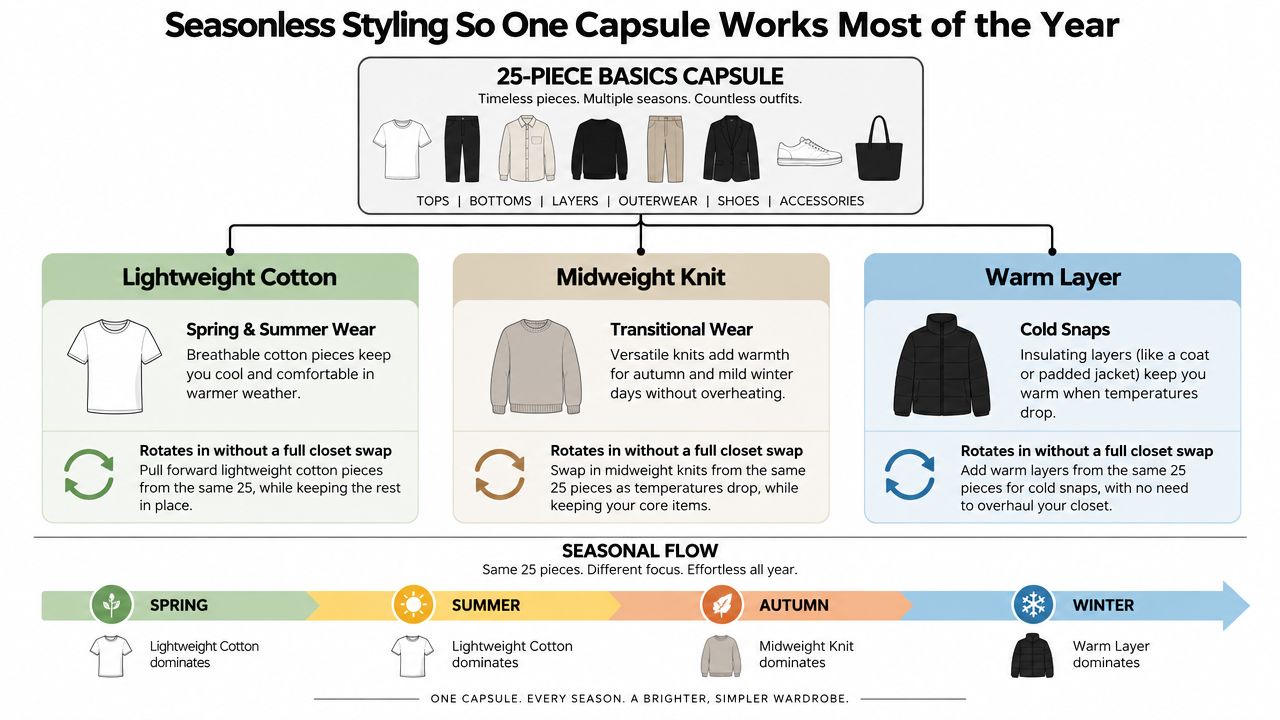
In practice, the swaps are simple:
- Warm days: Wear a lightweight tee or tank with shorts or lighter trousers.
- Shoulder seasons: Add an open overshirt or midweight tee over the same base.
- Cold spells: Put a heavyweight tee over a tank, then add a jacket or warm outer layer.
- Indoor winter dressing: Use joggers and a textured midlayer without changing your core colors.
Fabric weight is easy to assess by hand. Lightweight cotton feels pliable and folds quickly. Midweight jersey has more body and resists collapsing when held by one edge. Slubby cotton feels uneven because the yarn creates small variations across the surface. Those differences matter because two black tees can perform completely different jobs if one is airy and the other is dense.
The unisex cotton T-shirt guide is useful when comparing fit and fabric roles across a basics-led wardrobe. Read product descriptions for shape, thickness, and care rather than relying only on a color name.
Don't rebuild the capsule every season. Re-buying the same categories whenever the weather changes creates the cost and clutter the system was meant to prevent. Store only genuine off-season pieces, keep the core visible, and let layers do the seasonal work.
A 30-Day Launch Plan and Rules That Keep It Working
A capsule becomes useful when it enters daily life quickly. Stretching the edit across endless planning sessions encourages perfectionism, while buying everything at once makes it hard to distinguish a genuine gap from shopping excitement.
Week one
Complete the three-pile audit. Put the untouched pile into donation, resale, recycling, or discard bags according to condition, and move potential keepers into a clearly marked holding area. Don't buy replacements yet. You need to see what remains.
Week two
Photograph every kept piece flat or on a hanger. Create simple outfit tests using the photos, or lay the garments out physically. Mark gaps by function, such as “a layer for black joggers” or “a tee that works under the overshirt,” rather than by brand or trend.
Week three
Order only replacements that pass the pairing test. Before purchasing, write down three outfits using the proposed item and clothes you already own. If you can't produce three credible combinations, skip it.
Week four
Wear the capsule normally and record what you reach for. Note temperature, activity, laundry timing, fit problems, and pieces that remain untouched. Don't make daily changes based on one bad outfit. Look for repeated evidence.
The best capsule isn't the smallest one. It's the one that reflects the life you actually live.
Use a one-in, one-out rule for future additions. A new garment enters only when another is donated, sold, or worn out, and the replacement answers a documented need. This doesn't mean every new item must be identical to an old one. It means the total system can't expand without a deliberate decision.
Set a 30-minute monthly reset. Fold, hang, and remove items that have migrated outside their roles. Complete a fuller audit after six months, especially after a change in work, climate, exercise routine, or body fit.
Minimalism can improve how people feel about their wardrobes, but it can also increase attention toward fashion and encourage more buying. A study of a three-week capsule-wardrobe intervention reported increased subjective happiness, while survey data from 318 women connected minimalism with wellbeing, sustainable values, and fashion purchase engagement, as described in this research publication. That combination explains the “perfect basics” trap. A calmer closet can make you more interested in refining it.
Write your rules before you shop. The audit, three-outfit test, and one-in-one-out limit keep appreciation from turning into endless replacement.
99 Collection offers unisex casual staples including cotton T-shirts, tanks, and sweatpants, with washed and vintage-inspired treatments that can support a basics-led capsule. Review the current range at 99 Collection, then compare each piece against your actual outfit gaps before adding anything.