

You put on an oversized T-shirt, check the mirror, and something feels wrong. The shirt is comfortable, but the sleeves swallow your arms, the hem cuts across your legs, and your relaxed jeans turn the whole outfit into one soft rectangle. The problem usually isn't the T-shirt. It's the lack of a deliberate proportion.
Learning how to wear an oversized T shirt starts with treating the garment as a shaped silhouette, not a standard tee bought several sizes too large. Check where the shoulder seam falls, how far the hem extends, and whether your lower half gives the outfit a visual anchor. Once those checks become routine, you won't need a completely new wardrobe. You'll need better decisions with the pieces already in it.
Table of Contents
- Why Oversized Tees Feel Hard to Style and How to Fix It
- Finding Your Intentional Fit Before You Style
- Balancing Proportions With the Right Bottoms
- Tucks Layers and Accessories That Add Shape
- Five Ready to Wear Outfit Recipes for Every Day
- Making the Look Yours and Keeping It Sharp
Why Oversized Tees Feel Hard to Style and How to Fix It
An oversized tee looks simple on a hanger, but the extra fabric changes every relationship around it. A conventional T-shirt usually follows the body closely enough that almost any bottom can work. An oversized version adds width through the chest and shoulders, length through the torso, and often a dropped shoulder that changes the line of the sleeve.
That silhouette grew out of the street and youth cultures that made relaxed clothing visible. Oversized T-shirts became mainstream in the 1980s and 1990s, shaped by hip-hop, skate, and grunge, then returned strongly in the 2020s as a gender-neutral, comfort-first staple. Independent trend coverage connects that history with growing search interest in oversized apparel, but the styling lesson is more useful than the trend label: modern oversized tees are intended to look designed, not accidentally too large.
Practical rule: Extra volume needs one clear counterweight. If the tee is broad, the bottom, hem treatment, or accessory should provide definition.
The most common mistake is wearing a large top with an equally loose bottom and expecting the shoes to rescue the outfit. Shoes can ground the look, but they can't always restore a missing waistline or a disappearing leg line. A shorter hem, a front tuck, a straight trouser, or a controlled sleeve can do that work earlier in the outfit.
A useful system is simple. First, confirm that the tee fits intentionally. Next, choose a bottom according to the hem and fabric weight rather than personal habit. Finally, add one definition move, such as a half tuck, a belt, a structured layer, or a clean shoe. That method works across body shapes and gender-neutral wardrobes because it responds to the garment's proportions instead of forcing everyone into the same outfit formula.
Finding Your Intentional Fit Before You Style
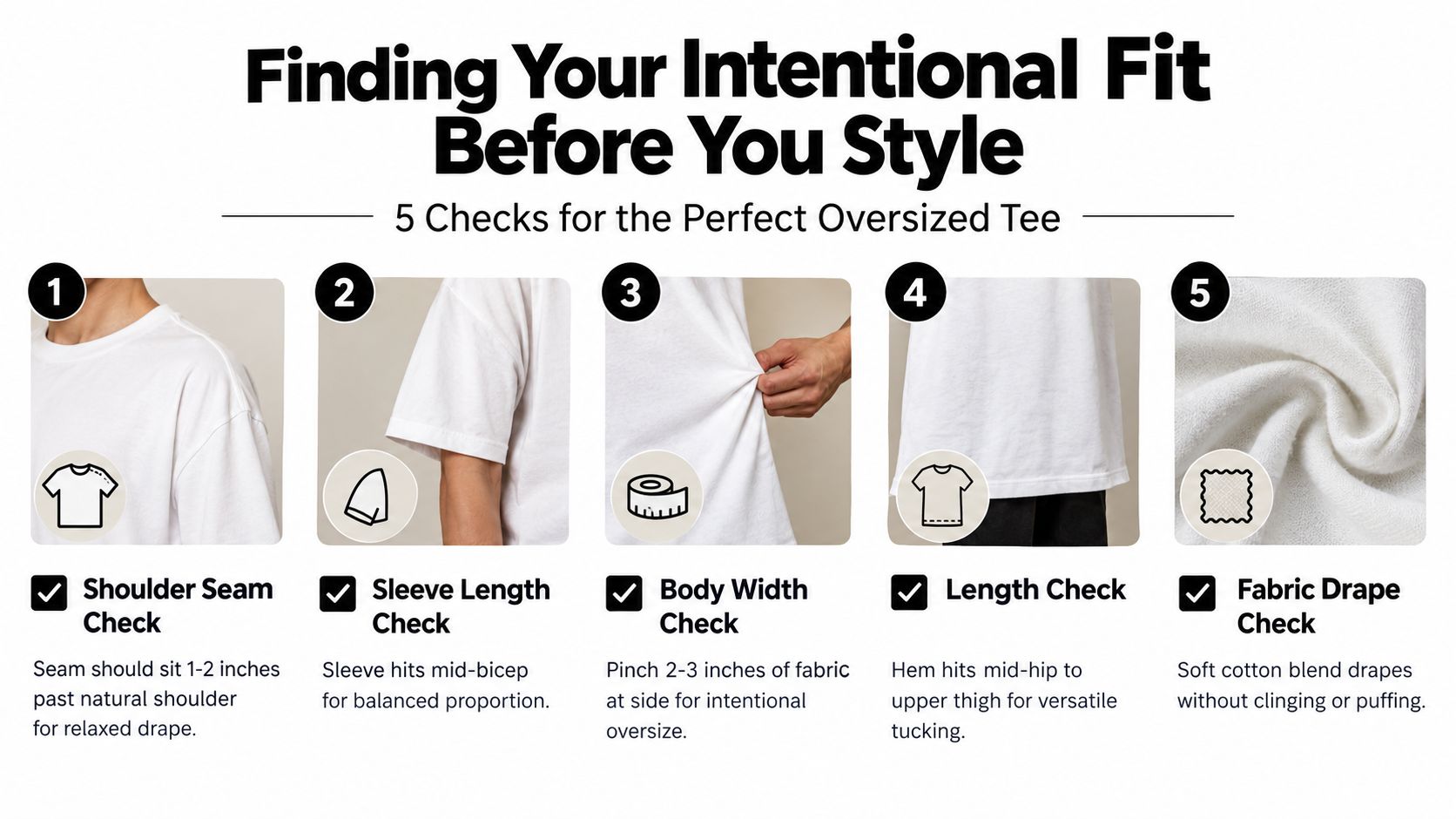
Don't style a tee until you know whether it's oversized or merely too big. A purpose-cut oversized shirt has room in the right places, while a standard shirt worn several sizes up can produce a collapsed shoulder, excessive length, and sleeves that lose all shape.
Use a mirror, your usual bottoms, and one layer you might wear over the tee. Then run through five checks.
Start at the shoulder
The shoulder seam should sit roughly 1 to 3 inches below the natural shoulder, according to independent oversized T-shirt fit guidance. A dropped seam creates the relaxed line you want. If it falls far down the upper arm, the garment may be overpowering your frame rather than draping across it.
The chest should feel roomy without pulling when you cross your arms. Pinch the side fabric, then move normally. You want ease, not a ballooned torso that puffs outward every time you sit.
Check the sleeve, length, and hem
Sleeves usually look balanced from mid-bicep to just above the elbow. Once they fall past the elbow, the upper arm can look visually heavy and the shirt begins to read more like an ill-fitting tunic. A small sleeve roll can help, but rolling a very long sleeve repeatedly often creates a thick band that draws attention to the problem.
The hem should land somewhere from the waistband to the upper thigh, depending on your intended styling. If it reaches mid-thigh and divides your body into two equal blocks, use a front tuck or choose a slimmer bottom. The 1abel fit guide emphasizes checking body length, hem width, and movement rather than relying only on size labels.
Hem width matters when you sit and layer. Sit down, raise your arms, and put on an overshirt. If the tee bunches into a stiff shelf or overwhelms the outer layer, the cut may be too wide or the fabric may lack enough drape.
Choose the right size category
A true oversized pattern is often designed to be worn in your regular size. A standard T-shirt may need only a 1 to 2 size increase to create a similar effect, while going beyond roughly 3 sizes up commonly pushes the silhouette toward sloppy territory, as noted by fit guidance for oversized T-shirts. Always compare garment measurements with a tee you already like instead of trusting the letter on the tag.
For a concrete example, the Snow Washed Oversized Cotton T-Shirt is listed as a unisex, 100% cotton tee with a 7.4 oz/yd², 250 g/m² fabric weight, moderate thickness, slight stretch, and a drop shoulder. Its listed sizes run from S through 3XL, with length, shoulder, chest, and sleeve measurements provided for each option. Those measurements are more useful than sizing up automatically, especially if you want the tee to layer cleanly.
Readers who need more room through the chest or torso can also use the fit considerations in this oversized T-shirt guide for plus-size shoppers as a starting point. The same checks apply: shoulder position, sleeve fall, body length, and how the fabric behaves while moving.
Balancing Proportions With the Right Bottoms
The easiest proportion test is the 1/3 to 2/3 balance. You're aiming for the shirt and lower half to create a deliberate relationship, rather than splitting the body into two equal-looking blocks. A shorter or tucked hem gives more visual space to the legs. A longer untucked hem can work, but it needs a cleaner or narrower lower line.
Start with the hem, then choose the bottom.
| Bottom Silhouette | Proportion Effect | Best For |
|---|---|---|
| Slim jean | Reduces the visual width below a broad tee | Avoiding a boxy look, casual street outfits |
| Straight trouser | Keeps the outfit clean without making the top feel oversized by comparison | Minimal styling and gender-neutral ease |
| Cargo pant | Adds utility, but needs a controlled tee hem | Streetwear, practical everyday dressing |
| Jogger | Creates a relaxed line with a tapered ankle | Errands, travel, and at-home outfits |
| Fitted short | Exposes more leg and offsets a long or broad shirt | Warm weather and a sharper casual finish |
A slim jean is useful when the tee has a generous shoulder and a hem that reaches toward the upper thigh. It doesn't need to be skin-tight. A clean slim or narrow-straight leg is enough to stop the outfit from becoming one continuous block of fabric.
Straight trousers are the safest middle ground. They preserve the comfort of an oversized shirt without creating the visual tension that can happen when a very wide tee sits over very narrow pants. Choose a higher waist if the hem is long, then use a small front tuck to show where the lower half begins.
Wide-leg pants can work, but they're the least forgiving option. Pair them with a tee that has strong fabric structure and a hem that doesn't extend too far down the thigh. Guidance on fabric and oversized construction points to medium-weight and heavyweight cotton, dropped shoulders, and a relaxed torso as useful construction features because they help the garment hold its line.
Light jersey tends to collapse closer to the body, which can make a wide tee and wide trouser look soft rather than intentional. A denser cotton or washed heavyweight option gives the shoulder and hem more presence, so you can use a straight or moderately wide bottom without losing the outline.
Tucks Layers and Accessories That Add Shape
The fastest way to improve an oversized tee is often a small adjustment at the hem. You don't need to tailor the shirt, and you don't need to expose your entire waist. You need one controlled point that tells the eye where the torso ends.
Use the hem deliberately
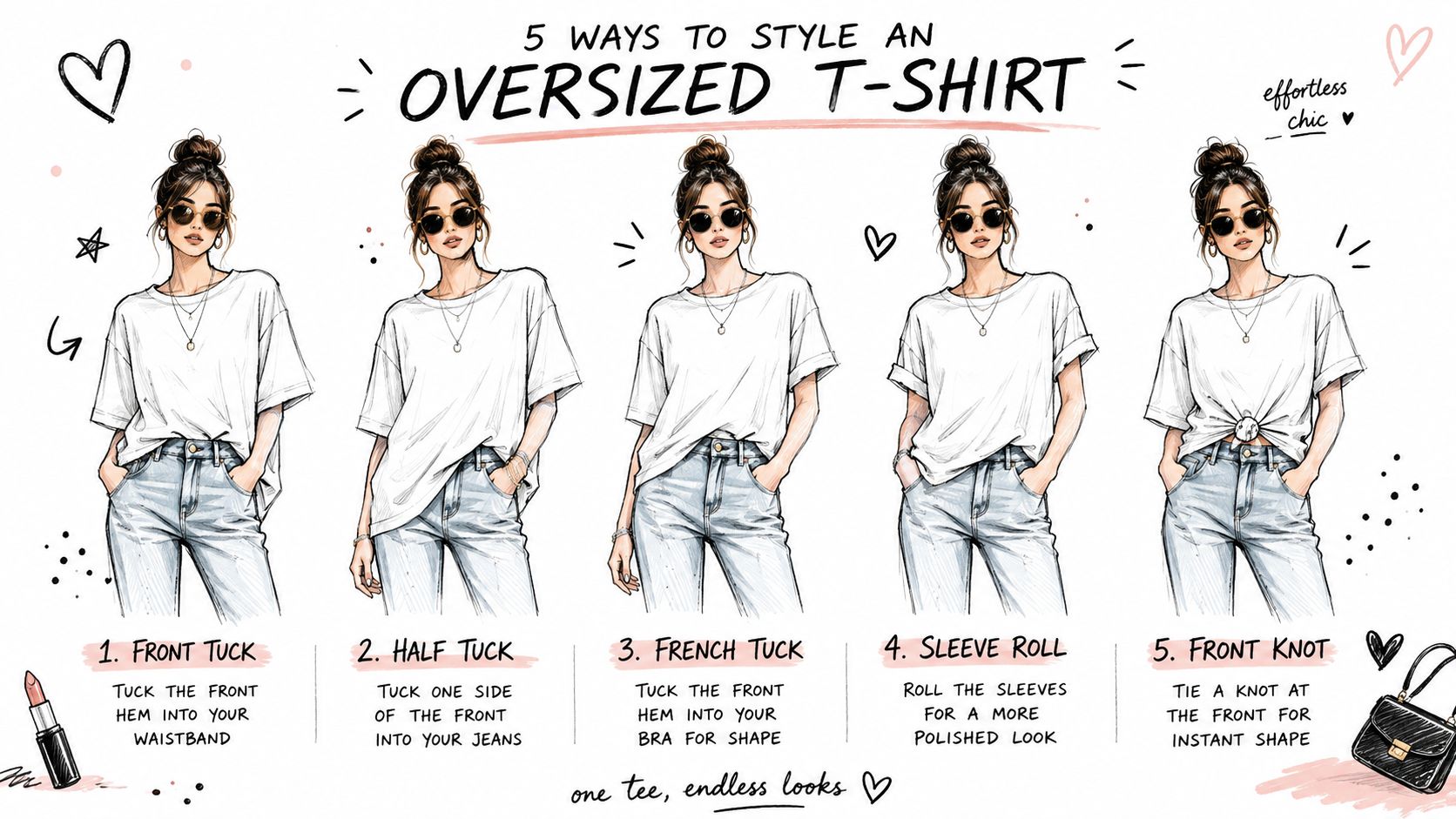
Try a front tuck into high-waisted jeans or trousers when the shirt reaches below the waistband. Tuck only the center front and let the sides fall naturally. This keeps the relaxed back while revealing enough of the waistband to restore the 1/3-to-2/3 relationship.
A half tuck works well with thicker cotton because the fabric stays in place. With a thin jersey, it can look accidental as the fabric slips out. A French tuck, placed slightly off-center, gives a similar result with less visible bunching.
Use a front knot only when the fabric is light enough to tie without creating a bulky lump. It works for warm-weather outfits with fitted shorts or a straight skirt, but it usually fights a heavyweight tee. For a campus or errands outfit, a small sleeve roll and a front tuck are more reliable than multiple dramatic adjustments.
A sleeve roll should expose some forearm without turning the sleeve into a tight cuff. If the sleeve already ends near the elbow, leave it alone. The garment is telling you that it has enough visual structure.
Layer for vertical lines
An open overshirt or lightweight jacket creates vertical edges that break up the tee's width. Keep the outer layer either visibly longer or clearly shorter than the tee. When both hems land at almost the same point, the layers can look crowded.
A hoodie under an oversized tee can work in cool weather, but it adds volume at the neck and shoulders. Use a tee with a firm collar and a bottom that narrows slightly. A boxy tank under an open tee gives a lighter version of the same idea and helps create depth without piling on heavy fabric.
Accessories should support the proportion, not compete with it. A belt defines the waist when the tee is tucked. A cap or restrained jewelry adds focus near the face. A structured crossbody or firm tote gives the soft cotton a visual counterpoint, while a clean sneaker grounds the outfit at the bottom.
For a visual example of how these moves combine, watch the styling demonstration below.
Five Ready to Wear Outfit Recipes for Every Day
Outfit formulas become easier once each one has a single job. One outfit can make the legs look longer, another can prioritize comfort, and another can create coverage without turning the body into a shapeless column.
Clean streetwear
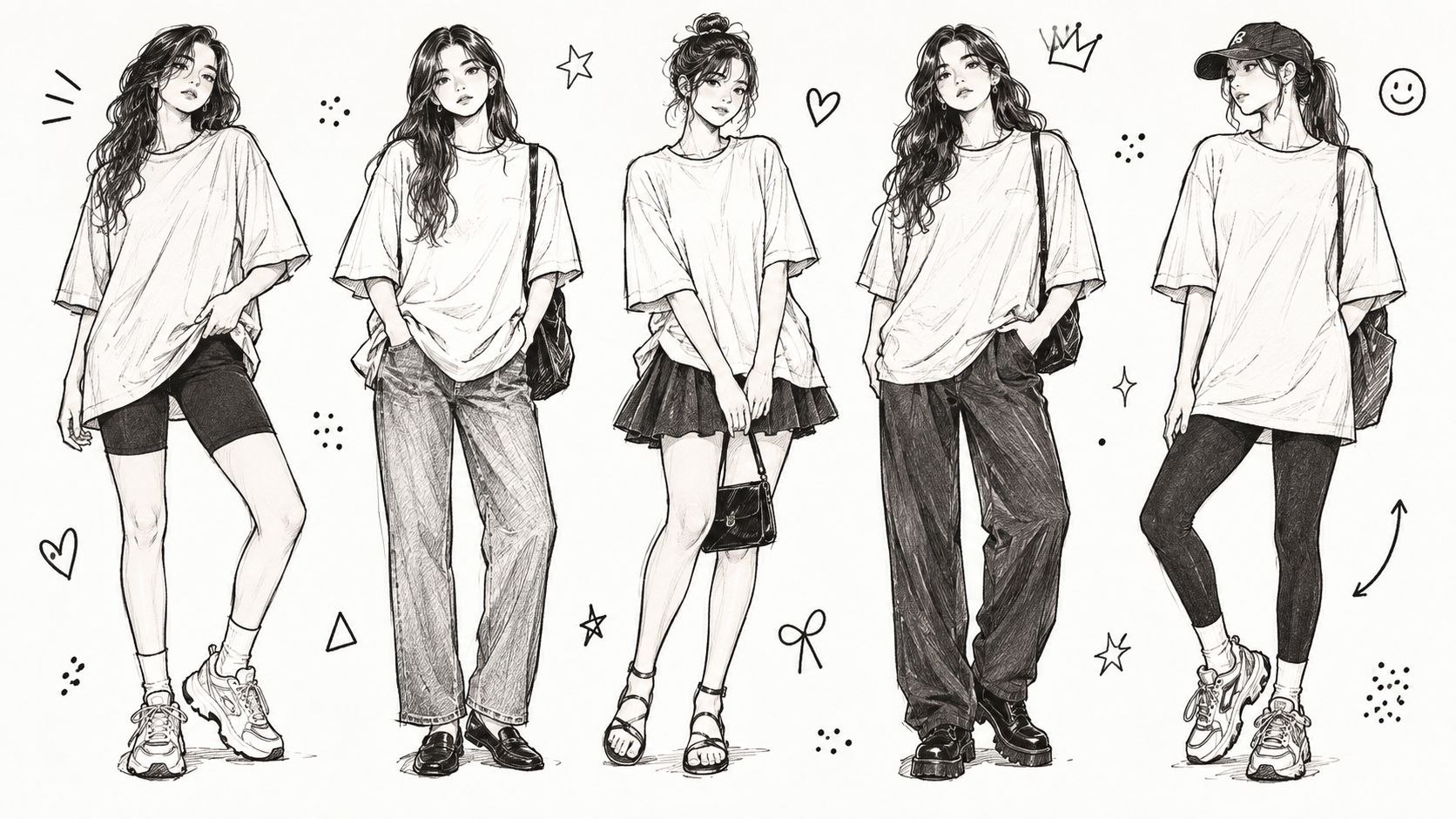
Wear a washed oversized tee with slim jeans, low-profile sneakers, and a cap. Give the hem a small front tuck and leave the back loose. This formula works because the narrow lower line offsets the shirt's shoulder width without making the outfit look formal.
Minimal and gender-neutral
Choose straight-leg trousers with a high waist, a tee that ends near the upper thigh, and simple sneakers. Use a French tuck, then add a belt with a restrained buckle. The straight leg keeps the look relaxed, while the tuck prevents the shirt from erasing the trouser shape.
Transitional layering
Start with a moderate or heavyweight oversized tee, then add an open overshirt or lightweight jacket. Pair it with tapered pants and structured sneakers. Keep the jacket's front open so the outfit retains a vertical line, and avoid adding another very wide layer underneath.
Relaxed everyday comfort
For home, travel, or quick errands, leave the tee untucked over joggers and finish with a firm sneaker or simple slip-on. The jogger's ankle taper supplies the anchor that a loose pant would not. If you want to compare relaxed lower-half options, the best jogger sweatpants guide can help you think about the relationship between a loose top and a narrowed ankle.
Modest coverage
Use a longer tee with straight trousers or a structured cargo pant, then add an open lightweight layer. Keep the bottom clean rather than equally oversized, and let the shoulder seam provide the main shape. A snow-washed cotton tee with a drop shoulder and moderate fabric weight can hold this kind of relaxed drape without requiring a knot or aggressive tuck. A heavier vintage-washed alternative can create more structure, but it may feel warmer and bulkier under outerwear.
The same T-shirt can therefore shift character through one change. Tucked into straight trousers, it looks considered and clean. Left untucked over tapered joggers, it becomes softer and more casual. The styling decision matters more than adding more garments.
Making the Look Yours and Keeping It Sharp
A wearable oversized uniform needs only three decisions: check the fit, choose one controlled anchor, and add one definition move. Check the shoulder, chest, sleeve, hem, and movement before worrying about shoes. Then decide whether your bottom should narrow, stay straight, or provide enough structure to support the shirt's volume.
The sloppy version usually reveals itself quickly. Sleeves past the elbow make the upper half feel heavy. A hem that reaches mid-thigh can split the body in half when left completely loose. A longline tee with equally voluminous trousers erases the waist and leg line, making the outfit boxy rather than deliberately oversized.
Fabric care also protects the styling. Washed cotton and heavier tees should be washed gently according to their care label, kept away from bleach when instructed, and dried with enough care to preserve the shape and print. For the Snow Washed Oversized Cotton T-Shirt referenced above, the listed instructions specify a gentle machine wash at 30°C, no bleach, low tumble drying, low-temperature ironing while avoiding the print, and no dry cleaning.
Before buying another oversized piece, test the method with what you own. Stand in front of a mirror, mark where the shoulder seam falls, check the hem with your usual bottoms, and try one tuck or one open layer. Intentional oversized dressing is a repeatable skill, not a size number.
99 Collection offers unisex cotton T-shirts, washed oversized silhouettes, tanks, and sweatpants that can support the proportion-focused outfits described here. Visit 99 Collection to browse the current essentials and test one oversized tee with your own straight trousers, slim jeans, or tapered joggers today.