

You're standing in front of the closet with one question in mind, which pair can handle a full day. Not just lounging at home, not just a quick gym run, but errands, travel, a casual meetup, and whatever else lands on the calendar. That's where jogger style sweatpants earn their place, because the right pair can feel easy without looking unfinished.
A lot of shoppers get stuck between words. Joggers, sweatpants, athleisure pants, tapered lounge pants, they all overlap enough to blur together. The useful difference isn't hype or softness, it's fit architecture, the waistband, inseam, rise, cuff tension, and fabric weight that decide whether a pair reads as tidy or sloppy.
Table of Contents
- Introduction to Jogger Style Sweatpants Today
- What Makes Sweatpants Jogger Style
- Anatomy of a Jogger From Waistband to Cuff
- Choosing the Right Fabric for Comfort and Season
- Finding Your Fit and Understanding Unisex Sizing
- How to Style Jogger Style Sweatpants for Everyday Wear
- Deciding If Classic Joggers Are Right for You
Introduction to Jogger Style Sweatpants Today
The modern jogger traces back to athletic roots, but today it sits in a much wider wardrobe. The category's history starts in the 1920s, when Émile Camuset of Le Coq Sportif created early sweatpants for athletes, and by the late 1930s they were common at the Olympic Games. Adidas widened the lane again in 1964 with the tracksuit, pairing sweatpants with a track top for mainstream athletic wear, according to the category history summarized on Sweatpants.
That background matters because it explains why joggers feel familiar in so many settings. They carry sportswear DNA, but they're now chosen for daily wear, travel, errands, and relaxed social plans, not just training.
A shopper usually notices the confusion right away. One pair looks like a true jogger, another looks like soft straight-leg sweatpants, and a third seems sharp enough to pass as casual pants. The difference is usually subtle on a product page, but obvious on the body.
The category is also still commercially relevant. One 2026 market estimate valued the global joggers and sweatpants market at USD 10.8 billion and projected growth to USD 14.99 billion by 2033, which the same source presents as a 4.77% CAGR from 2026 to 2033, according to TrueKung. That doesn't mean every pair is worth buying, it means shoppers still want a dependable version that works beyond the couch.
A good way to read joggers is to think of them as the middle ground between comfort and structure. They're not trying to look dressed up, but they are trying to look intentional. That's why the details in the next sections matter so much.
What Makes Sweatpants Jogger Style
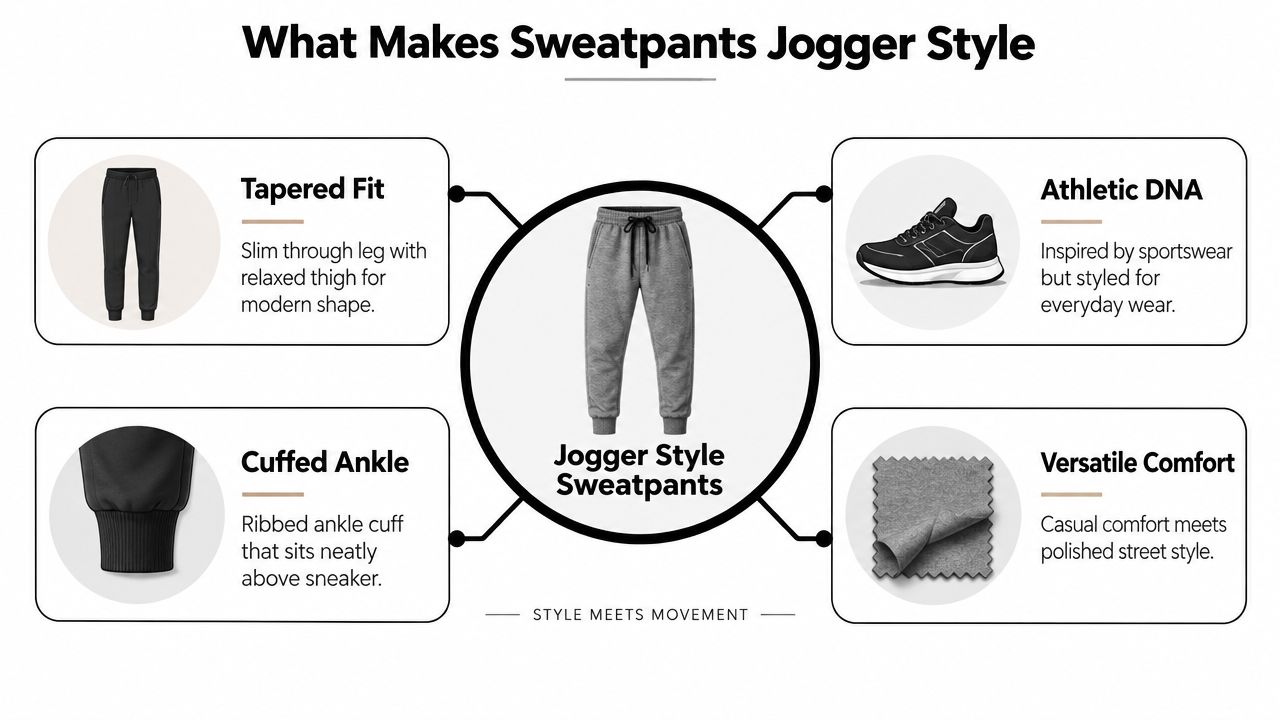
A jogger starts with shape, not softness. The leg stays relaxed through the upper section, then narrows toward the ankle, where a cuff holds the hem close to the body. That architecture is what separates jogger style from a classic open-hem sweatpant.
The shape does the heavy lifting
A casual pant with an athletic finish is the easiest way to read it. A straight-leg sweatpant falls in a more even line from hip to hem, while a jogger pulls inward near the ankle, which makes the outfit look cleaner around the shoe. Less fabric swings, and there is less bulk at the bottom.
That change matters in real settings. On a walk, at a café, or while traveling, the cuffed leg keeps the line neat instead of pooling over footwear. If you like the comfort of sweats but want them to look more resolved, that taper is doing the work.
The structure also has a practical side. A tapered leg, ribbed ankle cuffs, an elastic waistband, and pocket placement work together to create the jogger profile and help the pant stay in place, as shown in the tech-pack example from Skema3D. In other words, the shape is not just for appearance, it helps the garment sit properly on the body.
Practical rule: If the ankle opens too much, the pant starts reading more like lounge wear than a jogger.
A quick product example makes the idea easier to see. The Essential Jogged Sweatpants show how that structure can be built into an everyday pair, with an elastic waist, drawstring, pocket layout, and a mid waist fit. The sizing moves by length from 39.76 inches in S to 40.94 inches in XL, which suggests a design that balances ease with a controlled outline.
If you want a plain-language comparison, the guide on joggers vs sweatpants helps separate the two fast. The short version is simple. Joggers are sweatpants shaped to look more finished at the hem.
Anatomy of a Jogger From Waistband to Cuff
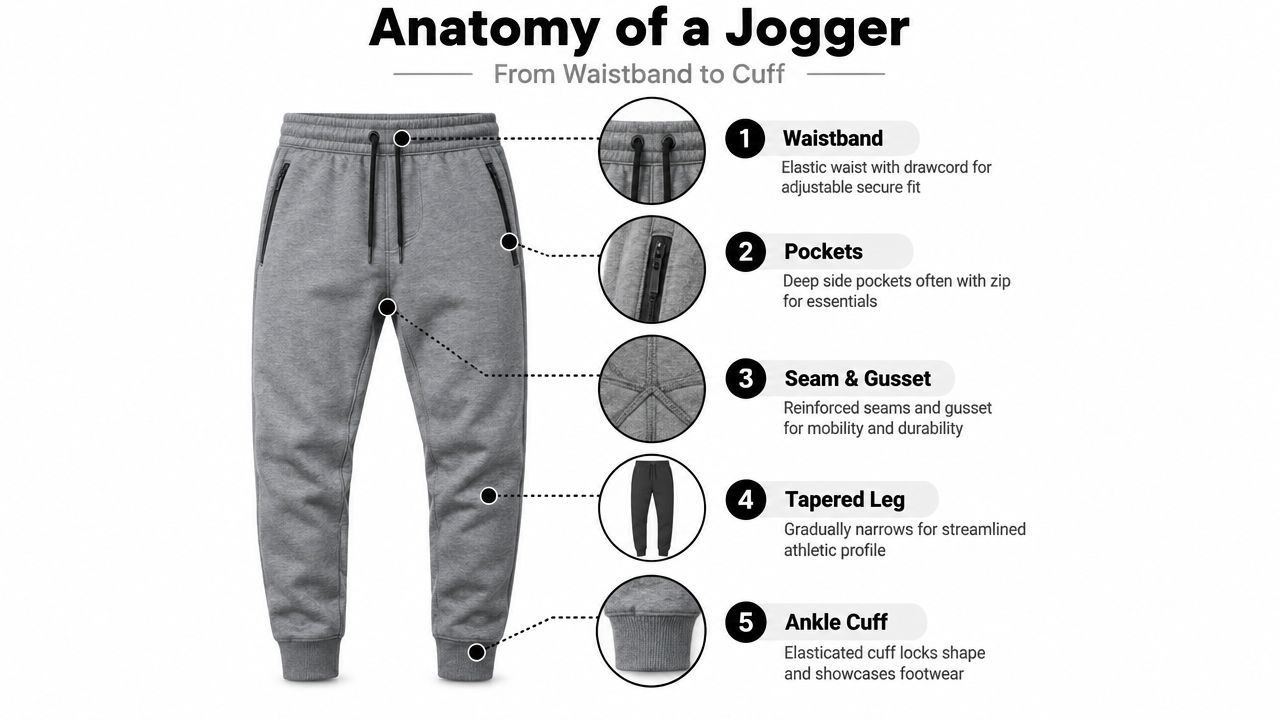
A jogger is easier to judge online when you read it like a garment map, starting at the waist and moving down to the cuff. Each part changes fit in a different way. The waistband controls hold, the pockets affect drape, the seams support motion, the leg line shapes the silhouette, and the cuff decides how the hem sits over footwear.
Start at the waistband and work downward
An elastic waistband with a drawstring gives you two kinds of adjustment, stretch and fine tuning. That matters for all-day wear, because a waistband that feels fine at first can loosen as the day goes on. The drawcord helps keep the fit steady without requiring a perfect size match.
Pockets deserve the same attention. A two-pocket or four-pocket layout gives room for keys, cards, or a phone, and it also changes how the front of the pant hangs. Deeper pockets are convenient, but on lighter fabric they can pull the shape forward a little.
Then the seam and leg line do their part. Reinforced seams support movement, while the tapered leg keeps the outline clean. The cuff finishes that line and keeps the ankle from spreading over the shoe.
A jogger can look polished on the hanger and still feel off if the cuff is too loose or the rise does not suit your body.
Fabric weight changes how the structure behaves
Fabric weight changes how all of that construction works in real wear. A French terry jogger example in the tech pack uses a 330 GSM body fabric with a cotton, polyester, and elastane blend, plus 1x1 rib cuffs at about 300 GSM and high cuff tension. That kind of build gives the pant enough body to hold shape, while the cuff helps keep the hem anchored above the shoe line.
The simple rule for shoppers is that structure and fabric need to match. A strong cuff on a flimsy body can still sag, and a good fabric with a loose cuff can still bunch. When you read product details with that in mind, you can tell whether a pair is likely to sit neatly or start collapsing after a few wears.
Choosing the Right Fabric for Comfort and Season
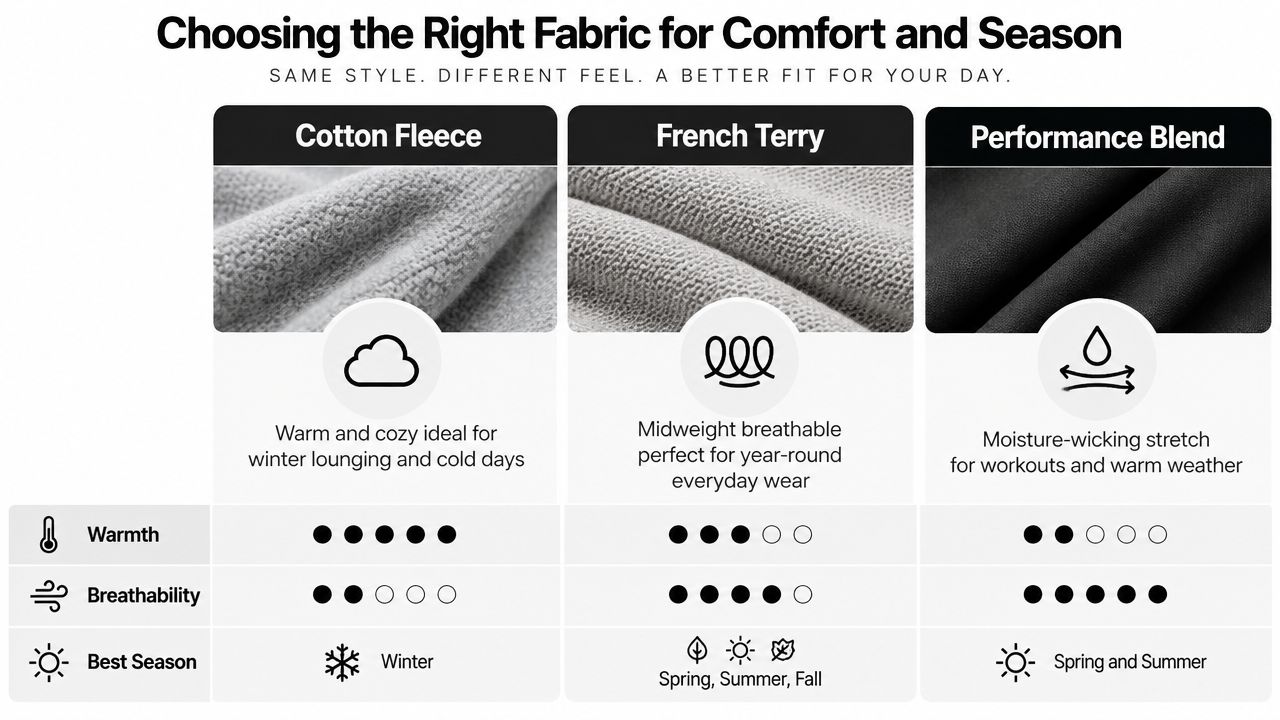
Fabric sets the range of use. One jogger may stay comfortable through a chilly commute and a long afternoon indoors, while another feels better for movement or warmer weather. If you focus only on softness, you can miss the bigger question, which is how the cloth works with the pant's structure and with your day.
French terry versus fleece
French terry has a looped interior, so it usually breathes better and handles moisture in a more forgiving way. That makes it a smart choice for year-round or transitional wear, especially when your day moves between indoor and outdoor settings, according to Tasc Performance. It tends to feel lighter on the body, which helps when you want comfort without overheating.
Fleece takes a different path. Its brushed surface holds more air, so it keeps warmth in more effectively. That makes it useful when insulation matters most, but it can feel too warm if you run hot or stay active.
The simplest way to separate them is this. French terry supports flexible wear, fleece supports warmth. Each fabric solves a different problem, and the better choice depends on the setting.
Reading blend and weight without guessing
Blend and weight add another layer. Cotton blends often feel familiar and can hold shape better than very soft, unstructured knits. A heavier knit also has more body, which helps the pant hang cleanly instead of collapsing.
The French Terry Boxy Tank Top gives a useful fabric reference point because its catalog details list 87% cotton and 13% polyester with a 10.0 oz/yd² (340 g/m²) fabric weight. It is not a jogger, but it shows how a French terry knit can be used in a denser garment that still works for casual layering.
That same idea helps with joggers. A fabric with more body usually supports a cleaner shape, especially around the leg and cuff. A lighter fabric may feel easy at first, but it can lose that structure faster if the cut and finish are too relaxed. So the goal is not just to pick a comfortable cloth, it is to match the cloth to the way the jogger is built.
Choose fabric by climate first, then by how you plan to wear the pant. If your day moves between rooms, streets, and transit, breathability matters more than plushness. If you want a pair for cold, quiet downtime, fleece makes sense. If you want one pair that can travel through more of the calendar, French terry usually gives you the wider range.
Finding Your Fit and Understanding Unisex Sizing
Fit problems are where most online jogger purchases go wrong. The shape can look right on a model, but the inseam, rise, and cuff position decide whether the same pair looks cropped, stacked, or just plain awkward on you. That's why measurements matter more than vague size labels.
Read the numbers in context
The first things to check are waist, hip, and length. On the Essential Jogged Sweatpants, the catalog lists S through XL with lengths from 39.76 inches to 40.94 inches, waists from 13.39 inches to 16.54 inches, and hips from 22.24 inches to 25.39 inches. Those numbers help you compare the garment to something you already own, instead of guessing from the size tag alone.
Here's the practical part. If the length is too short, the cuff can sit high and make the pant look cropped. If the length is too long for your height, the cuff can stack heavily at the ankle and lose that clean jogger line.
Use rise, cuff, and shoe choice together
A mid waist can feel more stable for mixed body types because it usually sits where many people expect casual pants to rest. An elastic waistband helps, but a drawstring is still useful if you're between sizes or buying as a gift. The cuff matters too, because a tighter hem can keep the pant above the shoe, while a looser one can drift downward and bunch.
Simple fitting check: If you want a neat silhouette, prioritize inseam and cuff tension before you prioritize color.
Unisex sizing adds another layer. Mixed-gender shoppers often want the same pair to work on different bodies, and that's where length availability becomes a real benefit. A recent Wirecutter review pointed to joggers offered in multiple lengths, which shows that inseam variety matters more than many product pages explain, according to The New York Times Wirecutter.
Quick size reference
| Size | Waist | Hip | Length |
|---|---|---|---|
| S | 13.39 in, 34 cm | 22.24 in, 56.5 cm | 39.76 in, 101 cm |
| M | 14.17 in, 36 cm | 23.03 in, 58.5 cm | 40.16 in, 102 cm |
| L | 15.35 in, 39 cm | 24.21 in, 61.5 cm | 40.55 in, 103 cm |
| XL | 16.54 in, 42 cm | 25.39 in, 64.5 cm | 40.94 in, 104 cm |
If you're shopping for someone else, this table is more useful than the usual “true to size” language. It tells you what the garment measures, which is what you need when no fitting room is involved.
How to Style Jogger Style Sweatpants for Everyday Wear
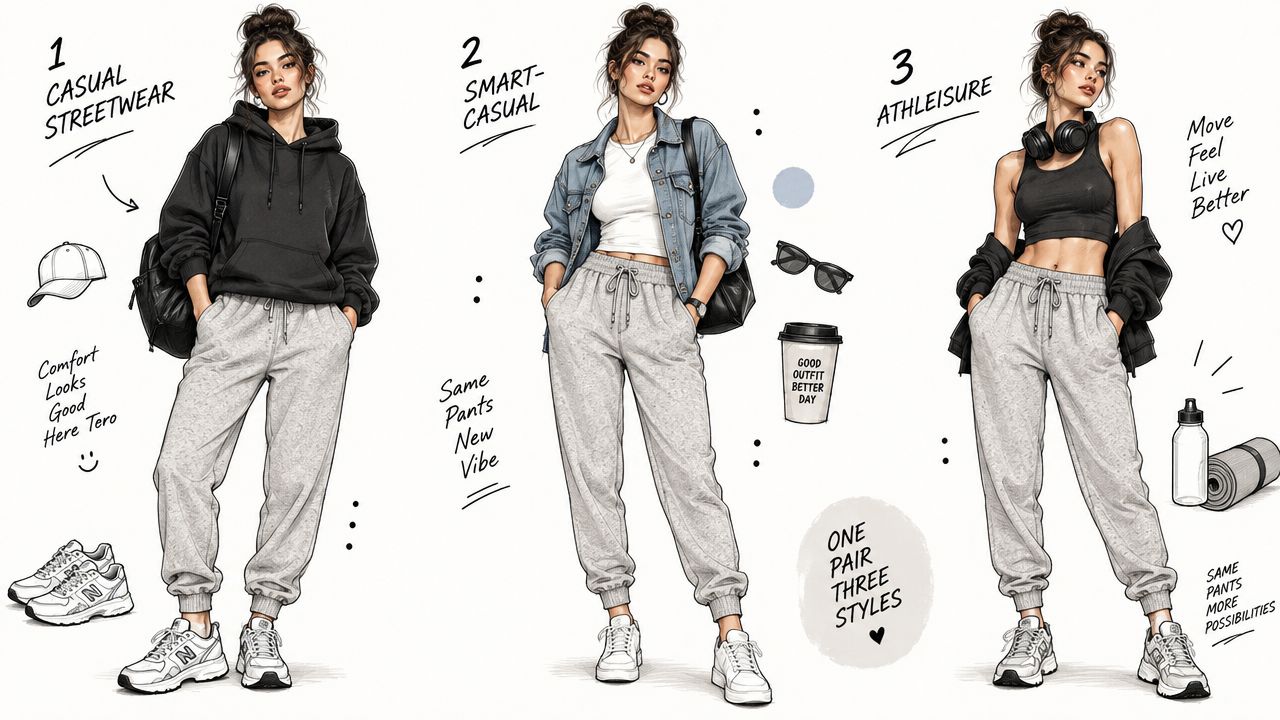
Joggers work best when the rest of the outfit respects their line. Because the leg narrows at the ankle, the top half of the outfit can stay simple without looking unfinished. That's why one pair can cover a lot of real life if you build around it intentionally.
A useful rule is to let the jogger do one job and the top do another. The pant brings shape at the bottom, so the shirt or layer can either stay clean and fitted or add deliberate volume on top.
Three outfit formulas that make sense
For a casual streetwear look, pair joggers with a plain tee, a clean sneaker, and a lightweight jacket. The cuff keeps the shoe visible, which helps the outfit feel composed rather than heavy. Neutral colors usually make this easiest because the silhouette already carries visual interest.
For a minimalist everyday outfit, use a boxy top or a structured tank with simple accessories. The wider top balances the tapered leg, and the result feels relaxed without drifting into sleepwear territory. If you like understated dressing, this is the safest formula.
For travel, think layers and movement. A jogger with a secure waistband, pockets, and a stable cuff is easier to live in during long sitting periods, and the pair still looks decent when you stand up. That's why joggers remain a strong option for transit-heavy days.
The black jogger styling guide at jogger sweatpants black is a good reminder that color choice changes the mood fast. Black reads sharper, while softer neutrals lean more casual.
Style cue: If the jogger is cuffed and tapered, keep your footwear clean and simple. Busy shoes can fight the line of the pant.
One final detail, don't overcomplicate the top half. A good jogger already carries enough structure for the outfit to feel deliberate, so the rest of the look just needs to support that shape.
Deciding If Classic Joggers Are Right for You
Classic joggers make sense when you want one pair that still looks considered outside the house. If your day includes errands, casual meetups, or travel, the cuffed silhouette usually gives you more polish than a looser sweatpant while keeping the same easy comfort.
That said, not every buyer needs the classic version. Recent coverage shows demand is shifting toward performance joggers and travel joggers, while broader sweatpants interest has stayed steady, which tells you shoppers are refining their expectations rather than abandoning the category entirely, according to Fioboc. If you want a more structured look, a well-fitting alternative may fit your life better.
The better question is whether you need versatility or a specific use case. A classic jogger is the smarter purchase when you want a minimalist, unisex staple that can move between home, errands, and casual settings without feeling too dressed up or too sleepy. If you need more polish, more technical fabric, or a more fashion-forward taper, start looking elsewhere.
Best jogger sweatpants content often focuses on trend, but the decision comes down to fit consistency, cuff behavior, and how often you'll wear the pair outside the house. That's the lens worth using.
If you want joggers built around clean basics, unisex ease, and everyday wearability, take a look at 99 Collection. You'll find simple pieces that fit this architecture-first approach, with jogger-style essentials designed for comfort, layering, and life beyond the couch.