

You click Add to cart on an oversized unisex tee because the model looks relaxed, balanced, and effortlessly put together. Then the parcel arrives. The shoulders droop too far, the body is strangely short, or the cotton feels so thin that the garment loses its shape before the first wash. The problem usually isn't the idea of an oversized tee. It's that “oversized” can describe several different patterns, fabrics, and finishes.
A good purchase starts with reading the garment like a pattern maker. Check the shoulder, chest, body length, fabric weight, and care instructions together. The right oversized unisex tee should look intentionally loose, not like a regular T-shirt that someone just ordered in a larger size.
Table of Contents
- What an Oversized Unisex Tee Actually Is
- A Short History of the Oversized Silhouette
- Anatomy of the Oversized Cut
- How to Size an Oversized Unisex Tee for Your Body
- Ways to Style an Oversized Unisex Tee
- Caring for Vintage and Snow-Wash Finishes
- Is a Heavier Oversized Tee Worth the Price
- Putting It All Together
What an Oversized Unisex Tee Actually Is
An oversized unisex tee is designed around extra ease. Ease is the space between your body and the garment, and an oversized pattern distributes that space across the chest, shoulders, sleeves, and sometimes the body length. A normal tee in a larger size may become wider without gaining the shoulder placement or length needed to keep the proportions balanced.
Look first for a drop shoulder, where the sleeve seam sits beyond your natural shoulder point. Then check the torso. A properly engineered cut normally gives the chest and waist enough room to create a straight, relaxed outline rather than pulling across the body. The hem often lands below the hip, though the exact length depends on the design and your height.
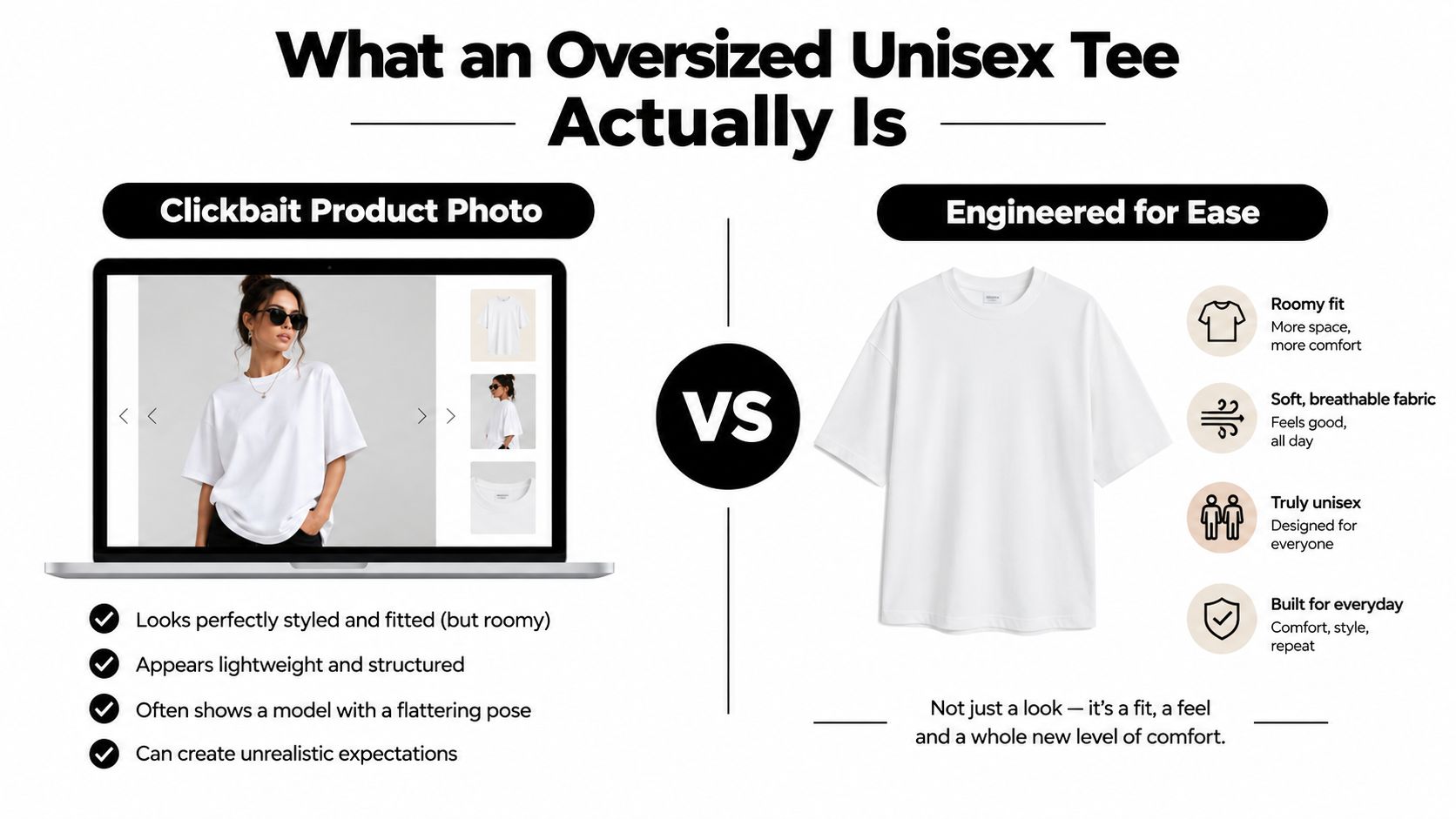
Designed ease versus accidental looseness
The distinction is easiest to understand with a bedsheet analogy. A bedsheet has plenty of fabric, but it only looks orderly when its dimensions suit the mattress. An oversized tee works the same way. Extra fabric needs proportion, or the garment can look either shapeless or oddly constrained.
Unisex sizing often starts from a broader traditional block, with grading adjusted across sizes so people with different body shapes can wear the garment. That doesn't mean every unisex tee fits every body in the same way. A person with narrower shoulders may see more shoulder drop, while someone with a fuller chest may use more of the intended ease in the torso.
Fabric helps determine whether the pattern holds together visually. A stable cotton jersey can support a boxier shoulder and straighter side seam, while a soft, lighter knit may fall closer to the body. The choice isn't automatically better or worse. It changes whether the tee reads as structured and architectural or soft and drapey.
The modern T-shirt has its own history of moving from undergarment to outerwear. An oversized version builds on that familiar base, but its appeal depends on coordinated measurements, not a loose size label.
A Short History of the Oversized Silhouette
The T-shirt became recognizable as a modern basic through utility first. In 1913, the U.S. Navy standardized a short-sleeve, crewneck cotton undershirt as part of its uniform, establishing the simple construction that later made the blank tee easy to produce and wear. By the 1950s, Hollywood figures including Marlon Brando and James Dean helped turn the T-shirt into mainstream outerwear, giving it a public identity beyond military and workwear use. The documented history of that transition is outlined in this history of the cotton shirt.
The oversized silhouette arrived through a different kind of cultural shift. In the 1980s, hip-hop culture helped move loose, baggy proportions from utility into street style, and the look continued through the 1990s as grunge made relaxed layering feel natural. The trajectory is described in this overview of oversized T-shirt history.
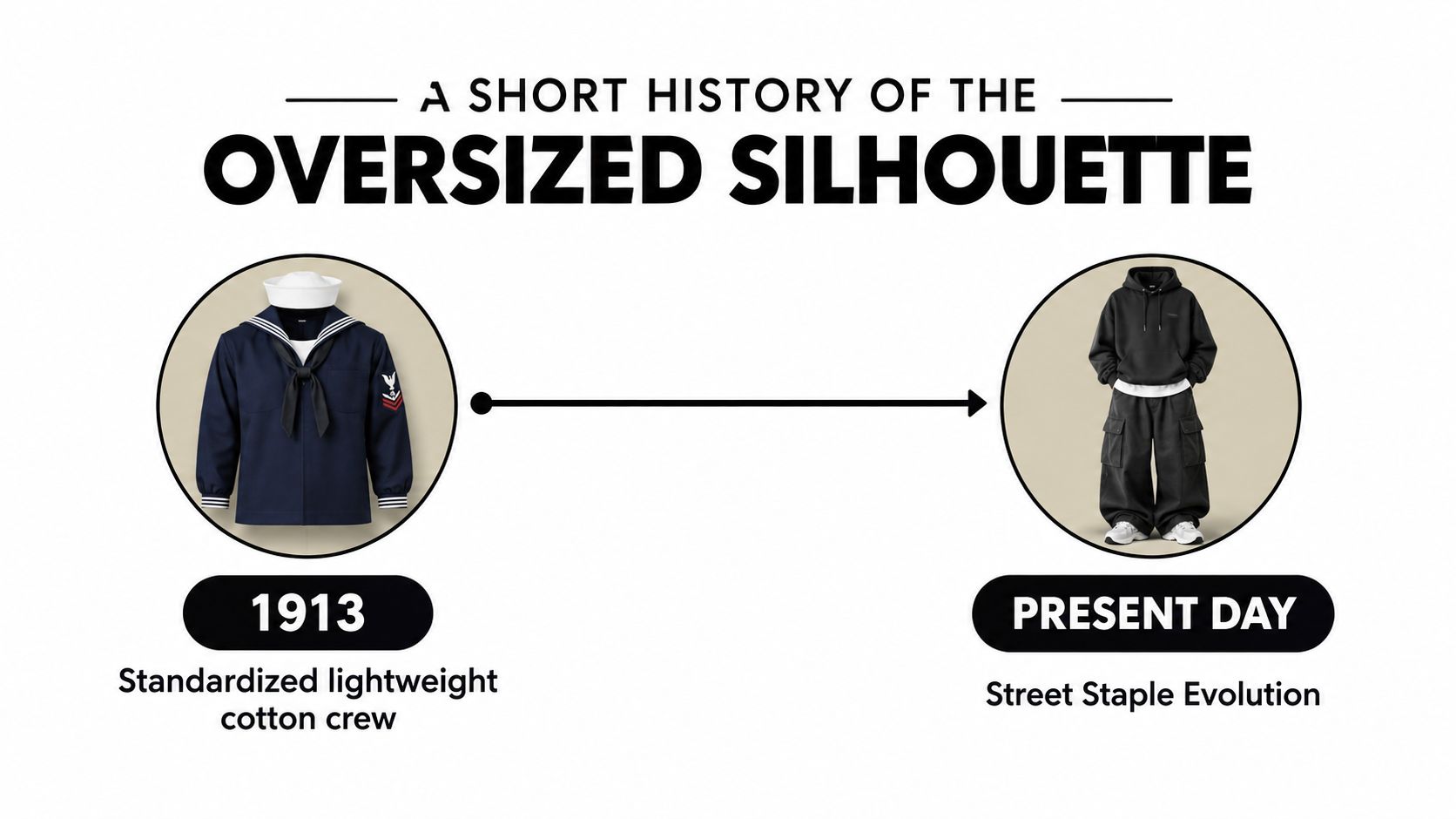
Why the old influences still matter
The silhouette carried forward because it solves practical and visual problems at once. Extra room makes layering easier, while a broad shoulder and longer body create a clear shape over denim, workwear trousers, skirts, or shorts. Later designers refined those proportions with cleaner seams, controlled hems, and fabrics chosen to support the intended outline.
That history also explains why a modern oversized tee can feel different from a casual hand-me-down. Streetwear made the volume visible and intentional. Contemporary unisex dressing uses the same volume as a way to reduce rigid gender coding, but the garment still depends on familiar pattern logic.
A current example is the Heavyweight Vintage Washed Frayed T-Shirt, a unisex 100% cotton style with a thick 430 g/m² fabric weight, drop shoulders, a long loose shape, and a vintage washed, frayed finish. Its care instructions specify a gentle machine wash at 30°C, no bleach, low tumble drying, and low-temperature ironing away from the print. Those details show how the category now combines historical streetwear volume with deliberate fabric and finish choices.
Anatomy of the Oversized Cut
A true oversized cut changes more than one measurement. It coordinates the shoulder line, chest width, sleeve position, body length, neckline, and fabric behavior so the shirt looks balanced from the front and side.
A drop shoulder usually pushes the seam beyond the natural shoulder point. The chest gains additional ease, and the body length often extends below the hip to prevent the wider upper half from looking cropped by accident. Neckline construction matters too. A firm ribbed crew neck can anchor a broad body, a wider neck can make the garment feel more relaxed, and a softer neckline can increase the impression of drape.
Side seams and tubular construction also create different results. Side seams let a maker control the body shape and position the garment more precisely on broader frames. Tubular bodies can feel simple and comfortable, but the lack of side shaping may produce a less controlled fall.
Read measurements instead of relying on labels
The Snow Washed Oversized Cotton T-Shirt lists a 100% cotton fabric with a 250 g/m² moderate weight, slight stretch, a drop shoulder, and a loose silhouette. Its measurements show that the garment's proportions are communicated through shoulder and length details, not only through the word “oversized.”
| Measurement Point | Regular Unisex Tee (in) | Oversized Unisex Tee (in) |
|---|---|---|
| Shoulder placement | Near natural shoulder | Extends beyond natural shoulder |
| Chest ease | Close to body | Clearly wider through torso |
| Sleeve position | Set-in or lightly relaxed | Often attached below shoulder |
| Body length | Usually near hip | Often below hip |
| Overall impression | Defined outline | Boxy or drapey outline |
Fabric gives the pattern its personality
Fabric weight changes how the same pattern behaves. Manufacturer guidance places suitable cotton jersey for relaxed oversized tees around 180 to 220 GSM, while a lighter jersey may collapse inward and a heavier jersey may hold a stronger box shape. The relevant oversized T-shirt manufacturing guidance also explains why laundering matters: pure cotton can shrink about 3% to 5% after a first hot wash and tumble dry, while aggressive heat can cause substantially more shrinkage in some garments.
That means a tee can arrive with the right shoulder and body proportions but lose its intended balance after washing. A shorter body makes the same wide chest look less like a deliberate oversized cut and more like a stretched standard tee.
How to Size an Oversized Unisex Tee for Your Body
Start with a tape measure and a shirt you already like. Measure your chest around the fullest point without pulling the tape tight, then measure shoulder width from seam to seam on a garment laid flat. If the product page gives flat chest width, double that measurement before comparing it with your body measurement.
Don't choose by the letter alone. Independent adult unisex sizing guidance commonly places chest-to-fit ranges at XS 32–34 inches, S 35–37, M 38–41, L 42–45, XL 46–49, and 2XL 50–53, as shown in this unisex T-shirt size guide. Those ranges describe a body framework, not the final garment dimensions, so you still need the product's chest, shoulder, and length measurements.
Use the size direction to control the look
Think of the choices as three different styling outcomes:
- True to size: Usually gives the designer's intended relaxed drape when the garment already has a generous cut.
- Size up: Adds more shoulder drop, sleeve volume, and body length, but can overwhelm a shorter frame.
- Size down: Can preserve the oversized shape while reducing excess length, especially when the chart shows a wide body with a longer hem.
| Chest (in) | Shoulder (in) | Unisex Size | Suggested Shirt Length | Sizing Direction |
|---|---|---|---|---|
| 32–34 | Compare with your shirt | XS | Shorter relaxed length | Stay true to size for controlled ease |
| 35–37 | Compare with your shirt | S | Moderate relaxed length | Choose true to size or downsize for a cleaner outline |
| 38–41 | Compare with your shirt | M | Standard relaxed length | Stay true to size for intended drape |
| 42–45 | Compare with your shirt | L | Longer relaxed length | Size down if length is your main concern |
| 46–49 | Compare with your shirt | XL | Longer relaxed length | Stay true to size for fuller volume |
| 50–53 | Compare with your shirt | 2XL | Longest relaxed length | Compare garment measurements before choosing |
These length descriptions are directional because brands draft differently. A petite shopper may want the width of an oversized tee without the longest hem, making a size down worth considering. A tall shopper may need the listed body length more than additional chest width. Someone with broad shoulders should check shoulder and sleeve placement first, because a narrow upper block can make even a loose torso feel restrictive.
For a broader body, a roomy chest isn't enough if the shoulder seam sits too close to the neck. For a narrower body, a very wide shoulder may create the intended streetwear effect, but it can also make the sleeve look unusually long. The best comparison is often a shirt already hanging well on your body. Measure it, then compare those numbers with the brand chart before ordering. A practical guide to unisex cotton T-shirts can help you think through that comparison without treating the size label as a guarantee.
Ways to Style an Oversized Unisex Tee
The easiest styling decision is to identify whether your tee is boxy or drapey. A boxy tee has a straighter side seam, more stable fabric, and a stronger horizontal shape. A drapey tee falls closer to the body, moves more when you walk, and can create extra volume around the waist and sleeve.
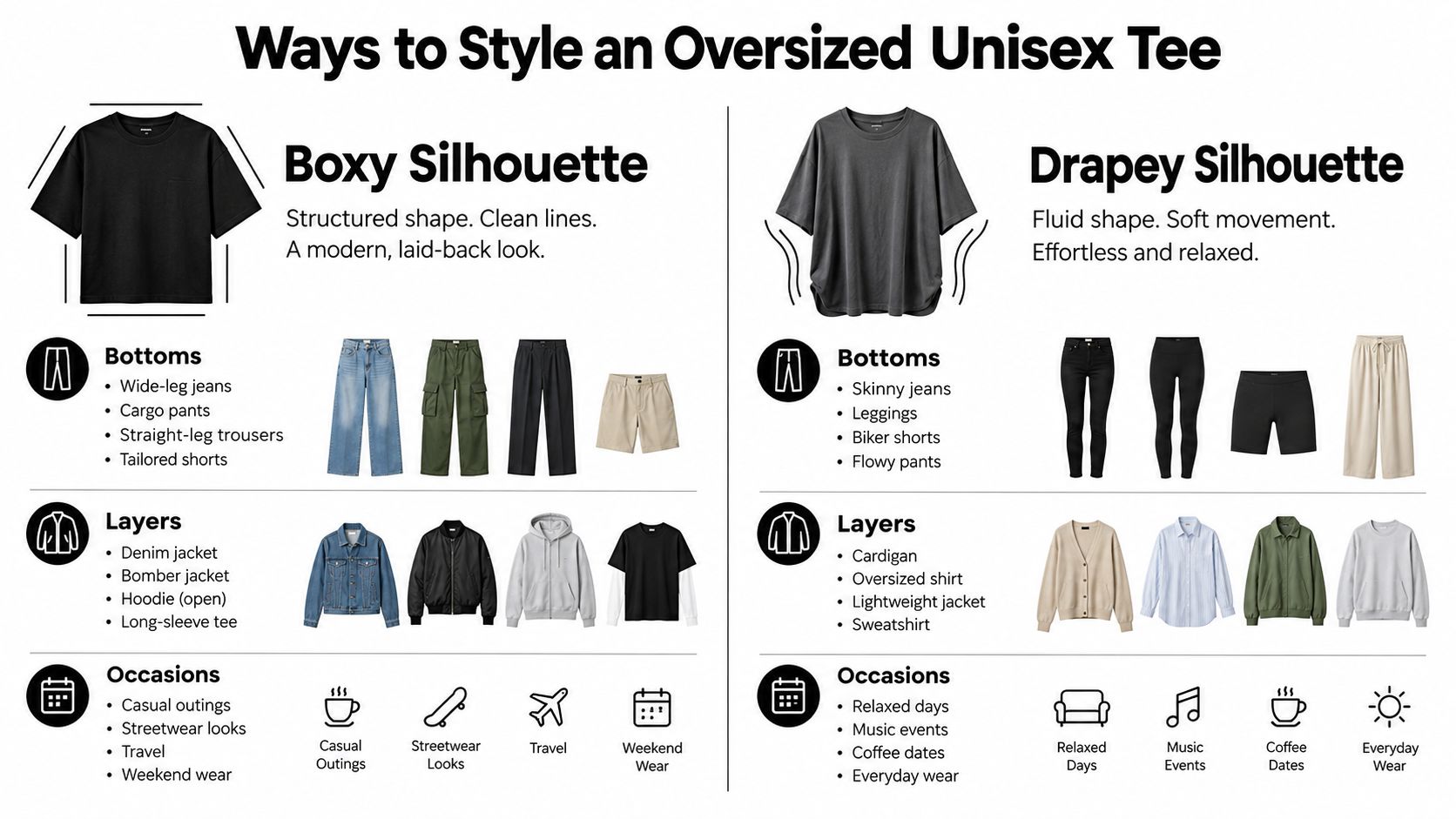
Boxy formulas
Pair a boxy tee with tapered trousers or pleated pants when you want the upper half to look intentional rather than oversized everywhere. The narrower lower line gives the outfit a visible endpoint. A structured chore coat or short jacket adds another firm layer without competing with the tee's shoulder shape.
For a weekend outfit, a snow-wash tee can work with wide denim and loafers. The denim echoes the casual volume, while the loafers add enough structure to keep the result from becoming purely lounge-oriented. If both the tee and trousers are very wide, show some ankle or choose a shoe with a defined sole.
A heavyweight cotton tee also layers well under a chore coat in cooler weather. The trade-off is comfort: the added thickness can make the sleeve and underarm area feel crowded beneath a close jacket. Choose a coat with enough room through the armhole rather than automatically sizing the T-shirt down.
Drapey formulas
A softer tee usually benefits from a cleaner lower half. Try slim leggings, fitted shorts, or straight trousers that don't add another large pool of fabric at the waist. A half-tuck can reveal the shape of the bottom while preserving the loose shoulder and sleeve.
A vintage-wash tee can sit comfortably with a midi skirt for a casual workplace, provided the graphic treatment and footwear suit the setting. Tucking the entire shirt creates definition but may add bulk. A front tuck is easier to adjust and lets you keep the back hem loose.
Styling rule: If the hem is already long, don't belt it automatically. A belt can gather the fabric into an awkward shelf instead of creating useful shape.
Cropping is another option, but it changes the garment's proportions permanently only if you alter the shirt. A temporary front tuck or small side tuck lets you test the effect first. The right choice depends on whether you want the tee to read as a long layer, a relaxed top, or a cropped-looking shape over high-rise bottoms.
Caring for Vintage and Snow-Wash Finishes
Wash finish changes the care routine because it changes the surface and sometimes the strength of the fibers. A snow-wash tee has a mottled, marbled appearance that can shift if you use harsh chemicals or high heat. A vintage-wash tee is meant to look lived-in already, but additional heat can accelerate fading, distortion, and uneven wear.
Snow-wash care
Turn the tee inside out and use a cool or cold, gentle wash with mild detergent. Skip chlorine bleach, and avoid treating the marbled surface as if it were a plain white cotton garment. Flat drying is the safest way to protect the visual balance while the shirt is damp, especially if the fabric has a wide shoulder or extended body.
A garment bag can reduce friction with zippers and rougher garments. Fabric softener isn't always helpful either. It can coat the fibers and alter the hand feel, while repeated agitation may soften a structured oversized tee more than you want.
Vintage-wash and heavyweight care
For vintage-wash cotton, low heat is the sensible middle ground. High heat can cause additional shrinkage or make a printed area fade unevenly, so reshape the tee while damp and dry it away from direct, intense heat. The vintage-wash T-shirt care guide is useful when you need to distinguish the appearance of a finish from the underlying cotton.
Heavyweight cotton needs patience. Use a gentle cycle and moderate spin, then support the garment rather than hanging it from a narrow hanger while wet. A thick tee holds more water and can stretch at the neckline or shoulder if its full weight pulls downward.
The Heavyweight Vintage Washed Frayed T-Shirt specifies machine washing at 30°C on a gentle cycle, no bleach, low tumble drying, low-temperature ironing away from the print, and no dry cleaning. Follow the product label first, because the finish and construction determine the safest routine.
Washer-side checklist
- Turn inside out: Reduce rubbing against other garments and protect printed or treated surfaces.
- Use mild detergent: Avoid chlorine bleach and unnecessarily aggressive formulas.
- Choose gentle movement: Lower agitation helps preserve seams, surface finish, and shape.
- Reshape while damp: Align the shoulder, side seams, and hem before drying.
- Control heat: Use low tumble drying only when the care label allows it, or air dry when shape retention matters most.
Is a Heavier Oversized Tee Worth the Price
Heavier doesn't automatically mean better value. Fabric weight affects opacity, structure, warmth, drying time, and how the garment feels under layers. Your climate and wearing habits matter more than a large GSM number on the product page.
A lighter oversized tee can breathe better in warm weather and layer neatly under a jacket. It may also deliver a softer drape, but the fabric can cling, show more underneath, or lose its crisp outline sooner. A heavier tee usually resists transparency and supports a boxier silhouette, although it can feel hot and take longer to dry.
| GSM Range | Opacity | Drape vs Structure | Cost per Wear |
|---|---|---|---|
| Around 180 GSM | More likely to need layering depending on color | Softer drape | Lower entry cost, useful when worn often in warm weather |
| Around 240 GSM | More substantial coverage | Balanced drape and structure | Worth considering for frequent everyday use |
| Around 320 GSM | Stronger coverage and presence | More structure, less fluid movement | Makes sense when the shape and durability fit your routine |
These ranges are practical comparisons, not guarantees. Fiber quality, knitting, dyeing, and finishing all affect the final hand feel. A carefully made lighter tee may outperform a poorly finished heavy one in comfort and wearability.
Use cost-per-wear without overcomplicating it
Cost per wear is the purchase cost divided by the number of times you expect to use the garment. You don't need a spreadsheet. Ask whether the tee works with several outfits, suits your climate, and feels comfortable enough that you'll reach for it repeatedly.
A heavy tee can justify a higher purchase cost if it replaces several less useful tops and remains part of your weekly rotation. It may not be worthwhile if you live in a hot climate, avoid slow-drying laundry, or mostly wear tees beneath fitted jackets. This guide to heavyweight cotton T-shirts can help you assess weight as one value factor rather than treating it as a quality score.
The strongest purchase is the one whose weight supports your actual wardrobe. Choose structure for boxy styling, lighter drape for breathable layering, and a finish you can maintain without resenting the laundry instructions.
Putting It All Together
Choose an oversized unisex tee by checking four things in order. Confirm that the cut has a deliberate shoulder and body length, not just a larger size label. Match the fabric weight to your climate and layering habits. Read the finish-specific care instructions before buying. Then compare your own chest, shoulder, and preferred shirt length with the product chart.
The fastest useful test is to measure a T-shirt you already wear comfortably. Lay it flat, record the chest width, shoulder width, sleeve length, and body length, then compare those figures with the new garment's chart. If the new tee adds width but loses the length you need, it probably won't create the silhouette shown in the product image.
Confidence comes from understanding the interaction between cut, fabric, and finish. A boxy heavyweight tee won't behave like a soft snow-wash style, and the same size won't look identical on a petite, tall, narrow-shouldered, or broad-chested body. Make the measurement comparison before you add the next tee to your cart.
99 Collection offers contemporary unisex wardrobe staples, including cotton T-shirts with snow-wash and vintage-wash finishes alongside heavyweight options. Compare the listed measurements, fabric details, and care instructions at 99 Collection before choosing the oversized unisex tee that fits your body and routine.