

You spot a purple T-shirt online with a marbled pattern that looks like a stormy sky. The color shifts from deep violet to dusty lavender, and the fabric appears soft, substantial, and already lived in. Then the practical questions arrive: Will it still look intentional after a season? Will the purple turn gray? Does acid washing weaken cotton?
Those questions matter because purple acid wash isn't just purple fabric with a random print. It's a finishing process that combines an overdyed base, abrasive stones, and chemical oxidation. The result depends on the cotton, the dye, the wash recipe, and the care routine that follows.
Table of Contents
- Why Purple Acid Wash Deserves a Closer Look
- The Origins of Acid Wash in Fashion
- How the Acid Wash Process Works
- What the Finish Does to Fabric Performance
- Vintage Wash, Snow Wash, and Other Variations
- Is Purple Acid Wash Still Trending in 2026
- Caring for Your Purple Acid Wash Pieces
Why Purple Acid Wash Deserves a Closer Look
Purple acid wash sits at the intersection of color, texture, and controlled wear. A garment may look casual and effortless, but its appearance comes from a carefully managed process. The washed areas aren't usually printed on top. Instead, the finishing treatment removes or lightens parts of the purple surface color, leaving the base garment with an irregular pattern.
That distinction helps explain why two garments with the same product description can look different. The stones don't touch every area with equal force, and the oxidizer doesn't affect every fold in the same way. A sleeve crease may become lighter than a flat chest panel, while a seam can retain a deeper tone because the fabric is folded or protected during processing.
The shopping question isn't only “Do I like the color?” It's “How was the color made, and how will the fabric respond to use?”
Purple adds another layer of uncertainty. A well-selected dye can discharge into a soft lavender or muted washed-purple shade. A less predictable dye system may shift toward patchy magenta, brown, or gray, particularly when the oxidizing treatment interacts unevenly with the garment. The effect can still look intentional, but it won't necessarily match a clean product photograph.
This guide separates the visual language shoppers often group together. You'll learn how acid wash developed from industrial denim finishing, how pumice and oxidizers create mottled contrast, and why neutralization matters after treatment. You'll also see how acid wash affects fabric performance, how it differs from vintage and snow washes, and where purple versions fit within current interest in heavyweight, boxy, and nostalgic clothing. Trend summaries describe growing attention to 250–350 GSM fabrics and boxy fits in washed apparel in a B2B vintage-wash trend summary.
The finish deserves to be treated as a managed-fade garment, not automatically as a maintenance-free basic. The right care routine won't freeze the purple tone forever, but it can help the garment age gradually instead of losing contrast through avoidable heat, friction, and sunlight.
The Origins of Acid Wash in Fashion
The story starts with denim rather than purple cotton jersey. Acid wash denim was patented in Italy by the Rifle jeans company in February 1986, following an accidental laundering process that used pumice stones and bleach in a dry washer, as documented in the history of stone washing on Wikipedia.
The accidental part is easy to understand. Pumice stones scrape against fabric as garments tumble, while bleach lightens the areas that receive more direct contact. Together, they create a pattern that looks irregular but can be repeated in an industrial setting. What may have begun as an unexpected laundry result became a production technique with a recognizable visual signature.
By the mid-1980s, acid wash had become a globally recognized denim effect, especially in the United States and Europe as described in the history of stone washing. Its importance wasn't limited to a particular decade's styling. The process made a niche distressed appearance scalable, giving manufacturers a way to reproduce abrasion, contrast, and age across batches of garments.
That industrial repeatability helped the look return in different forms. Designers and manufacturers could apply the same broad visual language to colors beyond indigo, including purple-toned washes. They could also move the treatment beyond jeans into T-shirts, tanks, fleece-like basics, and other cotton garments where an uneven surface finish adds character.
Why the old technique keeps returning
Acid wash survives because it communicates more than color. It suggests movement, use, and a slightly rebellious relationship with polish. Purple changes the mood from classic denim nostalgia to something more expressive, especially when a cool violet base breaks into smoky or lavender areas.
The finish also leaves room for variation. A heavily mottled garment feels retro and graphic, while a restrained wash can look more refined. That flexibility is why acid wash keeps resurfacing instead of remaining locked to its original denim moment.
How the Acid Wash Process Works
Purple acid wash is generally an overdye and discharge aesthetic. A manufacturer begins with a purple base garment, then removes some surface color from selected areas. Pumice stones create physical irregularity, while an oxidizing bath produces chemical lightening. The final pattern comes from both actions working together.
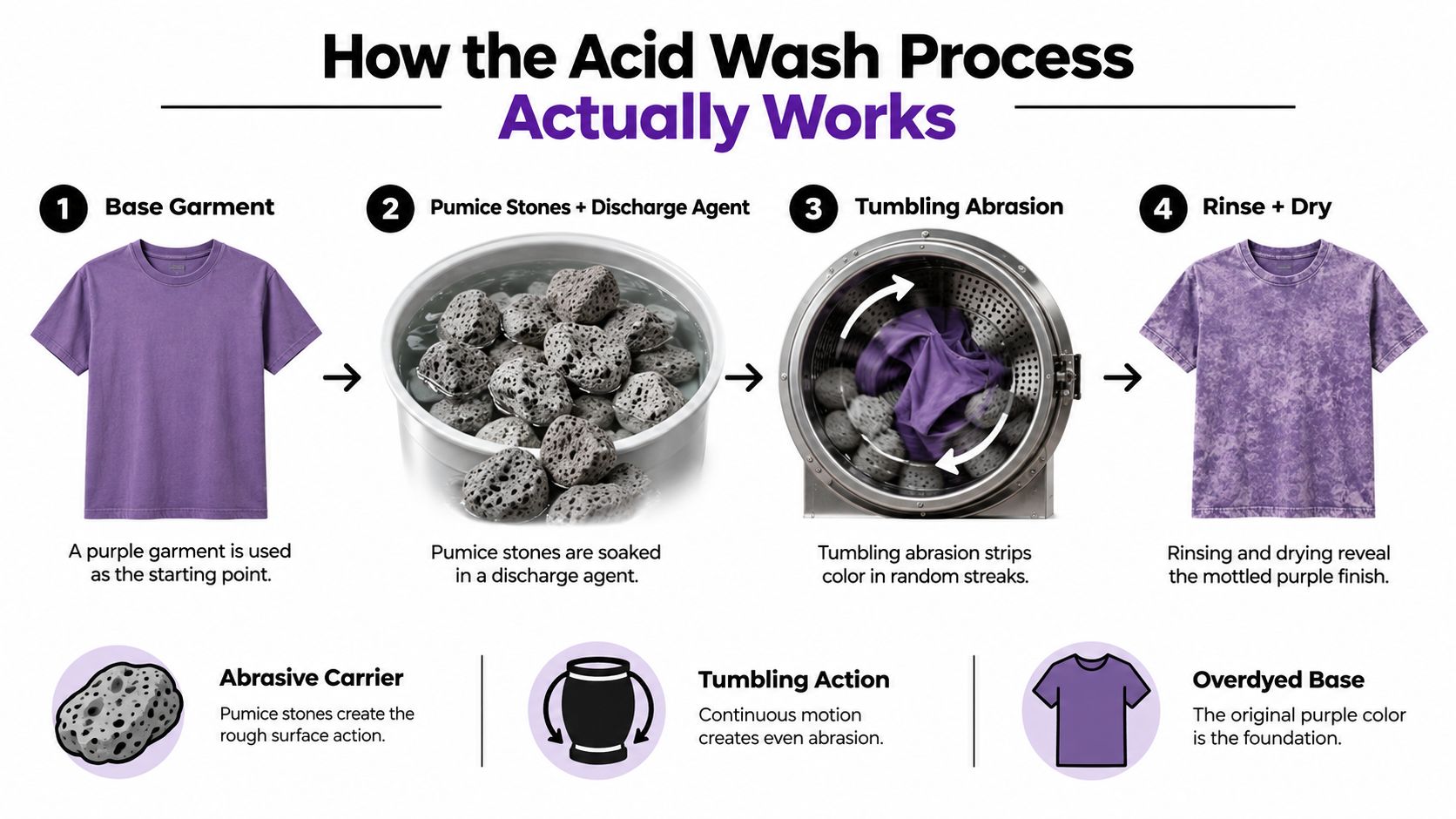
Four moving parts create the pattern
- Start with the purple base. The garment needs a dye system that responds predictably to oxidation. The base may be saturated violet, reddish purple, or cool blue-purple, and each shade can discharge differently.
- Add the abrasive carrier. Pumice stones are soaked in an oxidizing bath and loaded with the garments. They carry treatment into localized contact zones while scraping the cotton surface, so they affect chemistry and texture at the same time.
- Tumble the load. As the drum turns, stones press and rub against folds, seams, raised areas, and exposed panels. The result is a non-uniform pattern created through abrasion plus chemical oxidation, rather than evenly distributed lightening.
- Rinse and neutralize. The garment is rinsed, and some processes use a reduction bath or neutralizer. This matters especially with potassium permanganate systems, since leftover oxidizer can keep attacking cotton after the visible wash looks finished.
Technical denim-finishing guidance lists sodium hypochlorite at about 5–10% and potassium permanganate at about 3–6% among common oxidizing systems for acid-wash effects in this technical overview from Coats. These concentrations are not a home recipe. They show why factory control matters when a manufacturer must balance contrast with fiber preservation.
Why timing changes the shade
The stones work like rough stencils moving through a storm. Longer tumbling creates more chances for contact, while a heavier stone load increases abrasion. Contact time, stone load, and neutralization determine whether the final effect looks sharp, pale, or gently worn.
Purple dye selection matters just as much. A dye with poor resistance to the chosen oxidizer may not shift cleanly from violet to lavender. Separate dye components can react at different rates, producing muddy brown, gray, or uneven magenta areas. A clean purple acid wash therefore begins with compatible chemistry, not styling.
Construction also affects how clearly the finish appears. A heavyweight washed T-shirt such as Heavyweight Vintage Washed Frayed T-Shirt has catalog specifications identifying 100% cotton and a loose, drop-shoulder shape. The product is not described as purple acid-wash clothing, but dense cotton construction can provide a substantial surface where pronounced mottling reads clearly. That same treatment, however, still requires careful processing because appearance and cotton durability are connected.
What the Finish Does to Fabric Performance
Acid wash changes more than appearance. Oxidation can weaken fiber networks, abrasion can raise surface roughness, and wet processing can alter dimensions. The visible mottling may be the selling point, but strength, shrinkage, and hand feel determine whether the garment remains satisfying after wear.
A garment-wash study recorded 4.11% shrinkage in single jersey after acid washing, while bursting strength fell from 362 kPa to 337 kPa in the reported textile study. In the same study, rib fabric dropped from 440 kPa to 420 kPa, and terry fell from 446 kPa to 438 kPa in that study's fabric comparisons.
Translating the lab result into a buying decision
Bursting strength measures how much pressure fabric can withstand before it ruptures. You won't experience the result as a number while wearing a tee. You may notice it as a fabric that feels slightly more fragile at stress points, develops surface roughness, or changes fit after washing.
The result doesn't mean every purple acid-wash garment will fail quickly. Fabric construction, dye choice, treatment intensity, and finishing controls all matter. It does mean shoppers should avoid assuming that a thick garment is automatically immune to processing stress.
Look for construction first: A substantial cotton fabric can provide a stronger starting point, but the wash still needs controlled oxidation, rinsing, and finishing.
For makers, the practical response includes extra fabric margin, pre-shrunk or compacted cotton, and post-wash neutralization and softening. For shoppers, product-page clues include the fiber content, fabric weight, stated wash instructions, and whether the seller acknowledges normal batch variation.
What “different” can look like
A treated surface may feel less smooth than an untreated one because pumice creates localized abrasion. The garment may also settle into a slightly different shape after its first wash. That isn't automatically a defect, especially when the design depends on a lived-in finish, but it should be part of the purchase expectation.
Pay attention to seams, necklines, hems, and printed areas. Those regions experience different stress from the body and from laundering. A thoughtful care label is useful evidence that the seller understands the finish as a process rather than as a simple color choice.
Vintage Wash, Snow Wash, and Other Variations
Washed finishes share a family resemblance, so product labels can confuse shoppers. Acid wash usually has the strongest irregular contrast and the most visibly mottled surface. Vintage wash tends to suggest an even, softened sense of age, while snow wash often creates brighter, more concentrated streaks or speckles.
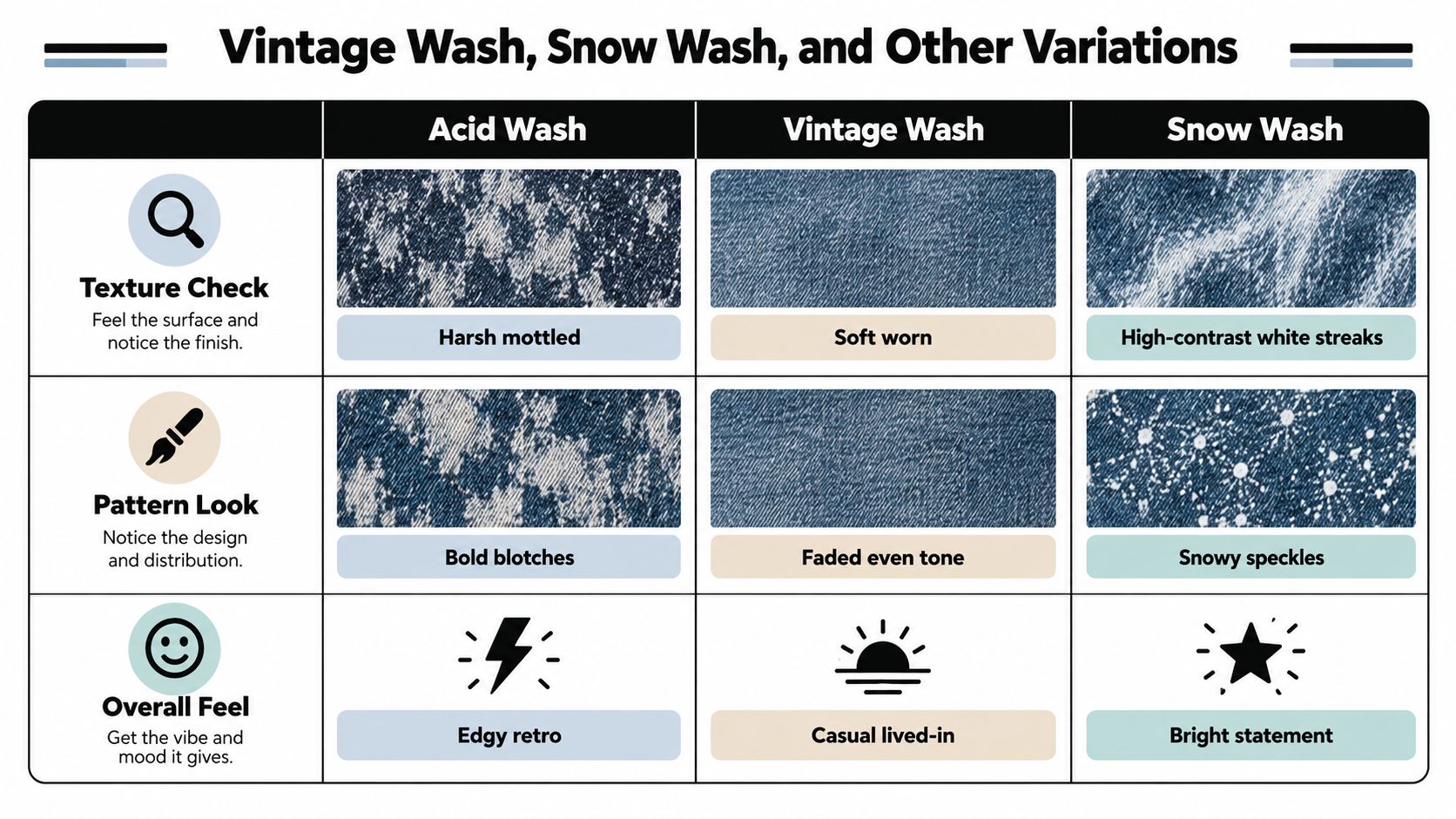
| Finish | Pattern Character | Texture and Feel | Best For |
|---|---|---|---|
| Acid wash | Bold blotches and irregular contrast | More visibly mottled, with a pronounced worn effect | Edgy retro outfits and statement color |
| Vintage wash | Faded, relatively even tone | Soft lived-in appearance | Casual everyday basics |
| Snow wash | White or pale streaks and speckles | High-contrast surface variation | Bright, graphic outfits |
A snow-washed oversized cotton tee illustrates the lighter side of the category. The Snow Washed Oversized Cotton T-Shirt is listed as 100% cotton, with a 250 g/m² fabric weight, a moderate thickness, slight stretch, and a loose drop-shoulder fit. Its snow-wash label signals a different visual goal from a dense, stormy purple acid wash.
Choose the mood before the label
Choose acid wash when you want the finish to become the main visual feature. The irregularity works particularly well with solid trousers, simple sneakers, and accessories that don't compete with the pattern.
Choose vintage wash when you want texture without a loud contrast. It sits comfortably in an essentials wardrobe because the softened tone behaves more like a neutral than a graphic statement.
Choose snow wash when you want light marks to stand out against the base color. The effect can look sharper and more decorative, especially on an oversized silhouette.
The same washed-cotton family can therefore produce very different results. A guide to vintage-wash T-shirts is useful when you're deciding whether you want a broadly worn appearance or the sharper interruption of acid-wash contrast.
Batch variation is normal with these finishes. Temperature, materials, dye response, stone contact, and processing conditions can shift the final pattern, so two garments may not look identical. With washed apparel, that difference is usually part of the visual character rather than proof that one piece is wrong.
Is Purple Acid Wash Still Trending in 2026
A shopper comparing a clean violet tee with a marbled purple one will notice the difference immediately. Purple acid wash remains relevant in 2026, but it is more accurate to call it a niche texture signal than a universal mass trend. Recent B2B trend coverage points to renewed interest in washed, vintage, and heavyweight looks in the cited trend summary. Style discussions also present acid wash as a more refined return of its 1980s predecessor, with the finish treated as a considered design choice rather than random wear.
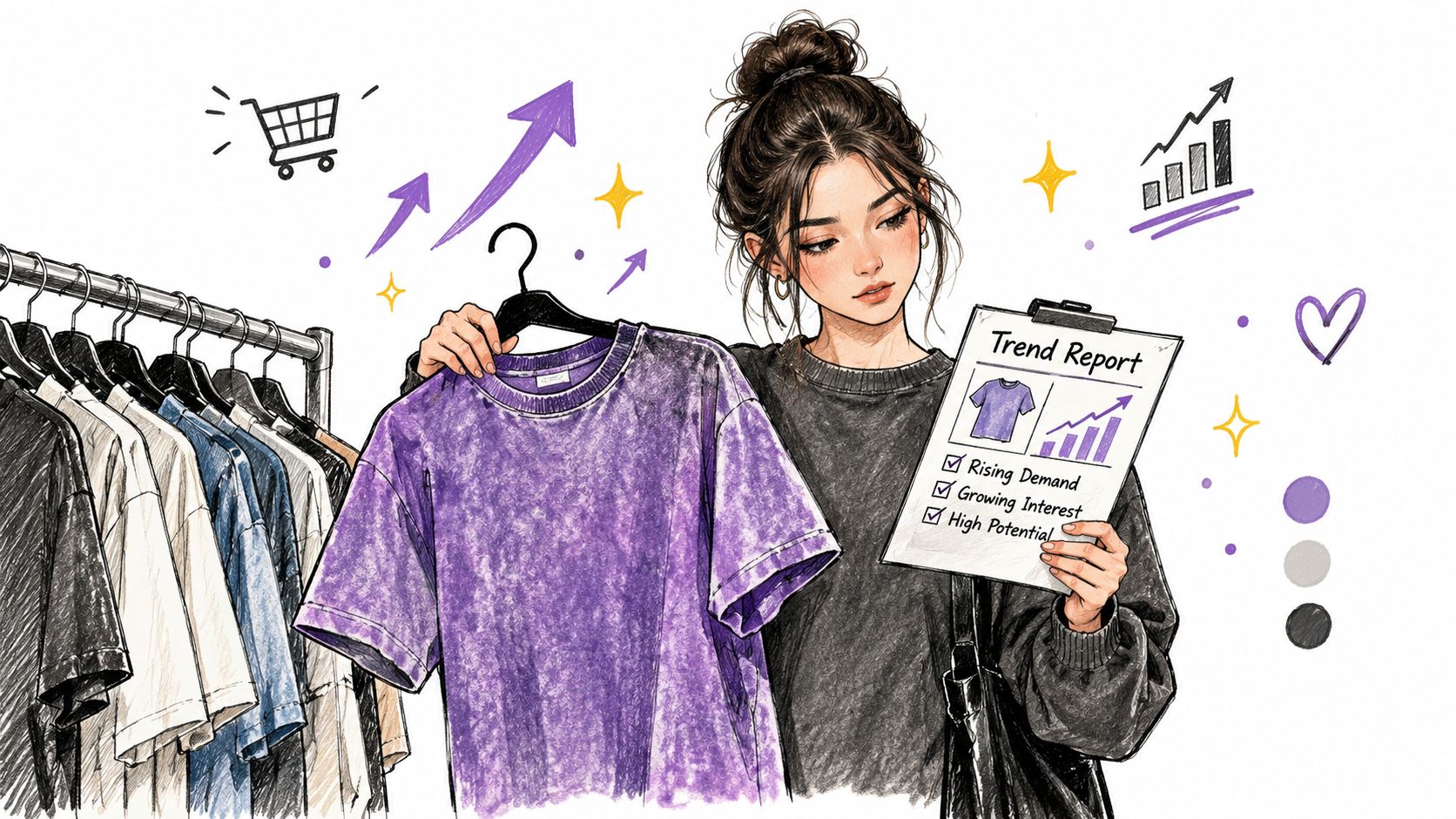
The distinction matters because a mass trend must suit many wardrobes, while a texture signal communicates surface character, nostalgia, and controlled irregularity. The wash is not merely a color treatment. It also reflects a finishing process that can create variation in the cotton surface and influence how the garment changes with use and laundering.
Purple suits this role because it adds color without demanding a complicated outfit. A washed violet tee can anchor black trousers, faded denim, gray sweatpants, or cream cotton. The marbling supplies visual interest, allowing the rest of the outfit to stay quiet.
Where the finish fits
- Heavyweight tees: Denser cotton gives irregular wash patterns a grounded, structured appearance. A boxy or loose shape strengthens the vintage and streetwear reference.
- Tanks: Purple wash makes a simple tank feel more deliberate, especially with relaxed trousers and restrained accessories.
- Sweats: Fleece-like basics turn the finish into a softer texture statement, although repeated heat can change both color and hand feel.
- Essentials wardrobes: One washed purple item works best as an accent, rather than making every garment compete for attention.
The commercial opportunity is selective. Nostalgia and Y2K influence support the look, yet purple remains more expressive than a neutral. It suits shoppers who want a familiar basic with a distinctive surface, not buyers seeking the least noticeable everyday layer.
For a broader framework on restrained streetwear dressing, see this guide to minimalist streetwear. Its practical principle is balance: let the wash provide personality while the silhouette and supporting colors remain uncomplicated.
The finish also rewards careful buying. Check the cotton feel, stitching, and care label alongside the color, because a striking surface cannot compensate for weak construction or care requirements that do not fit your routine.
Caring for Your Purple Acid Wash Pieces
Purple acid wash can look relaxed on the rack, yet its contrast depends on a surface treatment that responds to heat, rubbing, and light. Treat the garment as a managed-fade piece from the first wear. Independent denim-care guidance recommends turning acid-wash garments inside out, washing them in cold water with mild detergent on a gentle cycle, and air drying them in this acid-wash care guide. The same guidance warns that hot water, high-spin cycles, direct sun, and tumble drying can accelerate fading, shrinkage, and fiber stress.
The first rule is to reduce heat and friction. Inside-out washing shields the visible face from direct rubbing, like placing a printed surface away from repeated contact. A gentle cycle limits uneven softening, while cold water lowers the chance of dye movement and dimensional change.
A practical routine
- Wash separately or with similar dark colors. Purple dye may release more readily when the garment is new or intensely saturated. Keep it away from pale items until you understand how the piece behaves.
- Use mild detergent. Strong cleaning chemistry can speed color change. Bleach is unnecessary and may harm both the purple shade and the cotton fibers.
- Choose a gentle cycle. High spin compresses and twists the fabric, adding mechanical stress. Follow the care label first if it specifies another temperature or cycle.
- Air dry away from direct sunlight. Lay or hang the garment in a shaded, ventilated place. Ultraviolet exposure can fade one panel more than another, especially during drying or storage.
- Store it folded or evenly supported. Avoid leaving it over a sunny chair or against a window. Uneven light can create pale areas that interrupt the original wash pattern.
Care mindset: Let the color change slowly and evenly. You are managing the finish, not freezing it in place.
The same guide describes the effect as gradually softening over roughly 10–15 washes, which makes it closer to a managed-fade garment than a set-and-forget basic. That change does not make purple acid wash impractical. It means the garment's later appearance will partly reflect your laundering routine.
For a relaxed everyday silhouette, an oversized unisex tee guide can help you compare fit and wardrobe use before buying. Read the care label, check the fabric details, and expect some batch variation in washed apparel.
99 Collection offers unisex cotton T-shirts and casual essentials with washed, vintage, and minimalist styling. Visit 99 Collection to compare silhouettes and choose a washed piece that fits your care routine.