

You pull a new T-shirt from its package, try it on, and notice something unusual. The cotton already feels soft. The color looks gently faded rather than freshly dyed, and the fabric hangs with the relaxed character of a favorite tee you've owned for years. Then you check the product description and see the words vintage wash or snow wash, without knowing exactly what they mean.
That uncertainty matters because a washed finish isn't only a color choice. It can change the shirt's surface texture, softness, visual depth, shrinkage behavior, weight perception, and long-term wear. A lightweight snow-washed tee won't feel or behave like a dense heavyweight vintage-washed style, even when both have a faded appearance.
Table of Contents
- Introduction to Vintage Wash T Shirts and Their Lived In Appeal
- What Vintage Wash and Snow Wash Really Mean
- How Vintage Wash Finishes Are Achieved
- What to Expect for Look Feel Weight and Fit
- How to Care for Vintage Wash Tees So They Stay Soft
- Styling Vintage Wash T Shirts for Everyday Outfits
- Choosing the Right Vintage Wash Tee for Your Wardrobe
Introduction to Vintage Wash T Shirts and Their Lived In Appeal
A vintage wash T-shirt is designed to look familiar before you've had time to break it in. Instead of presenting a perfectly even, crisp surface, the garment may show softened color, subtle variation, and a handfeel that resembles cotton after repeated comfortable wear. The effect can make a simple tee feel more personal, especially when the rest of your wardrobe is built around quiet, versatile basics.
The appeal also fits the scale of the wider category. One independent industry estimate says the global T-shirt market consumed 22 billion units in 2024 and was worth $85.9 billion, with a projection of 25 billion units and $105.1 billion by 2035 IndexBox's T-shirt market overview. Cotton remains central to that market, accounting for over 70% of global trade volume in the same source, which helps explain why cotton and cotton-rich blanks are the usual foundation for washed finishes.
A washed tee can work for a minimalist wardrobe, a relaxed streetwear outfit, or a faith-informed casual look because its interest comes from texture rather than loud decoration. The important question isn't whether the fading looks good. It's whether the finish suits the weight, fit, climate, care routine, and durability you need from the garment.
This guide starts with the finish itself, then separates vintage wash from snow wash, explains the main processing methods, and translates those methods into everyday buying decisions. By the end, you'll know when a lighter snow wash makes sense and when a heavier vintage wash offers the structure and longevity you're looking for.
What Vintage Wash and Snow Wash Really Mean
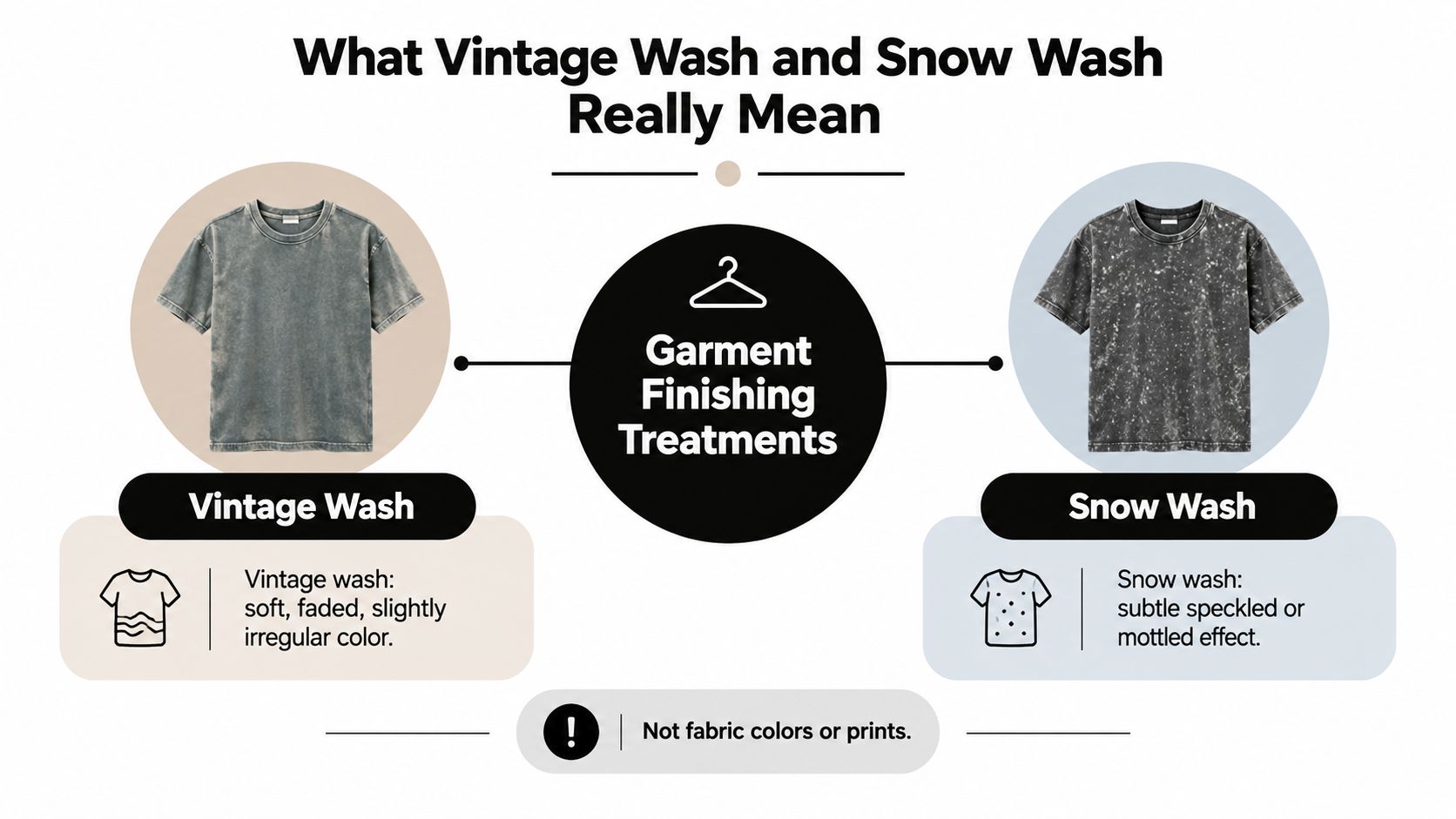
Vintage wash and snow wash describe garment-finishing treatments. They aren't fabric colors, woven patterns, or printed graphics. A manufacturer first makes the cotton T-shirt, then treats the finished garment to alter its color depth, surface feel, and visual character.
A useful comparison is denim. A brand can sell jeans in the same basic cotton fabric, but washing, abrasion, and fading can make one pair look crisp while another looks broken in. Washed T-shirts follow a similar logic. The process works on the completed garment, so the result can include slight variation around seams, edges, panels, and raised areas.
Vintage wash creates softened character
A vintage wash usually aims for a faded, softened, slightly irregular appearance. The color may look less saturated than a new, unwashed tee, while the cotton can feel smoother or more broken in. The exact result depends on the dye, fabric construction, treatment intensity, and whether the garment also receives mechanical abrasion.
The phrase enzyme wash often appears alongside vintage wash, but the terms aren't interchangeable. Vintage wash describes the desired visual and tactile result. Enzyme wash describes one possible way to achieve part of that result.
Snow wash adds mottled variation
Snow wash generally produces a speckled, cloudy, or mottled effect. Rather than looking uniformly faded, the garment may show lighter and darker areas that create visual movement across the surface. Some snow-washed tees look subtle and dusty, while others have stronger contrast.
For a concrete product example, the Snow Washed Oversized Cotton T-Shirt is listed as a unisex, 100% cotton garment with a 250 g/m² fabric weight, moderate thickness, slight stretch, a loose drop-shoulder shape, and care instructions that specify a gentle 30°C machine wash, no bleach, low tumble drying, and low-temperature ironing.
Core idea: A wash is a treatment applied to a garment. The name tells you more about the finish than the base color, and the finish can affect how the shirt feels and behaves.
Don't assume every tee with “vintage” in its name has the same construction. A lightweight cotton basic can receive a washed appearance, while a dense streetwear blank can receive a similar treatment and retain a much firmer drape. Read the fiber content, fabric weight, measurements, and care label together.
How Vintage Wash Finishes Are Achieved
A vintage wash is built through controlled chemical treatment, mechanical abrasion, or a combination of both. Each route changes the shirt differently, affecting softness, contrast, texture, weight retention, and strength. That is why two tees with a similar faded color can wear very differently.
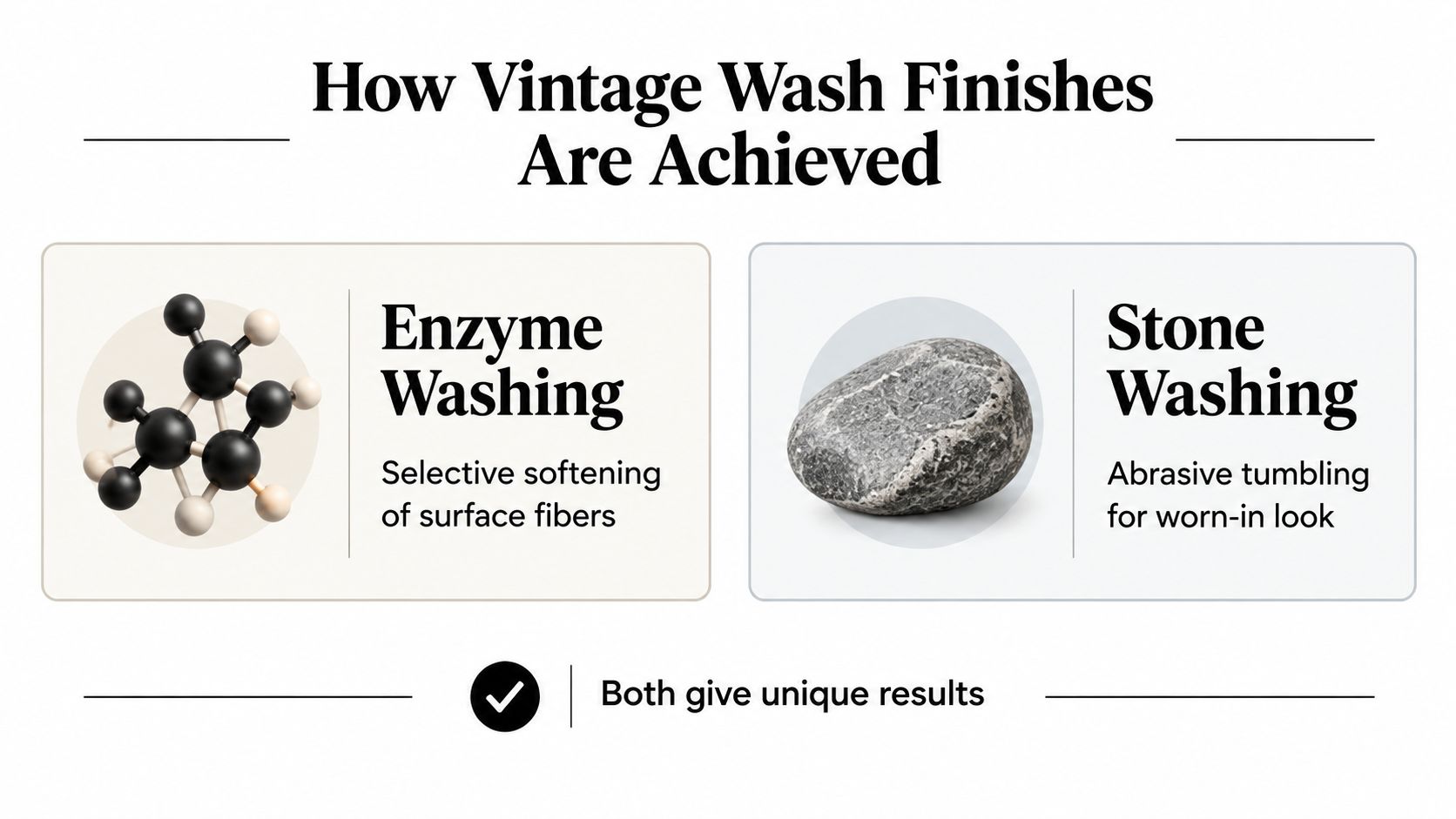
Enzyme washing softens the surface selectively
An enzyme wash uses enzymes to break down some cellulose fibers at the cotton surface. The effect is selective: the tee can gain a softer handfeel and a more worn appearance without depending entirely on rough tumbling. Processing may use pH 4.5 to 7, 30 to 90 minutes, and 0.5% to 3% enzyme owf. Controlled treatments are commonly associated with about a 5% to 15% tensile-strength reduction, according to Apex Fashion Lab's enzyme-wash explanation.
The finish therefore involves a trade-off. A mild treatment can soften the outer surface while keeping the fabric's body. A stronger treatment creates more visible character, but it can also change how much structure the finished shirt retains. For everyday wear, the desired result is usually a broken-in feel without making the tee seem fragile.
Stone washing uses abrasion
Stone washing creates its worn appearance through mechanical tumbling and abrasion. Friction softens the hand and can produce stronger fading in areas that receive more movement. Compared with chemical softening alone, it may leave a more irregular, visibly broken-in surface.
Snow wash focuses on mottled or contrast-heavy color. It may overlap with bleaching or other color-altering treatments, so the name does not identify one universal recipe. A lightweight snow-washed tee can feel easy and relaxed, while a heavyweight vintage-washed tee may keep a firmer shape beneath a softened surface.
A practical comparison
| Method | Typical look | Handfeel impact | Best for |
|---|---|---|---|
| Enzyme washing | Soft fading with a gently worn surface | Smoother and softer hand | Vintage character with controlled surface change |
| Stone washing | More visibly abraded, broken-in fading | Softer with added mechanical texture | Stronger worn-in appearance |
| Snow wash treatment | Speckled, cloudy, or mottled contrast | Can range from smooth to textured | Distinctive color variation and casual streetwear styling |
Garment washing uses water, energy, chemicals, and mechanical action, and its environmental footprint is an active concern in textile processing. A review of garment washing and water pollution examines pollution impacts and approaches intended to reduce resource and chemical loads. A faded appearance alone cannot show whether a garment was made responsibly. Look for clear care and production information, then choose the fabric weight and finish that match how you plan to wear the tee.
What to Expect for Look Feel Weight and Fit
The first thing you'll notice is usually the color. A vintage-washed tee often looks less flat than a standard solid, with softened areas that give the surface depth. A snow-washed tee adds more visible mottling, so the shirt can appear lighter in some places and darker in others.
The second difference is touch. Depending on the process, the cotton may feel smooth, brushed, peach-like, or lightly textured. A wash can make a shirt feel broken in, but it doesn't automatically make a thin fabric substantial. Finish and fabric weight are separate decisions.
Lightweight snow wash versus heavyweight vintage wash
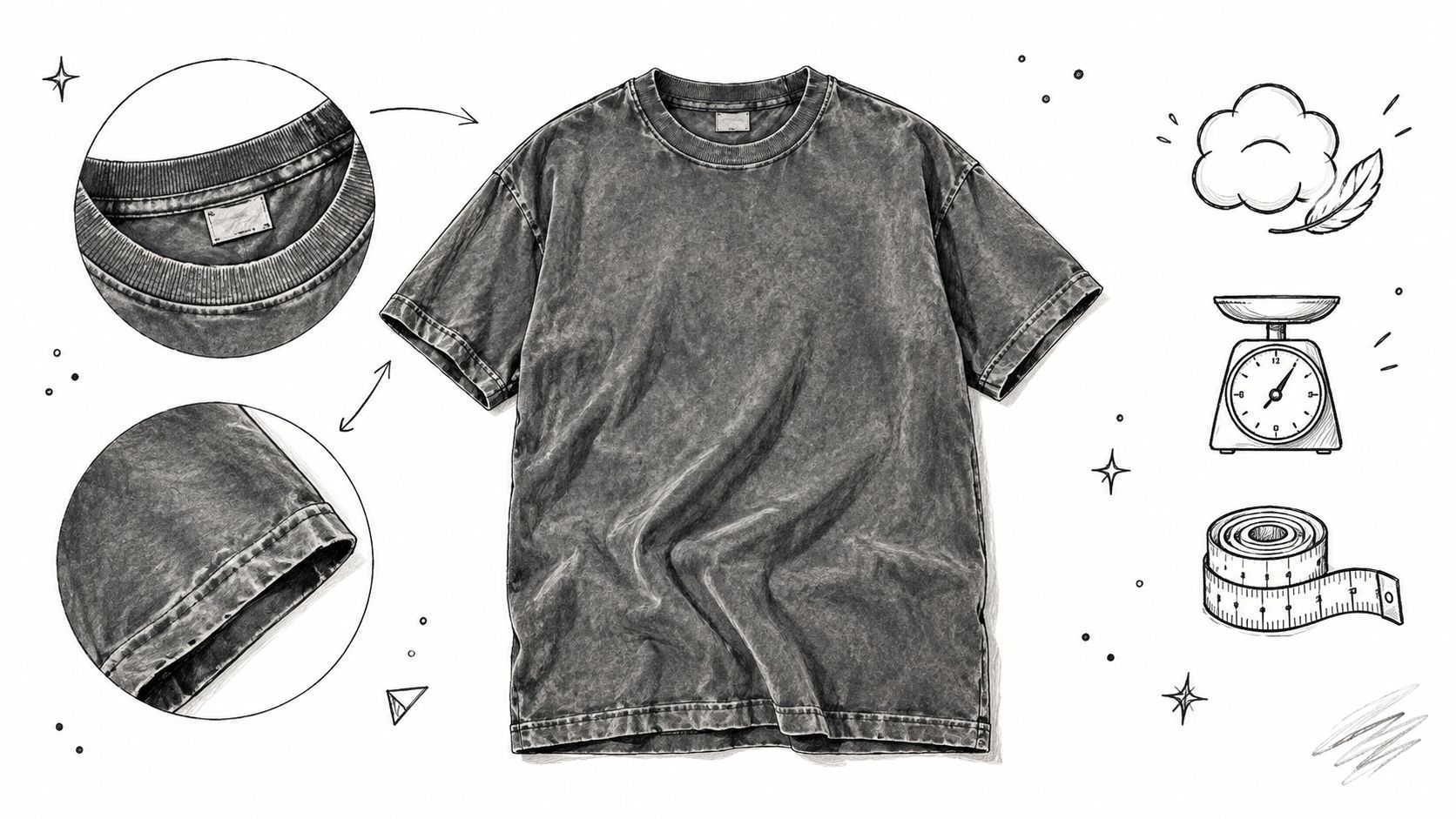
A lighter snow-washed tee generally drapes more easily and can feel comfortable in warm weather or under an open shirt. Its mottled color supplies visual interest without requiring a large graphic. The trade-off is that lighter fabric may offer less structure through the shoulder, sleeve, and torso.
A heavyweight vintage-washed tee holds its shape more firmly. It can create a boxier silhouette, stand away from the body, and support layered outfits in a way a softer lightweight tee may not. The wash may reduce some of that crisp newness, but the underlying density still controls much of the garment's drape.
The catalog example described earlier sits in the moderate-weight range at 250 g/m², with a loose drop-shoulder construction. That combination suggests a shirt where the cut contributes as much to the relaxed silhouette as the wash itself. A drop shoulder can make the sleeve appear longer and the upper body broader, so don't choose a size based only on your usual chest measurement.
Shrinkage changes the fit conversation
For 100% cotton T-shirts, garment washing or dyeing commonly produces shrinkage of around 3% to 5% in length and 1% to 3% in width the streetwear T-shirt specification guide from Groove Color. The same source notes that heavier streetwear fabrics in the 250 to 400 GSM range can show changes in that order of magnitude.
Use the garment's actual size chart, not just the label. Check body length, chest width, shoulder width, and sleeve length, then compare those measurements with a tee you already like. Small batch variations can also occur because finishing conditions and materials vary, so a washed garment shouldn't be expected to look completely identical to another piece.
For broader fit guidance, the unisex cotton T-shirt guide can help you think about shoulder placement, body room, and the difference between a regular unisex cut and an intentionally oversized silhouette.
A short visual reference can make these differences easier to assess:
A washed finish can make a tee look relaxed, but only the pattern and fabric construction determine how relaxed it feels on your body.
How to Care for Vintage Wash Tees So They Stay Soft
Your care routine determines whether the finish stays softly faded or becomes noticeably dull, misshapen, and rough. Higher wash temperatures and tumble drying can drive additional cotton shrinkage and fading, while cooler cycles and air-drying reduce those effects Groove Color's cotton T-shirt care guidance.
A simple preservation checklist
- Wash cool and gently: Use the care label's cooler setting and a gentle cycle. This reduces unnecessary agitation and heat exposure.
- Turn the shirt inside out: The inside-out position limits direct rubbing on the visible face and helps protect printed or embroidered details.
- Skip bleach: Bleach can create unwanted color changes and place extra stress on cotton fibers. A washed tee already has its intended color treatment.
- Choose low tumble or air-drying: Low heat is safer than a hot dryer. Air-drying gives the fabric more time to settle without adding intense heat.
- Iron at low temperature: If the shirt needs pressing, use low heat and avoid ironing directly over a print.
- Follow product-specific instructions: A care label takes priority because the manufacturer knows the particular dye, finish, decoration, and construction.
The heavyweight cotton T-shirt care guide is especially relevant when you're comparing dense washed blanks. A thick shirt may feel durable, but heat can still alter its dimensions and surface over time.
What not to do
Don't wash a vintage-wash tee repeatedly with rough towels, heavily textured garments, or abrasive hardware. Don't treat fading as a problem to correct with harsher chemicals. The finish was created under controlled conditions, while home experiments can produce uneven color, weakened fibers, or unwanted marks.
Practical rule: Preserve the finish with low heat, gentle movement, and patience. The lived-in look should age gradually, not be forced through aggressive laundering.
Styling Vintage Wash T Shirts for Everyday Outfits
A vintage-wash tee works best when you treat its texture as a neutral detail. The fading already gives the garment character, so the rest of the outfit can stay clean and uncomplicated. That balance helps the shirt feel like a wardrobe staple instead of a costume built around a trend.
Start with a quiet tonal outfit
Pair a charcoal or faded black tee with clean black denim, dark trousers, or muted joggers. Keep the shoes simple and let the softened surface create the contrast. This formula works particularly well with minimalist wardrobes because the outfit has depth without relying on a prominent logo.
For a lighter snow wash, use one of the tones already visible in the mottling as a bridge to the rest of the outfit. A grey-washed tee can sit comfortably with stone, cream, navy, or washed denim. Avoid adding several heavily distressed pieces at once, since competing textures can make the outfit look accidental.
Use layering to control proportion
An oversized washed tee can sit over a boxy tank, a long-sleeve base layer, or a fitted undershirt. The contrast between a broad outer shape and a closer layer gives the outfit structure. With a regular-cut tee, try an open overshirt or light jacket instead, keeping the outer layer slightly more defined so the look doesn't lose its shape.
The guide to wearing an oversized T-shirt is useful when you're deciding whether to size up or choose an intentionally oversized pattern. Those are different choices. Sizing up can add length and unwanted shoulder drop, while a designed oversized cut may distribute the volume more evenly.
Build relaxed weekend combinations
For an easy weekend outfit, wear a vintage-wash tee with straight denim and low-profile sneakers. For home or travel, combine a softer washed tee with relaxed sweatpants, then add a clean jacket when you leave the house. A snow-washed tee can also balance a plain bottom because its surface supplies a restrained point of interest.
Current style coverage places vintage-washed tees alongside oversized, boxy, heavyweight, and minimalist logo styles in the wider T-shirt category Easson Apparel's 2026 T-shirt trend coverage. Search-interest reporting in that coverage also describes renewed momentum around acid-wash terms in February 2026, while broader fashion reporting points to renewed attention around graphic tees and archive-inspired pieces. The practical lesson isn't to chase every trend. Choose a wash with restrained contrast, a useful fit, and enough comfort to wear repeatedly.
A vintage wash reads more timeless when the color variation is controlled, the neckline stays clean, and the garment works with several bottoms. It reads more trend-dependent when extreme contrast, dramatic distressing, or oversized proportions become the only styling option.
Choosing the Right Vintage Wash Tee for Your Wardrobe
Choose a lighter snow-washed tee if you want easy drape, visible mottling, and a relaxed shirt for warm weather or layering. Choose a heavier vintage-washed tee if you want more body, a stronger silhouette, and a garment that can anchor a streetwear or minimalist outfit.
Before buying, check four things:
- Fiber: 100% cotton offers the familiar natural handfeel associated with many washed tees.
- Weight: Fabric density controls structure more than the wash name does.
- Measurements: Compare length, chest, shoulder, and sleeve dimensions with a favorite shirt.
- Care commitment: A cooler, gentler routine will help preserve color, softness, and shape.
The broader vintage and retro T-shirt segment has been reported to grow by over 15% annually, according to a 2025 industry summary Worldmetrics' T-shirt industry overview. That momentum doesn't mean every washed tee is temporary. A restrained finish can function like a neutral, especially when the cut is comfortable and the color works with the rest of your wardrobe.
Start with one wash and one dependable silhouette. If you prefer soft movement and subtle contrast, begin with snow wash. If you want structure and a more substantial everyday layer, look for heavyweight vintage wash.
99 Collection offers contemporary unisex staples including snow-washed and vintage-washed cotton T-shirts, with minimalist styling suited to casual wardrobes. Visit 99 Collection to compare washed finishes and choose a tee that fits your preferred weight, silhouette, and everyday routine.